Showing posts with label Burl Ives. Show all posts

Monday, July 8, 2019

June 29 - America Sings

Image courtesy pinterest.com
On this day, in 1974, Disneyland’s salute to the United States’ 200th birthday, America Sings, opened in Tomorrowland. As Bicentennial Fever began sweeping the nation in the early Seventies, Disneyland naturally wanted to get in on the action. It was decided to create a new show to go in the space occupied by the Carousel of Progress. That classic show, one of the holdovers from the 1964 World’s Fair, was packed up and, in 1973, relocated to the Magic Kingdom in Walt Disney World, where it still runs today. Imagineers, led by the Legendary Marc Davis, then got to work on an all new attraction.

America Sings was structured similar to Carousel of Progress (kind of a necessity since it used the same space). A total of six theatres rotated around a central cluster of stages, each theater moving to the next stage every four minutes. Guests entered the show in stage one, saw a brief introduction, rotated through four eras of American musical history, then saw a brief conclusion and exited from stage six. For the show’s narrators, Marc created Eagle Sam, voiced by Burl Ives, and Ollie Owl, voiced by Sam Edwards. While Eagle Sam is sometimes referred to as Sam the Eagle, he shouldn’t be confused with our Muppet friend of the same name or the 1984 Olympic Mascot, Sam the Olympic Eagle; those are three distinct characters. In a nod to taking over Carousel’s space, Rex Allen, who played the narrator of Carousel, has a small part in America Sings as Sombrero, a dog.

Image copyright Disney
On a tragic note, America Sings was responsible for the death of a cast member shortly after it opened. On July 8, 1974, just nine days after its debut, Deborah Stone was caught between the stationary outer wall of the attraction and one of the inner moving walls. The 18 year old was crushed to death but her body wasn't discovered for nearly twenty minutes. Guests had actually heard her screams but thought it was part of the show. As a result of the accident, America Sings was closed for three days while safety lights were installed and the moving walls were redesigned to include breakaway panels. Thankfully, no further incidents were recorded.
Image copyright Disney
It might seem ridiculously out of place to plunk a historical show down in Tomorrowland, but Bicentennial Fever was a powerful thing in the mid Seventies and no one really minded. Until after the reasonable time that bicentennial celebrations could go on, of course. By the early Eighties, America Sings not only didn’t fit into a land that claimed to have its eyes set on the future, but it was getting long in the tooth as a concept as well. The show persisted almost to the end of the decade, however. In 1986, it was slight victim of recycling when two geese Audio-Animatronics were removed, stripped of their skin and installed as baggage droids in the queue of Star Tours. The rest of America Sings kept on singing until April 10, 1988. At that point, most of the remaining 113 Audio-Animatronic figures found a new home in Splash Mountain, which opened the following year. The Stork figure from the show’s finale is used as a training tool to teach and test new Imagineers on how to program Animatronics.
Image courtesy allears.net
Plans were made to install a third show in the rotating theaters and a “coming soon” sign was placed in front of the attraction. That sign stood there for almost ten years, as the remaining sets of America Sings slowly deteriorated and the building was used as office and storage space, the new attraction a victim of Euro Disneyland’s financial shortcomings. Finally, in 1998, the building was completely renovated and became Innoventions, Disneyland’s version of the Epcot area. In 2015, the space was further updated and became the West Coast’s Star Wars Launch Bay, a walkthrough attraction highlighting all things Star Wars related.

Monday, December 3, 2018

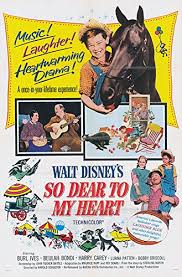
November 29 - So Dear to My Heart

Image copyright Disney
On this day, in 1948, So Dear to My Heart had its world premiere in Chicago, Illinois. Directed by Ham Luske and Harold Schuster, Heart is one of several Disney films from this era that combined live action and animation. Unlike the earlier movie Song of the South, there isn't any controversy surrounding this film. The story was adapted from a book by Sterling North, Midnight and Jeremiah. After the release of Heart, Sterling revised his book to match the movie and re-released it with the title So Dear to My Heart.

Heart stars one of Disney's frequent child actors, and one of the first contract players at the studio, Bobby Driscoll. Bobby also appeared in Song of the South, Treasure Island and voiced the title role in Peter Pan. His co-star, Luana Patten, was also under studio contract and had appeared in Song with Bobby. Beulah Bondi played Bobby's grandmother. She is probably best known for playing Jimmy Stewart's mother in several films, including It's a Wonderful Life. The main cast is rounded out by the beloved Burl Ives. Among the supporting cast, Harry Carey made his final film appearance (no, not the Chicago Cubs announcer, a silent film star who is best known as the Senate president in Mr. Smith Goes to Washington).

Image copyright Disney
Heart was fairly well received at the time. It reaped double its budget and an Oscar nomination for Best Original Song for "Lavender Blue." Burl Ives, who sang the song in the movie, kept it in his repertoire for the rest of his life. Bobby Driscoll received a special Juvenile Oscar for his role in Heart and an RKO drama, The Window. For anyone wishing to watch this heartwarming tale of a boy who learns valuable life lessons by raising a lamb that had been rejected by its mother, there are DVD copies of it out there and it's also available in the iTunes store.