Showing posts with label Chicago. Show all posts

Wednesday, October 9, 2019

October 8 - Great Chicago Fire

Image courtesy nationalgeographic.org
On this day, in 1871, the Great Chicago Fire started, eventually burning down a large chunk of the city. Maybe it's just a Midwest thing, but when I went to camp one of the songs we used to sing that went like this:

Late one night, when we were all in bed,
Old lady Leary left the lantern in the shed
And when the cow kicked it over, she winked her eye and said
It'll be a hot time in the old town tonight!

The lyrics weren't ever really explained to us kids, it was just a fun ditty to sing. We knew it had something to do with a fire but that was it. No one ever told us of the devastation the fire caused or the fact that the whole cow theory of ignition was just a bunch of bull.

Image courtesy mentalfloss.com
We do know that the fire did indeed start sometime after 9 p.m. in the shed next to the O'Leary family barn at 137 DeKoven Street. Later, the legend of a cantankerous cow kicking over an oil lamp while being milked and setting the barn on fire would take hold of the public's imagination but there is no evidence to support it. The O'Learys claim they were already in bed when the flames roused them. Other people claimed it wasn't the cow who knocked the lantern over but some intoxicated men playing cards in shed. The fact remains, however, that we will never know what started the conflagration (and no, it wasn't aliens or a comet either) which hardly matters anyways. It's what came next that changed Chicago forever.

Image courtesy wikipedia.org
Prior to the blaze, Chicago had been in the grip of a hot, dry summer. Between July 4 and the night of October 8,  the city only experienced one inch of rainfall total. Two-thirds of the buildings in the Windy City were made almost entirely of wood. The only part that wasn't wood were the highly flammable tar roofs. Additionally, the sidewalks and most of the roads were of wood construction. The city of Chicago only employed 185 firefighters at that time, with only 17 horse-drawn steam engines, most of whom were already worn out having battled several small blazes during the week before. Put all those things together and it's basically a miracle that the fire wasn't worse.

The fire spread incredibly quickly, partly due to conditions and partly because the firefighters were accidentally sent to the wrong place at first. When they finally arrived on DeKoven Street, things were already out of control. Over the next forty hours or so, it moved north, spurred on by high winds that actually caused several other large fires around the Midwest on the same day. When it reached the south branch of the Chicago River, firefighters crossed their fingers that it would stop but it barely paused. The lumber yards on the river's bank coupled with the large number of barges in the river itself made the jump into the downtown area easy peasy. Officials again hoped that the main branch of the river would provide a natural firebreak and were again disappointed. A good chunk of the north end of the city also burned before the flames were brought under control and burned out.

Image courtesy chicagotribune.com
In the end, a swath of Chicago about four miles long and half a mile wide burned to the ground. Over 17,500 buildings were destroyed by the Great Fire. At least 300 people were dead and nearly 100,000 were left homeless (that's about a third of the residents for those of you counting). The charred remains of downtown smoldered for several days. In financial terms, the damage topped $222 million (the equivalent of nearly $4.7 Billion today).

The good news is that the ruins of Chicago weren't allowed to hang around for very long. The city council immediately adopted new construction standards mostly designed to stop the spread of fires in the future. Rebuilding efforts began shortly thereafter, mostly due to a huge outpouring of donations from around the world. Thanks in part to a bequest from London, England, the city was able to start a new public library system, replacing the private, members-only libraries that existed before. Working closely with fire prevention specialists and insurance executives, Chicago also soon had one of the top fire fighting companies in the world. None of this helped the people who had lost important papers like birth and marriage certificates in the fire and struggled to recover for the rest of their lives, but it did make life better for those who came after.

Image courtesy ghostwatch.net
A few remnants of the Great Fire can still be seen in Chicago. There were only a handful of buildings left standing in the affected areas of the city. The Water Tower, the Chicago Avenue Pumping Station and St. Michael's Church in Old Town are still links to the past. If you visit St. James Cathedral on the corner of Huron and Wabash, the church is new but if you look at the top of the bell tower, you should be able to notice some bricks that were blackened by the massive amounts of soot that enveloped the city 147 years ago. But if you're looking to take a gander at the O'Leary's shed, where the whole thing started, you're out of luck. The shed, barn and house were torn down in 1956 to make way for the Chicago Fire Academy, one of the premier firefighter training facilities in the country. It's not a place where cows or gamblers are allowed any where near open flames.

Also on this day, in Disney history: Art Babbitt

Tuesday, June 25, 2019

June 16 - DisneyQuest

On this day, in 1999, DisneyQuest Chicago opened its doors to guests on the corner of Ohio and Michigan in Chicago, Illinois. The concept of DisneyQuest began in the late Nineties as an experimental attraction in a little side room of Innoventions at Epcot. Guests were invited in as test subjects to play a virtual reality game based on Aladdin. They donned big heavy VR helmets, sat on “flying carpets” and flew their way through the streets of Agrabah and the Cave of Wonders, collecting jewels and searching for the Genie. Guests oohed and aahed their way through the simple game, marveling at the new technology. What they didn’t know is that Disney wasn’t just testing out virtual reality. They were also testing out an entirely new concept for a theme park.

Image courtesy forums.wdwmagic.com
The end of the 20th Century found the Walt Disney Company thirsting for new arenas to make money in, mostly outside of the existing parks and resorts. A new division was created called Disney Regional Entertainment to make this dream come true. There are several projects from this period that either never came to fruition or actually started and then were abruptly shut down. One that didn’t make it past the planning stages was the idea of having Disney owned and operated rest stops along the major highways of America. The first concept to open was Club Disney, a playland/birthday party destination for the under 10 crowd. That chain made it up to five locations in California and Arizona before being shut down just months after the fifth one opened. The second idea to open was DisneyQuest.

Image courtesy touringplans.com
The first DisneyQuest opened on the West End of Downtown Disney in June 1988 and was touted as the first virtual theme park. Personally, I loved the place. There was that original Aladdin attraction as well as ‘rides’ based on Pirates of the Caribbean, Jungle Book, Space Mountain and Alien Encounter. It really was like having a whole theme park in one multi-story building, complete with a midway on the top floor and classic video games scattered throughout. The concept really caught on and a second DisneyQuest was announced for the Magnificent Mile shopping district of Chicago, Illinois.

Full disclosure time: a few months after DisneyQuest Chicago opened, my wife and I moved from Orlando to Chicago and I began working there as a cast member in the retail operations part of it. I wasn’t around for the honeymoon period, but I did get to watch all the missteps that occurred over the next year. My version of what happened is probably a little (or a lot) more honest than the official company version.

Image courtesy picclick.com
DisneyQuest Chicago was the first entertainment venue Disney ever opened in Midwest, making it the closest Disney destination for tens of millions of Americans. On top of that, it was located in a city that hosts millions of tourists from all over the world every year. The success of DisneyQuest Chicago really should have been an easy thing to attain. Of course, unlike the California and Florida properties, this park would have to rely more heavily on repeat business from the locals and that is where management started going wrong.

Hear me now: DisneyQuest Chicago always turned a profit, no matter what you read in company accounts. As it was told to me, the place achieved somewhere in the 6-7% range. Unfortunately, Michael Eisner at the time was fixated on (and had promised shareholders) 20% profits from business units, not necessarily an attainable goal much less a sustainable one. In an effort to boost the numbers, DQC management began tinkering with its mode of admission. They tried a system where guests would buy points, everything inside cost a certain amount of points, you could buy more points as you went along. They tried a flat admission fee, everything included. They tried a tiered plan where you paid different amounts for different groups of attractions and games. The biggest problem was that they tried all of these things one right after the other during the year I was there. They knew that locals would probably come once every three months or so. Want to guess how often they changed admission prices and systems? Locals were really beginning to love the place and be excited about making it a regular part of their entertainment rotation, but every time they showed up, it was like visiting a completely new place when they went to buy a ticket. That gets tiresome really quickly. Eventually people will throw their hands up in frustration and stop coming. And, by the end, that’s what was happening.

Image courtesy yelp.com
I wasn’t there for end. I saw it coming and got out. The breaking point for me came when the third DisneyQuest that had been announced for Philadelphia, Pennsylvania was cancelled even though construction had already begun. That deal left a literal hole in the ground for several years before it was finally filled in and turned into a parking lot. On September 4, 2001 DisneyQuest Chicago closed its doors forever, leaving the DQ at Downtown Disney the sole surviving part of the great experiment. That first and final location continued operating for almost sixteen years after that however, not closing until July 2, 2017. In my mind that proves the viability of the concept, but my mind also thinks that turning a profit is a good reason to keep a venture going. Clearly, in a world where large chunks of money are poured into failing ventures in order to try to save them (rarely successfully), I don’t know what I’m talking about.

Image courtesy planet99.com
Disney Regional Entertainment did launch a third brand during its tenure, the ESPN Zone, a sports themed restaurant, in July 1998. Nine of those eventually opened in places like Baltimore, Maryland and Denver, Colorado. A large one was located right next to DQC. Although that chain lasted the longest, most of them were closed or closing by 2009 (one, in Los Angeles,  lasted until 2013 but it was operated by a separate company) and DRE itself was dissolved in 2010. What had started so promisingly a dozen years before was now a victim of corporate impatience and greed. The time when a virtual theme park was considered an innovative place to play has probably passed us by (although with the rise of personal virtual reality systems, you never know), so the chances of seeing anything like DisneyQuest in the near future is slim. Which is too bad. I kinda miss the place.

Wednesday, June 5, 2019

June 2 - Wayne Brady

Image courtesy mayoarts.org
On this day, in 1972, Wayne Alphonso Brady was born in Columbus, Georgia. The son of West Indian immigrants, Wayne moved to Orlando, Florida as a young child to be raised by his grandmother. In his mid-teens, he started performing in local community theaters and became part of the improv troupe at the SAK Comedy Lab in downtown Orlando. He graduated from Dr. Phillips High School, an arts magnet school, in 1989 and began attending classes at the University of Miami. A degree wasn’t in the cards for young Wayne, however, and by 1996, he’d moved to Los Angeles, California to see what fate had in store for him.

Fate has blessed Wayne with at least a constant flow of employment opportunities if not many that could be considered long-term. His first television appearances came on a late-night syndicated show called Kwik Wit. It pretended to be an improv show but in reality, while based on popular improv games and original material, was pretty rehearsed. It did, however, lead to regular appearances on the British improv show Who’s Line Is It Anyway? during its final season, which was taped in Hollywood. That rolled into the American version of the show and real nationwide exposure for Wayne. In 2003,  Wayne’s work on Who’s Line won the Primetime Emmy Award for Outstanding  Individual Performance in a Variety or Music Program (try saying that with a mouthful of pretzels), making him one of only a handful of people to win that particular award for a regular series as opposed to a one-off special.

Image courtesy study5.info
In 2001, Wayne had his own short-lived variety show. The show only lasted a partial season but the name, The Wayne Brady Show, lived on for two more years as a daytime talk show, which earned its namesake two consecutive Daytime Emmy Awards for Outstanding Talk Show Host. Over the next several years, Wayne enjoyed a whole slew of guest appearances.  He guest starred on both of The Drew Carey Show’s live episodes. He starred as Neil Patrick Harris’ brother on How I Met Your Mother. He appeared on a Canadian sitcom, Getting Along Famously, with former Who’s Line costar Colin Mochrie. He spent two seasons as the host of Don’t Forget the Lyrics!, a game show on Fox. And those are just the highlights.

Wayne finally got a real long-term gig in 2009 when he was asked to be the host of a new version of the classic game show, Let’s Make a Deal. Updating the format a bit with a liberal dash of (what else?) improv (the show's announcer, Jonathan Magnum, is also quite adept at it and was also part of the first Wayne Brady Show), Wayne has been making deals with guests for a decade now, every weekday on CBS. Incidentally, CBS's two daytime game shows owe quite a bit of their continued success to Who's Line Is It Anyway? Their other one, The Price Is Right, has been hosted by Drew Carey since 2007.

Image courtesy ew.com
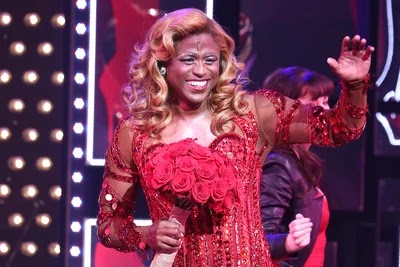
Wayne is no stranger to stages around the country either. In 2004, he made his Broadway debut when he joined the revival of Chicago as the smooth talking lawyer, Billy Flynn. In 2015, he returned to the Great White Way, taking on the role of Lola in Kinky Boots for six months. The following year, he was in Los Angeles playing Charley Kringas in a production of Stephen Sondheim's Merrily We Roll Along. Then Wayne wowed audiences in Chicago (the city, not the show this time) when he spent four months portraying Aaron Burr in Hamilton.

Image copyright Disney
Wayne's connection to Disney goes way back. One of his first jobs as a teen was in the entertainment department at Walt Disney World (rumor has it he was good friends with Goofy). Since then, both versions of the Wayne Brady Show aired on ABC, he wrote and sang the theme song for The Weekenders and he sang "Beautiful" along with Jim Brickman on Jim's Disney album. Sharp eared listeners will recognize Wayne's voice behind Don on an episode of Phineas and Ferb called "Where's Pinky?" and he was a regular cast member on the short lived ABC improv show Trust Us With Your Life in 2012. He's also made an appearance on Dancing With the Stars, not as a contestant but as a performer in a tribute to James Brown. Wayne sang a version of The Tiki, Tiki, Tiki Room for the 2008 album Disney Music Block Party and produced an album of children's songs he helped write called Radio Wayne (inspired by the Radio Disney network) in 2011.

Image copyright CBS
Currently, Wayne is busy taping episodes of the next season of Let's Make a Deal (for which he finally won an Emmy last year after being nominated seven times) while simultaneously making appearances on the CBS soap opera The Bold and the Beautiful as Reese Buckingham. Will there be more improv shows in his future? Probably and when they pop up, you can be sure they'll be funny and look effortless (which really describe's Wayne's basic mode of operation). Happy 47th birthday, Wayne and here's to many, many more!