Showing posts with label Annette Funicello. Show all posts

Monday, April 8, 2019

April 8 - Annette Funicello

On this day, in 2013, Annette Joanne Funicello passed away in Bakersfield, California. Annette was born in Utica, a city of around 60,000 near the middle of the state of New York, on October 22, 1942. It should come as no surprise that she inherited an Italian lineage from both of her parents. When she was four, the Funicello made a cross-country move to Southern California. Throughout her childhood, Annette took dance lessons to try to help alleviate the almost painful shyness she experienced. By the time she was twelve, she was good enough on her feet to be chosen to perform the role of Swan Queen in Swan Lake for a recital that took place at the Starlight Bowl in Burbank, California. As luck would have it, there was one member of the audience for that Spring 1955 performance who knew Annette was just what he'd been looking for.

Image copyright Disney
Plans were coming together for the Disney Studio's new television show, The Mickey Mouse Club, but Walt felt that it wasn't quite right yet. When he saw Annette dance, he was intrigued enough to ask to meet her. Once he met her, he loved her and offered her a seven year contract that would start with becoming a Mouseketeer. Annette was, in fact, the final kid chosen to wear the coveted mouse ears and one of only a few that were handpicked by Walt. Not only was Annette frequently featured in the talent portions of the daily show, she was cast in many of the serials as well. After appearing in Adventure in Dairyland and Spin and Marty, there was one in the final season simply called Walt Disney Presents: Annette (not that he was biased or anything).

As the seasons of The Mickey Mouse Club progressed, Annette went from being Walt's favorite Mousketeer to America's favorite. By season two, she was receiving over 6,000 pieces of fan mail every month, more than several of the other Mouseketeers combined. When she sang the song "How Will I Know My Love" during the Annette serial, the studio was inundated with so much mail that the studio decided to release it as a single. Walt also managed to coerce Annette into signing a recording contract (which didn't thrill her, but could she really say no to Uncle Walt?). Plans were made to film an adaptation of the Wizard of Oz stories starring Annette and Darlene Gillespie, another popular Mouseketeer, but they ultimately fell through.

Image copyright Disney
Following the end of The Mickey Mouse Club, Annette still had a few years left on her contract and Walt didn't waste them. She was given a multi-episode story arc on Zorro. She starred in 1959's The Shaggy Dog with Fred MacMurray and Tommy Kirk. And she was finally put into a full blown musical, 1961's Babes in Toyland, but that venture turned out to be fairly disappointing. Annette and Tommy would reteam for two more pictures following Toyland, 1961's The Horsemasters and 1962's Escapade in Florence.

On the recording front, Annette reluctantly sang a string of pop hits, many of them written by the studio's in house composers, the Sherman Brothers. People of a certain age will remember Tall Paul, O Dio Mio, First Name Initial and Pineapple Princess. She also had several hits that were written by a young Paul Anka, like Train of Love and It's Really Love. Paul supposedly had a huge crush on Annette, but Walt wouldn't allow any shenanigans on his watch, so the crush went unfulfilled. Paul's big hit Puppy Love is said to be inspired by his interest in Annette.

Image courtesy nj.com
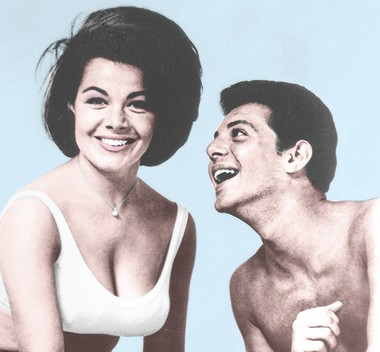
When her contract with Disney finally came to an end, Annette transformed from the girl next door to teen heartthrob. She starred in a string of beach party themed movies with fellow teen idol Frankie Avalon. The first one, Beach Party, was so successful that the film's distributor, American International Pictures, signed Annette to their own seven year contract. The resulting series included Muscle Beach Party, Bikini Beach, Pajama Party, Beach Blanket Bingo, Ski Party, Dr. Goldfoot and the Bikini Machine and How to Stuff a Wild Bikini. The return on investment dropped with each subsequent movie (shocker!). By 1966, API decided they needed a new formula so they added Fabian to the team of Frankie and Annette and put all three in a racing film, Fireball 500. It did well enough that a second stock car movie, Thunder Alley, was made the next year but that's as far as it went.

Image courtesy pinterest.com
During her beach phase, Annette found time to return to Disney for a couple of projects. She reunited with Tommy Kirk for The Misadventures of Merlin Jones in 1964, which became a surprise hit. The next year, they made a sequel, The Monkey's Uncle. Not only did Uncle score well at the box office again, Annette sang the title song with the Beach Boys backing her up and that became a modest hit as well.

By 1967, Annette's career essentially came to an end. She spent most of the Seventies raising her three children, making very occasional guest appearances on television shows. In 1979, she began appearing in a string of commercials for Skippy peanut butter. She made a television movie for Disney in 1985, Lots of Luck, and had a return to the big screen with Frankie Avalon in 1987's Back to the Beach.

Image courtesy pinterest.com
It was during the concert tour connected to the latter project that Annette began to experience dizzy spells. It wasn't until 1992 that she was officially diagnosed with multiple sclerosis, the same year she was declared an official Disney Legend. A year later she started the Annette Funicello Fund for Neurological Disorders as part of the California Community Foundation. In 1994, she published her autobiography, A Dream Is a Wish Your Heart Makes: the Annette Funicello Story. A made for television movie was produced with the same name a year later and marked the final appearance for Annette. Already using a wheelchair at that point, she completely lost the ability to walk by 2004 and couldn't speak five years later. It would take another four years after that for the disease to take her life altogether at the age of 70. If you ever find yourself visiting Disneyland Paris, you can always pay homage to America's Favorite Mouseketeer by stopping in to Annette's Diner.

Saturday, March 23, 2019

March 19 - The Shaggy Dog

Image copyright Disney
On this day, in 1959, Disney's first live action comedy, The Shaggy Dog, debuted in theaters. Made for less than a million dollars, it grossed over $9 million in its initial run, making it a more profitable movie than Ben Hur which was released the same year. This fact wasn't lost on Walt and his executive team and the formula of The Shaggy Dog was used over and over again for the next couple of decades: put a supernatural element in a light hearted comedy, preferably involving some kind of animal, using the same sets on the backlot and starring recognizable, but not too pricey, actors. If you think about it, that describes most of the films the studio made throughout the Sixties and Seventies. Sure, most of them would never be called masterpieces, but they created more than sufficient cash flow to subsidize everything else the company was doing.

Image copyright Disney
The Shaggy Dog is also notable for being the first Disney movie to star Fred MacMurray. Fred had already been a staple around Hollywood for years, but mostly in Westerns and film noir. This picture would start a string of comedic roles for the company that would stretch over the next fourteen years and include classics like The Absent-Minded Professor and The Happiest Millionaire (it would also be instrumental in landing Fred his long running sitcom gig on television, My Three Sons). The rest of the cast was filled out with Mickey Mouse Club regulars like Annette Funicello, Tommy Kirk, Tim Considine and Kevin Corcoran. Even the film's director, Charles Barton, came from the show (he'd directed the Spin and Marty series). Paul Frees, the veteran voice actor, makes a rare live appearance in The Shaggy Dog as the psychiatrist, but interestingly doesn't receive credit for it.

Image copyright Disney
Not only did The Shaggy Dog create a formula for comedy success, it was the start of a mini franchise. In 1976, Disney released The Shaggy D.A. starring another company staple, Dean Jones. The sequel took place about 30 years after the original, but if you're wondering what happened during that time, you are in luck. The Return of the Shaggy Dog aired in two parts on the Disney Sunday Movie in 1987, starring Gary Kroeger. Two remakes have been produced as well, one for The Wonderful World of Disney in 1994 and a theatrical release starring Tim Allen in 2006, but, for my money, just stick with the original.

Thursday, December 20, 2018

December 19 - Robert B Sherman


image courtesy of wikipedia.com
On this day, in 1925, Robert Bernard Sherman was born in New York, New York. As the son of famous Tin Pan Alley songwriter Al Sherman, Robert, and his brother Richard (who would come along a couple of years later), eventually dove into the family business and elevated it to world renown status. The family moved frequently during Robert’s childhood before finally settling in Beverly Hills, California. During his high school years, Robert wrote and produced several programs for the radio and stage. One of those, Armistice and Dedication Day, raised thousands of dollars for bonds to finance World War II and caught the attention of the War Department. Robert was a mere 16 year old at the time.
In 1943, Robert talked his parents into letting him join the army when he was only 17. In April of 1945, he was wounded in the knee and would walk with a cane for the rest of his life. His list of medals for his service is fairly impressive: the Purple Heart, the Combat Infantryman Badge, two Battle Stars, an American Campaign Medal, a Good Conduct Medal and several marksmanship badges. As he convalesced from his wound in England, Robert became interested in British culture and soaked up as much history and made as many English friends as he could. He was always grateful for this period in his life since so much of his later career would center on British stories and characters.
Image courtesy of wikipedia.com
After his return home from the war, Robert attended Bard College in Annandale-on-Hudson, New York. He majored in English literature and painting, served as editor-in-chief of the campus newspaper and wrote two novels. His brother, Richard, also attended Bard as a music major. A few years later, the brothers were living together in an apartment in Los Angeles, struggling to create their separate masterpieces. One day, their father, Al, goaded them with a dare: I bet you two guys couldn’t pool your talents and come up with a song that some kid would give up his lunch money to buy. He was a wise one, that Al. The boys banded together for the first time and wrote the song Gold Can Buy Anything (but Love) and sold it to Gene Autry. The Sherman Brothers, as a songwriting duo, was born.
Image copyright Disney
In 1958, Robert founded his own music publishing company, Music World Corporation. The following year, the brothers had their first Top Ten hit, Tall Paul sung by Annette Funicello. A former Mouseketeer having a hit song of course attracted the attention of Walt Disney. Walt began having the Brothers write a song here and there, like the ones used in The Parent Trap. Then Walt finally got the rights to his magnum opus, Mary Poppins, and he hired Robert and Richard on as full time staff songwriters. They won two Academy Awards for Poppins, wrote the music for a whole slew of attractions (Adventure Thru Inner Space, Carousel of Progress and Journey Into Imagination to name just a few) and movies (like The Jungle Book, The Aristocats and Bedknobs and Broomsticks). The most ear wormy thing they ever wrote however, and their song that’s been played the most often, is the them to It’s A Small World. I would go so far as to bet that it will be stuck in your head for the next hour just because I mentioned it. I’m not sorry. It is a pretty good song.
Image copyright Amazon.com
After Walt’s death, Robert and Richard stopped working full time for the Disney company (although they never really left it completely). Their first outside project was to team up with Poppins star Dick Van Dyke on the 1968 fantasy Chitty Chitty Bang Bang. Over the years they began writing screenplays for projects as well as the music. Their version of Tom Sawyer won first prize at the Moscow Film Festival in 1973. An adaptation of Cinderella titled The Slipper and the Rose was chosen for a Royal Command Performance in 1976. On stage, the Brothers wrote a musical called Over There! that was nominated for Tony Awards and was the highest grossing musical of 1974. Since then, highly successful stage versions of both Mary Poppins and Chitty Chitty Bang Bang have graced stages around the world.

Image copyright Disney
The tragedy of all the marvelous music, laughter and joy Robert and Richard brought to the world over their decades long career, is that it turns out the Sherman boys were pretty good actors as well. Modern conveniences may have kept their collaboration going, but the Brothers were, in actuality, bitter rivals who could go years without speaking to each other. Whether or not they ever actually repaired the rift between them, Robert and Richard were both inducted into the Songwriter’s Hall of Fame in 2005, given the National Medal of the Arts by President George W. Bush in 2008 and had been made official Disney Legends in 1990. In 2010, the Brothers received their own window on Mainstreet USA in Disneyland which reads “Two Brothers Tunemakers, Richard M Sherman and Robert B Sherman, proprietors, We’ll write your tunes for a song!” They also recently had a soundstage at the Burbank studios renamed in their honor
Robert B. Sherman, decorated war hero, father of four, and co-writer of more film scores for musicals than anyone else (except his brother of course) passed away on March 6, 2012 in London, England. He was 86.

Tuesday, December 18, 2018

December 14 - Babes In Toyland

Image copyright Disney
On this day, in 1961, Walt Disney Productions' first live action musical, Babes In Toyland, was released in theaters. The film is loosely based on a 1903 operetta by Victor Herbert and was originally conceived of as animated. Walt eventually decided he wanted a movie along the standards of Wizard of Oz and Babes became, in the words of one executive, “a Disney cartoon with live people.” To that end, Ray Bolger, the Scarecrow from Oz, was cast except this time as the villain, Barnaby. The cast is filled out by teen heartthrobs Tommy Sands and Annette Funicello, Disney stalwarts Tommy Kirk and Kevin Corcoran and Ed Wynn in the second of his many appearances with the studio.

Image copyright Disney
For the Disney version of Babes, Walt had most of the lyrics from the operetta rewritten and many of the tempos of the songs changed up as well. It may not have been the best choice. Rather than living up to Oz, Babes opened to mainly negative reviews. Generally regarded as juvenile and clunky, even Tommy Kirk refers to it as an oddity at best, although he isn’t embarrassed about it like some of his other work.

While there were several other versions of Babes before this one (including one starring Laurel and Hardy), Disney’s take was the first one to be shot in Technicolor. It’s longest lasting legacy isn’t its music or any of its performances. It’s the fact that the toy soldiers from the film can still be seen every year in the various holiday parades at Disney parks around the world.

Wednesday, October 3, 2018

October 3 - The Mickey Mouse Club

On this day, in 1955, The Mickey Mouse Club debuted on ABC. As the Disney Studio’s second regular television series, The Mickey Mouse Club would spend the next four years coming into folks living rooms on a daily basis, becoming a cultural icon in the process. So much about this show is embedded in our collective consciousness. If I start singing “M-I-C” most people will either sing back “K-E-Y” or “See you real soon,” even if they’ve never actually seen an episode of the show. The thousands of mouse ears that are sold every day in parks all around the world. When something goes wrong or weird and someone says “it must be anything-can-happen day.” The legacy of those five hours a week has a staying power that any other show that’s ever aired would kill to have.

While Walt, of course, kept a finger in the soup that was becoming a juggernaut, Disneyland was taking up most of his time and energy. It was Bill Walsh, as producer, who really brought everything together. Bill hired both children and adults to be a part of the fun, conceived of rotating theme days, decided there would be alternating animated bits and live action serials and even worked with one of the show’s adult regulars, Roy Williams, to develop the instantly recognizable head gear for the cast.

The show was hosted each day by Jimmy Dodd, also known as the Head Mousketeer. Jimmy wrote the show’s theme song as well as many of the songs he performed during the show. Thousands of kids learned how to spell encyclopedia thanks to Jimmy.  He would often do short segments, known as Doddisms, exhorting kids to have high moral standards. Jimmy led the cast off camera as well. He frequently had barbecues at his home and really made all the kids feel like part of his family.

The main bulk of the cast, or Mouseketeers, consisted of kids. Over the run of the show, 39 different kids were part of the cast, divided into three separate teams. The Red team was the most popular kids, most of whom were around for the entire run of the show. Those are the names every knows, well at least their first names: Annette Funicello, Bobby Burgess, Cubby O’Brien, Darlene Gillespie, Karen Pendleton, Doreen Tracy, Sharon Baird, and Tommy Cole. Every episode would have most of these guys on it. The rest of the kids were either on the white team or the blue team. They didn’t get as much air time and rotated in and out a lot more than the red team.

Every day of the week had a designated theme and the segments for that day would usually revolve around it. The themes were:
Monday – Fun with Music Day
Tuesday – Guest Star Day
Wednesday – Anything Can Happen Day
Thursday – Circus Day
Friday – Talent Round-Up Day

The show also had a rotating cadre of serials it would show. For many of the serials, actors who weren’t part of the regular show, like Tim Considine or Tommy Kirk, would participate. Viewers of the show might remember Spin and Marty, The Hardy Boys, Adventure in Dairyland and spots featuring Jiminy Cricket among others. Many of the serials from the show would be aired by themselves for decades on the Disney Channel or even edited into shorts that many kids saw in school.

For the first two seasons of the Mickey Mouse Club, the show was immensely popular and ran for an hour each day. In season three, the show was still immensely popular but was shortened to 30 minutes.  In season four, the show remained popular but Disney and ABC couldn’t come to a financial agreement about its continuation. Most of season four consisted of parts from seasons one and two edited down into half hour shows. Very little new material was filmed. After cancelling the show, ABC wouldn’t let it air on any other network. Walt ended up suing ABC and won a settlement. He pretty much agreed, though, that the show wouldn’t be revived. It was expensive to produce and the studio wasn’t making much profit off merchandise. Which doesn’t mean the fun ended.

Over the next few years, many of the Mouseketeers traveled to Australia for a live show tour. Australia was a few years behind the US in seeing first run shows, so The Mickey Mouse Club didn’t end there until well into the sixties. Starting in 1962, the studio relented to fan demand and repackaged the show into half hours for syndication. Even in re-runs, it was again wildly popular for at least three years and would run in some markets for five until finally petering out. It would begin syndicated runs again in the mid-seventies and would air daily for the first six years the Disney Channel existed, 1983-89.


The show was rebooted three separate times.  In January of 1977, The New Mickey Mouse Club debuted, featuring a disco theme song and a more diverse cast of Mouseketeers. Even though the cast appeared during the Super Bowl Half Time Show, this version was discontinued by July of the same year. The second revival happened in 1989 and was a hit for seven seasons. This version aired on the Disney Channel, once again five days a week, and was called The All-New Mickey Mouse Club (although fans usually just referred to it as MMC).  A lot of things changed in the updated version. The ears were out; jackets were in. The dramatic serials were replaced with sketch comedy. The new format worked for a new generation and once again everyone knows who some of the new Mouseketeers were even if they never saw a show: Britney Spears, Ryan Gosling, Christina Aguilera and Justin Timberlake, to name a few. The third reboot is called Club Mickey Mouse and is only happening online.

It's now been 63 years since The Mickey Mouse Club first hit the airwaves and it's still going on. Will the latest version be as big as the original? Probably not. Success seems to skip a generation on this one. Does that mean we won't see a newer all-new version sometime in the future? You can bet your ears we will.

Also on this day, in American history: First Motor Powered Vacuum