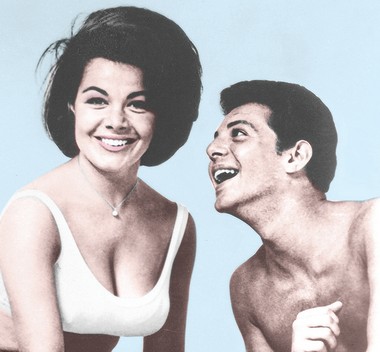
On this day, in 2013, Annette Joanne Funicello passed away in Bakersfield, California. Annette was born in Utica, a city of around 60,000 near the middle of the state of New York, on October 22, 1942. It should come as no surprise that she inherited an Italian lineage from both of her parents. When she was four, the Funicello made a cross-country move to Southern California. Throughout her childhood, Annette took dance lessons to try to help alleviate the almost painful shyness she experienced. By the time she was twelve, she was good enough on her feet to be chosen to perform the role of Swan Queen in
Swan Lake for a recital that took place at the Starlight Bowl in Burbank, California. As luck would have it, there was one member of the audience for that Spring 1955 performance who knew Annette was just what he'd been looking for.
 |
| Image copyright Disney |
Plans were coming together for the Disney Studio's new television show,
The Mickey Mouse Club, but Walt felt that it wasn't quite right yet. When he saw Annette dance, he was intrigued enough to ask to meet her. Once he met her, he loved her and offered her a seven year contract that would start with becoming a Mouseketeer. Annette was, in fact, the final kid chosen to wear the coveted mouse ears and one of only a few that were handpicked by Walt. Not only was Annette frequently featured in the talent portions of the daily show, she was cast in many of the serials as well. After appearing in
Adventure in Dairyland and
Spin and Marty, there was one in the final season simply called
Walt Disney Presents: Annette (not that he was biased or anything).
As the seasons of
The Mickey Mouse Club progressed, Annette went from being Walt's favorite Mousketeer to America's favorite. By season two, she was receiving over 6,000 pieces of fan mail every month, more than several of the other Mouseketeers combined. When she sang the song "How Will I Know My Love" during the
Annette serial, the studio was inundated with so much mail that the studio decided to release it as a single. Walt also managed to coerce Annette into signing a recording contract (which didn't thrill her, but could she really say no to Uncle Walt?). Plans were made to film an adaptation of the
Wizard of Oz stories starring Annette and Darlene Gillespie, another popular Mouseketeer, but they ultimately fell through.
 |
| Image copyright Disney |
Following the end of The Mickey Mouse Club, Annette still had a few years left on her contract and Walt didn't waste them. She was given a multi-episode story arc on Zorro. She starred in 1959's
The Shaggy Dog with Fred MacMurray and Tommy Kirk. And she was finally put into a full blown musical, 1961's
Babes in Toyland, but that venture turned out to be fairly disappointing. Annette and Tommy would reteam for two more pictures following
Toyland, 1961's
The Horsemasters and 1962's
Escapade in Florence.
On the recording front, Annette reluctantly sang a string of pop hits, many of them written by the studio's in house composers, the Sherman Brothers. People of a certain age will remember
Tall Paul, O Dio Mio, First Name Initial and
Pineapple Princess. She also had several hits that were written by a young Paul Anka, like
Train of Love and
It's Really Love. Paul supposedly had a huge crush on Annette, but Walt wouldn't allow any shenanigans on his watch, so the crush went unfulfilled. Paul's big hit
Puppy Love is said to be inspired by his interest in Annette.
 |
| Image courtesy nj.com |
When her contract with Disney finally came to an end, Annette transformed from the girl next door to teen heartthrob. She starred in a string of beach party themed movies with fellow teen idol Frankie Avalon. The first one,
Beach Party, was so successful that the film's distributor, American International Pictures, signed Annette to their own seven year contract. The resulting series included
Muscle Beach Party, Bikini Beach, Pajama Party, Beach Blanket Bingo, Ski Party, Dr. Goldfoot and the Bikini Machine and
How to Stuff a Wild Bikini. The return on investment dropped with each subsequent movie (shocker!). By 1966, API decided they needed a new formula so they added Fabian to the team of Frankie and Annette and put all three in a racing film,
Fireball 500. It did well enough that a second stock car movie,
Thunder Alley, was made the next year but that's as far as it went.
 |
| Image courtesy pinterest.com |
During her beach phase, Annette found time to return to Disney for a couple of projects. She reunited with Tommy Kirk for The Misadventures of Merlin Jones in 1964, which became a surprise hit. The next year, they made a sequel,
The Monkey's Uncle. Not only did Uncle score well at the box office again, Annette sang the title song with the Beach Boys backing her up and that became a modest hit as well.
By 1967, Annette's career essentially came to an end. She spent most of the Seventies raising her three children, making very occasional guest appearances on television shows. In 1979, she began appearing in a string of commercials for Skippy peanut butter. She made a television movie for Disney in 1985,
Lots of Luck, and had a return to the big screen with Frankie Avalon in 1987's
Back to the Beach.
 |
| Image courtesy pinterest.com |
It was during the concert tour connected to the latter project that Annette began to experience dizzy spells. It wasn't until 1992 that she was officially diagnosed with multiple sclerosis, the same year she was declared an official Disney Legend. A year later she started the Annette Funicello Fund for Neurological Disorders as part of the California Community Foundation. In 1994, she published her autobiography, A Dream Is a Wish Your Heart Makes: the Annette Funicello Story. A made for television movie was produced with the same name a year later and marked the final appearance for Annette. Already using a wheelchair at that point, she completely lost the ability to walk by 2004 and couldn't speak five years later. It would take another four years after that for the disease to take her life altogether at the age of 70. If you ever find yourself visiting Disneyland Paris, you can always pay homage to America's Favorite Mouseketeer by stopping in to Annette's Diner.