Tuesday, May 21, 2019

May 20 - Tom Sawyer Island

Image copyright Disney
On this day, in 1973, Tom Sawyer Island opened in Frontierland of the Magic Kingdom in Walt Disney World. The 19th century, small town existence portrayed in Mark Twain’s classic story of Tom Sawyer, would seem to be a perfect vehicle for Walt Disney to have explored at some point. Given his own childhood in Mareceline, Missouri and the entrance to his theme park that was modeled after his boyhood home, it might come as a surprise that Walt never produced a film version of Tom Sawyer. In fact, Disney wouldn’t make a film featuring Tom and his friend Huckleberry Finn until nearly three decades after Walt’s death, the 1995 clunker Tom and Huck. That doesn’t mean Walt couldn’t find a use for the classic idealization of Middle America; he just chose to include it in his living movie instead.

Image courtesy waltdisney.org
The original Tom Sawyer Island opened in Disneyland on June 16, 1956, one month and one day before the park’s first anniversary. Walt had considered several different themes for the large island in the middle of the Rivers of America before settling on the Twain tale. He asked the legendary Marc Davis to design an area especially for kids to enjoy some unstructured play (that of course wasn’t the phrase they used back then; they just called it having fun). Supposedly, none of Marc’s plans wowed Walt enough, so the Boss took the task upon himself and cranked out his own final design in one late night session. That makes Tom Sawyer Island the only attraction completely designed by Walt himself (in macro of course, Imagineers still took care of all the details).

Image courtesy youtube.com
Guests had to board free floating rafts to get between the island and Disneyland proper. Once on the island, they could freely roam the paths, exploring caves, discovering forts and generally whooping it up in the ‘wilderness’. At one time, cast members would even leave large paintbrushes hidden around the island, evoking a sense that Tom had left it behind after doing some chores for Aunt Polly. If guests found one and turned it in, they received a small prize (and no it wasn’t getting to white wash a fence for the rest of the afternoon). Guests could also experience Tom Sawyer Island from afar by riding the Riverboat, the Mike Fink Keelboats or using their own power on the Davy Crockett Explorer Canoes to glide along the Rivers of America and circumnavigate the island.

Image courtesy themeparkreview.com
Tom Sawyer Island proved pretty popular through the years, so when Walt Disney World opened, it was decided to replicate the area. The Florida version opened about 20 months after the park. Ten years later, when the theme parks went international for the first time, Tokyo Disneyland got its own version that opened with the park. Disneyland Paris has an island in the middle of its River but theirs is occupied by Big Thunder Mountain Railroad.

While Walt Disney World’s version of Tom Sawyer Island is still operating (albeit on a more seasonal basis; if it is open when you go, the snack bar is killer) and is virtually unchanged from when it opened, the same cannot be said of Disneyland’s. In 2007, the theme of the original Island was pretty much completely changed over to Pirates of the Caribbean. A thin link was kept to the story of Tom and Huck by claiming that now, since the boys loved to pretend they were pirates, the island is an extension of their imaginative playtime. The only non-pirate themed structure is Tom and Huck’s tree fort, but even that has some pirate elements in it to tie everything together. The guest accessible area of the island has also shrunk over the years, as most of the technical equipment for Fantasmic! now takes up one end of it (for those of you only familiar with that show at Disney’s Hollywood Studios, the Disneyland show takes place on the Rivers of America). So if you're looking for the original experience, head to Florida or Japan. If you want to do Tom Sawyer Island 2.0, head on over to Anaheim. Either way, be prepared to slow down a little bit and let your sense of adventure take over for an hour or so. You'll be glad did.

Monday, May 20, 2019

May 19 - Alan Young

Image courtesy discogs.com
On this day, in 2016, Angus Young passed away in Woodland Hills, California. Alan, as he became known, was born in North Shields, Northumberland, England on November 19, 1919 (as he got older he tried to move his birth date up to 1924, but the official record didn't fall for that trick). As a toddler, his Scottish parents briefly moved the family to Edinburgh, finally relocating to British Columbia, Canada when he was six. Alan suffered from severe asthma as a child and was stuck in bed a good deal of the time because of it. During those long bedridden hours, he listened to massive amounts of radio programs and fell in love with all of them. When he hit high school, he managed to get his own radio show with the Canadian Broadcasting Corporation doing comedy sketches. When World War II came along, he gave it all up, joining the Royal Canadian Navy to prove himself. Unfortunately, the RCN planned to use him as a writer for their radio programming, not as a fighter on the front. When Alan found out, he resigned the Navy, intending to join the Canadian Army instead. The Army said no thanks, your asthma isn't something we want to deal with (which given the prevalence of gas based warfare, was the right decision) and Alan's patriotic fervor would go unfulfilled.  He moved to Toronto and restarted his radio career.

Image courtesy imdb.com
In 1944, Alan was noticed by an American agent who enticed him to move to New York. He started with appearances on the Philco Radio Hall of Fame, but quickly got his own program, The Alan Young Show, which ran off and on for six years before making the leap to television for three more seasons. On the small screen, The Alan Young Show would pick up two Emmy Awards, one for Best Variety Show and one for Lead Comedy Actor.

Alan debuted on the silver screen in 1946 as Roy Hornsdale in the romantic comedy Margie. Throughout the rest of the Forties and Fifties, he regularly appeared in films, mostly comedies, starring alongside the likes of Jane Russell in Gentlemen Marry Brunettes, William Frawley (of I Love Lucy fame) in Chicken Every Sunday, Peter Sellers in Tom Thumb and as the title character in George Bernard Shaw’s Androcles and the Lion.

Image courtesy looppng.com
In 1961, Alan began his run in his most famous live action role, Wilbur Post, on the hit CBS comedy Mister Ed. Most television shows have their initial runs on a network and then live beyond their cancellations (sometimes for decades) in syndication, the process by which all the episodes of a show are made available to local channels to buy and use to fill in gaps in national programming. Often times, early episodes of a show will enter syndication before it gets cancelled, which is how you might see season seven of something once a week on NBC but seasons one through five on your local Fox station every afternoon during the same time period. Some programs, like game shows, might spend their entire lives in syndication, never having prime time runs on a network. Mister Ed is a rare show that started out in syndication, became popular and was picked up by a network, CBS in this case. It might be fairly corny by today’s standards, but the thought of a talking horse in the early Sixties was pretty novel and having a pro comedian like Alan along for the ride gave the premise enough legs to last six seasons. It turns out that Bamboo Harvest, the horse that played Mr. Ed, was a pro as well. The crew only had to manually move his lips for a short time before he did it himself when prompted with a touch and eventually moved them when Alan stopped talking, like any other actor.

Image copyright Disney
Following the end of Mister Ed’s run in 1966, Alan filmed another pilot episode for a show called Mr. Terrific but declined to star in it when CBS decided to pick it up. Instead, he semi-retired from acting for several years. Actively involved with the Christian Science Church, he helped them set up a broadcasting division during this period.

By the early Seventies Alan was looking to get back into acting and started a new career as a voice over artist. His first project for Disney was the 1974 Disneyland Records album An Adaptation of Dicken's Christmas Carol, Performed by the Walt Disney Players (yes that mouthful is the full title). Alan co-wrote the script for it and performed several voices for it. He played Mickey Mouse (the one and only time he ever did) as Bob Cratchit, Morty Fieldmouse as Tiny Tim, Merlin as the Ghost of Christmas Past and, for the first time, Scrooge McDuck as Ebenezer Scrooge. Alan's portrayal of Scrooge marked the first time the wealthy duck had ever had a true Scottish accent. He said that he modeled the voice after his own Scottish father. Alan was so good at bringing Scrooge to life, he would portray McDuck for the next four decades.

Image copyright Disney
Eight years later, Alan reprised the role of Scrooge as Ebenezer for a reissue of the 1974 record in anticipation of a big screen adaptation of A Christmas Carol. Next of course, came Mickey's Christmas Carol (Alan only did Scrooge for that one), which was followed by every episode of DuckTales. That spawned several read along books, a DuckTales movie, more Disneyland Records, a Disney on Ice show, theme park shows and parades, Mickey's Once Upon a Christmas, House of Mouse episodes, Kingdom Hearts video games and Mickey's Twice Upon a Christmas. You name it, Alan did it, from that 1974 record right up to the recent new Mickey shorts, making him one of the longest continuous voices of a Disney character ever.

Image courtesy twitter.com
And Scrooge isn't the only thing Alan did for Disney. He was also the voice of Hiram Flaversham in The Great Mouse Detective and played Doctor Winger in the1978 comedy The Cat From Outer Space with Ken Berry and Sandy Duncan.


Outside of Disney, Alan returned to television, making guest appearances on dozens of shows from The Love Boat to ER to Sabrina the Teenage Witch. He ramped up the Scottishness for Ren and Stimpy as Haggis McHaggis and for the video game The Curse of Monkey Island as Haggis McMutton (is that really the only name writers can come up with for a tartan wearing character). His voice was heard on Batman: The Animated Series, Spiderman and His Amazing Friends, Alvin and the Chipmunks, The Smurfs, Scooby and Scrappy Doo and A Flintstone Family Christmas. Even though he was well into his nineties, Alan showed no signs of wanting to slow down. He was all set to record stuff for the reboot of DuckTales. Scrooge had been recast (Dr. Who fans were tickled to know it was now David Tennant's character) but Alan was going to play someone different. It didn't come to be however. Before he could get into the recording booth, the man TV Guide once called the Charlie Chaplin of television passed away in his sleep at his assisted living home in Woodland Hills, California in May 2016. He was 96 years Young.

Saturday, May 18, 2019

May 18 - Larry Lansburgh

Image courtesy d23.com
On this day, in 1911, Lawrence Muzzy Lansburgh was born in San Francisco, California. Larry’s father, Gustav Albert Lansburgh, was an architect who designed many of the opulent theaters built on the west coast during the early part of the twentieth century. His work includes the San Francisco Opera House and the El Capitan Theater in Los Angeles (the latter now fully owned and restored by the Walt Disney Company). The family was wealthy enough that young Larry learned to ride horses at a venerable old stable on the campus of Stanford University and developed a lifelong love of animals at the same time.

After finishing high school, Larry moved to Texas to tend livestock and compete in the rodeo scene. He loved working with the animals but couldn’t make enough money to keep his stomach full. Eventually he had to give it up, move to Hollywood and become a stuntman for Cecil B. DeMille. He hated it but it paid the bills. Or at least it paid them right up to the moment he fell off a horse and broke his leg in 1939. Now in his late twenties, and injured, Larry desperately took the first position he could find. That job just happened to be as a delivery boy at the Walt Disney Studio. Larry probably couldn’t feel it at that moment, but he was going to turn out just fine.

Image courtesy npr.org
Larry started out at Disney whisking memos and story boards and all manner of things between the different departments, including bringing Walt his lunch every day. As time went on, he slowly worked his way up through the ranks, learning film editing, writing, sound production and cinematography. As a cameraman, Larry joined Walt and his crew when they went on their goodwill tour of South America. Some of his footage can be seen in the two films that came out of that tour, Saludos Amigos and The Three Caballeros. 

Following World War II, Larry started producing and directing films, becoming instrumental in the filming and production of the True-Life Adventure films. By the mid Fifties, he was making his own documentary films for the company. His 1956 film, Cow Dog, was nominated for an Academy Award. In 1957, Larry started his own production company, sort of. For the first several years, he was mostly funded and distributed by Disney, but he did have the autonomy to make whatever movies he wanted. Two of his movies from this early period would win Oscars, The Wetback Hound in 1958 and The Horse with the Flying Tail in 1961. During this same period, he was also asked to direct several animal based episodes of The Wonderful World of Disney. 

Image courtesy filmaffinity.com
Larry never liked the word documentary. He always felt that there was plenty of drama to be found in the lives of animals, if only you looked hard enough. But he was equally against using gimmicks to make a story. If you let the animals be themselves, the story will present itself. Larry was a also a pioneer in not only championing the ethical treatment of animals in film but in keeping guns out of sight of his audience, especially on films geared toward kids, and if a gun did appear, it was never used gratuitously.

By the early Seventies, Larry had moved his production company to a sprawling ranch in Oregon. He continued to make films throughout the next couple of decades, mostly using local talent.  He also used his prodigious talent as a horseman as a judge for the American Royal Horse Show, held each fall in Kansas City, Missouri. In 1998, for all his help in moving the Walt Disney Studio beyond animation and into live action films, Larry was declared an official Disney Legend. Three years later, among the dogs and horses he'd loved all his life, Larry passed away on his ranch in Eagle Point, Oregon. He was 89.

Friday, May 17, 2019

May 17 - Ralph Wright

Image courtesy listal.com
On this day, in 1908, Ralph Waldo Wright was born in Grants Pass, Oregon. Beyond his place of birth, there is no information on Ralph’s life until he shows up in Burbank, California in 1940 and starts working at the Walt Disney Studio in the story department.  His fellow artists sometimes poked fun at his appearance, calling his too-short pants and suspender ensembles country bumpkinish, but no one doubted his ability to come up with seemingly infinite variations on every gag in a picture. His first project with the studio was Goofy’s Glider, the very first How To… short starring Goofy. Ralph is generally credited with creating the format of the would-be hero comedically failing at something over and over. The Disney Studio itself would use the formula many times, especially with Goofy, but the highly successful trope spilled over into other studios, most notably at Warner Brothers with their Roadrunner shorts, and is still in use today.

Image copyright Disney
Over the next two and a half decades, Ralph quietly added elements to (or flat out wrote) the stories for all sorts of films at the studio. His feature credits include Bambi, Saludos Amigos, The Three Caballeros, Peter Pan, Song of the South, Sleeping Beauty and Lady and the Tramp. His other credits include the Oscar nominated shorts Donald’s Crime and Lambert the Sheepish Lion, several more How To Goofy shorts and a number of Donald Duck and Pluto shorts. And, of course, when the studio started getting into television in the Fifties, it was all hands on deck and Ralph did his share, writing several episodes of The Wonderful World of Disney anthology show.

Image courtesy wikipedia.com
Ralph was no stranger to freelance work during this period either. In the late Forties he wrote for Gaumont British Animation, working with former Disney animator David Hand on his Animaland series. In the early Sixties, he dabbled in writing episodes of different cartoon series that began popping up on all the networks, including Popeye the Sailor, Mr. Magoo, The Dick Tracy Show, and Snuffy Smith and Barney Google. He even contributed dialog to Warner Brother’s first animated feature, Gay Purr-ee, which starred Judy Garland (in her only animated role) and Robert Goulet (in his first feature film).

Image copyright Disney
In the mid Sixties, the time for Ralph to do things quietly came to an end. As the studio was developing its first Winnie the Pooh short, the team of writers (which included Ralph) began modeling one of my favorite characters, Eeyore, the old gray donkey, on the pleasantly gloomy guy with the deep voice in the Story Department whose name was… Ralph Wright. As the time came to assemble the voice cast, director Wolfgang Reitherman asked Ralph to make a test recording for Eeyore. Ralph was brilliant at it and got the part. When Winnie the Pooh and the Honey Tree debuted in 1966, his voice became synonymous with the beloved sad sack of the Hundred Acre Wood.  Ralph would reprise the role he was born to play for 1968’s Winnie the Pooh and the Blustery Day, the 1977 feature The Many Adventures of Winnie the Pooh and 1983’s Winnie the Pooh and a Day for Eeyore (his final project).

Image courtesy wikipedia.com
Following his triumphant turn as Eeyore, Ralph didn’t let all that fame go to his head. He saved the drama for the recording booth and continued making the stories Disney told as funny and as heartwarming as he could. He nabbed several more story credits over the remaining years of his career, adding his touch to The Aristocats, The Jungle Book and Bedknobs and Broomsticks. As the Seventies came to a close, Ralph retired from Disney to spend more time with his wife and play with his grandchildren. On December 31, 1983, he suffered a fatal heart attack at his home in Los Osos, California. He was 75.

Thursday, May 16, 2019

May 16 - Muppet*Vision 3D

Image courtesy undercovertourist.com
On this day, in 1991, the Muppet*Vision 3D attraction opened for mayhem at the Disney MGM Studios in Walt Disney World. Starting in 1989, Jim Henson began to negotiate a merger between his entertainment empire and the Walt Disney Company. As part of those negotiations, several shows and attractions were planned to capitalize on the new partnership. Only three ever came to fruition and two of them didn’t last very long. What happened to all that potential, all the youngins might ask? We don’t like to talk about it, but Jim developed pneumonia, didn’t get medical help in time and suddenly died from toxic shock syndrome on May 16, 1990, late in the production of Muppet*Vision and exactly one year before it opened. His unexpected demise threw every Muppet-filled plan out the window except the ones that were already nearing completion and brought negotiations to a grinding halt.

Image courtesy muppet.fandom.com
Just nine days after Jim’s passing, on May 25, 1990, the first Muppet show opened in a little theater in the Animation Courtyard area of the Disney-MGM Studios. Called Here Come the Muppets, the show utilized life-sized versions of the characters rather than the puppet sized ones you might be used to. This show was kind of thrown together to give the Muppets a presence in the park until Muppet*Vision was ready to open, but you wouldn’t have known it was supposed to be temporary looking at it. Here Come the Muppets actually ran for four months beyond the opening of its sister attraction, closing in September 1991 to make way for Voyage of the Little Mermaid, although savvy observers can still claim to see a small piece of it running on a daily basis. The mechanism that moves the rock Ariel sits on to sing Part of Your World is the same one that made a monorail crash the stage of Muppets (if you squint just right, you can almost see it happening).

Image courtesy muppet.fandom.com
Two weeks after Here Come the Muppets closed, a second live show opened. Muppets on Location: The Days of Swine and Roses (could they have possibly come up with a longer title?) once again used the life-sized versions of the Muppets, but this time in an outdoor setting that was much more interactive with the audience. This Muppet show ran for three years before it too closed to be replaced by an Ace Ventura show of all things (What can I say, to paraphrase Groucho Marx, they can’t all be good folks).

Image courtesy guide2wdw.com
Which leaves us with the one Muppet attraction from that era that still runs today, Muppet*Vision 3D. A version of the attraction did also run (somewhat intermittently) in the theater that currently shows Mickey's Philharmagic on the West Coast in Disney's California Adventure between 2001 and 2014. It’s the last project that Jim ever worked on and one of the last that Richard Hunt, another beloved Muppet performer, was a part of (Richard died in January 1992). Putting that tragic history aside, it’s easy to see what could have been had the merger continued when you see Muppet*Vision. All the classic Henson humor is there, coupled with what was then cutting-edge technology. A combination of puppets, computer graphics, live characters, animatronics and special effects that culminate in a glorious three hour finale (just kidding, it’s only ninety seconds) is enough for any Muppet fan to go weak in the knees. The bittersweetness of hearing Kermit’s original voice is mitigated by the delightfulness of the whole presentation (and for those of you saying what does he mean Kermit’s original voice? When did it change? you can find your own way out, thank you very much).
Image courtesy youtube.com
Of course in the end, we aren’t left with just Muppet*Vision 3D. Fourteen years after the first deal fell apart, Disney finally did acquire all the characters from The Muppets and Bear in the Big Blue House. A live stage show featuring Bear ran for two years around the turn of the 21st century and guests can currently see a full on puppet show every day in Liberty Square at the Magic Kingdom, The Muppets Present… Great Moments in American History (again with the paragraph masquerading as a title). The current show is Muppet mayhem at its finest and enjoyed the input of several classic Muppet performers during its development, including Dave Goelz and Steve Whitmire (before he was abruptly fired). So there is hope that we will continue to get new doses of the Muppets from time to time and I think that is something that most of us can agree that the world sorely needs right now.

Wednesday, May 15, 2019

May 15 - The Mickey Mouse Theater of the Air

Image courtesy fredallensotrhome.blogspot.com
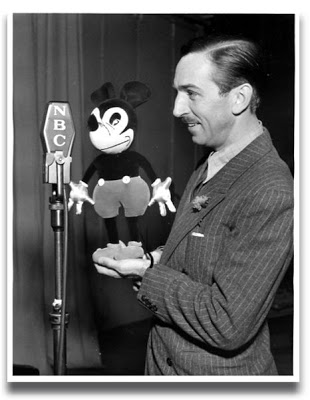
On this day, in 1938, the final episode of The Mickey Mouse Theater of the Air, “Old MacDonald,” was broadcast on the NBC radio network from the Disney Little Studio on the RKO Pictures lot. Originally created as a way to promote Snow White and the Seven Dwarfs, Theater of the Air’s first episode was broadcast on January 2, 1938 (Snow White premiered at the Carthay Circle Theater December 21, 1937 but wouldn’t be shown nationwide until February 1938). Pepsodent, the toothpaste company, sponsored the musical variety series to run on consecutive Sunday afternoons, geared mainly towards children. Theater of the Air proved so popular it expanded from its thirteen show contract into twenty episodes all together. Every episode opened with Who’s Afraid of the Big Bad Wolf, from The Three Little Pigs, and closed with Heigh-Ho from Snow White.

Image courtesy 2719hyperion.blogspot.com
Each week, the songs and skits revolved around a different story theme. Some of them were based on stories that had appeared in the Silly Symphony series (King Neptune, Mother Goose and Who Killed Cock Robin?) while others concerned tales that the studio wouldn’t revisit until decades later (Cinderella, Sleeping Beauty, King Arthur and Robin Hood). All the central Disney characters, Mickey, Minnie, Donald and Goofy, made regular appearances on the show with frequent visits from Snow White herself (it was her movie being promoted after all). Walt himself did the voice of Mickey for the first few episodes then passed the baton off to Joe Twerp (who only ever voiced the Big Cheese for these broadcasts). Walt got so busy at during the run of Theater of the Air, that even his voice was impersonated during the latter half.

After the last show aired, Theater of the Air quietly disappeared. Walt was too busy working on Pinocchio to devote any time to it and he wasn’t enamored of the radio to begin with (he felt his characters had to be seen to truly be enjoyed). But, for a few months at the beginning of 1938, kids got a regular dose of Disney without having to leave their living rooms, something that wouldn't happen again for seventeen years (and then everyone would see the characters).

May 14 - Richard Deacon

Image courtesy pinterest.com
On this day, in 1921, Richard Deacon was born in Philadelphia, Pennsylvania. As a young boy, Richard’s family moved across the state border to Binghamton, New York where he would finish his childhood years. After graduating from Binghamton Central High School, alongside the other future Binghamton star Rod Serling, he would serve in the Army Medical Corps during World War II. Following the end of the war, Richard returned home, began working as a lab technician at Binghamton General Hospital and started taking courses at nearby Ithaca College with the intent of becoming a doctor. Along the way, he was bitten by the acting bug, though, and he never become a actual doctor, but he did get to play one on tv several times.

Richard began acting in the late Forties in college productions which naturally led to regional theater stages. He eventually crossed paths with Helen Hayes, who told him that while he would probably never become a leading man, he should definitely pursue a career as a character actor. He took the advice to heart and built a massive body of work on it.

Image courtesy pinterest.com
Richard’s film and television careers both started in the Fifties. His first film role was as an MP in 1953’s Invaders from Mars, which also featured future co-star Barbara Billingsley. Over the next five years, before his debut on the small screen, Richard appeared in 34 films, ranging from comedies like Abbot and Costello meet the Mummy (pictured) to dramas like The Power and the Prize to musicals like Carousel. He would grace the cast list of over 100 movies before his career was over, but it wasn’t until he started making weekly visits in everyone’s living rooms that he became someone everyone knew.

Image courtesy thiswastv.com
Richard made his television debut on The Jack Benny Show in 1954 but his first recurring role was on the venerable sitcom Leave It To Beaver.  He spent six years as Fred Rutherford, father to Lumpy Rutherford, one of Wally Cleaver’s friends. His most famous role started in 1961 (and actually overlapped his Beaver gig for a year). Richard was cast as Melvin Cooley on The Dick Van Dyke Show (pictured). For five seasons, he masterfully played the butt of Morey Amsterdam’s jokes, occasionally also doing producer duties for his brother in law Allen Brady on the show within a show. Following the end of that series, Richard had recurring roles on The Phyllis Diller Show, The Beverly Hillbillies and The Mothers-In-Law. In 1969, he returned to the stage, making his Broadway debut as a replacement Horace Vandergelder in Hello, Dolly, reteaming with Phyllis Diller for almost a year.

Image courtesy dvdizzy.com
Richard joined the Disney family early in his career. In 1958, he starred as Uncle Archie McCloud in the serial Walt Disney Presents: Annette on the original Mickey Mouse Club (pictured). He later appeared in a string of films for the company throughout the Sixties, including That Darn Cat!, Lt. Robin Crusoe, USN, The Gnome-Mobile, Blackbeard’s Ghost, and The One and Only, Genuine, Original Family Band. His final Disney appearance came in 1984 when he was part of the cast of The Hoboken Chicken Emergency, a film that aired on the newly minted Disney Channel.

Image courtesy pinterest.com
Throughout the Seventies and into the Eighties, Richard made dozens of guest appearances on everything from Maude to The Love Boat (of course) to a recurring role as Sheriff Masters on BJ and the Bear. He even continued to land a handful of big screen roles in films like The Man From Clover Grove, Rabbit Test (Billy Crystal’s debut) and The Happy Hooker Goes Hollywood (pictured). He was also something of a gourmet chef in his private life and hosted a microwave cooking show in Canada, publishing a companion cookbook to go along with it. In 1983, twenty years after Leave It To Beaver went off the air, Richard reprised his role of Fred Rutherford for a made for tv reunion movie, Still the Beaver. The reunion was so successful that a new Beaver series was developed (which would air its first season on the Disney Channel) and Richard was slated to be a part of it, but it wasn’t to be. Before filming could start, he suffered a heart attack on August 8, 1984 at his home in Los Angeles, California. Paramedics rushed him to the hospital, but he was pronounced dead on arrival. He was 63.