
Showing posts with label Mickey Mouse. Show all posts
Showing posts with label Mickey Mouse. Show all posts
Saturday, July 27, 2019
Update: Russi Taylor

Sunday, July 14, 2019
July 7 - Ub Iwerks
 |
| Image courtesy youtube.com |
 |
| Image courtesy medium.com |
The only thing Walt was left with after the bankruptcy of his first studio was a short film that was a hybrid of live action and animation. He took that film with him out to California and convinced his brother, a financial wizard, to start a new studio. The Walt Disney Studio got a contract to produce more films like the one he had. They became known as the Alice Comedies and they were chiefly animated by Walt's old friend, Ub.
Ub followed Walt out to California and became one of the driving forces behind the success of the Walt Disney Studio. He was basically an animating machine, able to churn out quality work at incredible rates. The look and feel of early Disney animation should actually be referred to as the look and feel of Iwerks animation. As the Alice Comedies were winding down in 1927, Walt asked Ub to create a new character. He came up with Oswald the Lucky Rabbit and supposedly completely animated the first short, Poor Papa, himself. If you look at the bottom of most of the Oswald posters, you can see Ub's signature, which means he created the artwork for those as well. When the studio lost the rights to Oswald in 1928 to Universal, Ub was right in the mix helping to design the studio's next character, Mickey Mouse (who is admittedly just Oswald with round ears instead of long ones and a different tail).
 |
| Image courtesy lambiek.net |
 |
| Image courtesy bcdb.com |
 |
| Image courtesy cartoonbrew.com |
Following the collapse of his studio, Ub was contracted by Leon Schlesinger to animate four Looney Tunes shorts, two of which he also directed. He then spent a few years under contract with Columbia Pictures' animation unit, Screen Gems, directing several of their Color Rhapsodies series. By 1940, Ub and Walt had repaired their friendship enough that Ub would return to work full time at the Walt Disney Studio.
Ub's second career with Disney was mostly involved with the technical side of things. He was kind of put into a department by himself where he worked on creating new visual effects for animation. Ub is credited with coming up with a new process, called the multi-head optical printer, for combining live action with animation that was used in Song of the South. He would win an Academy Award for later improving that process and nab another one for perfecting color traveling matte technology. He also created the xerography process of transferring animator's drawings onto acetate cels that was first used on One Hundred and One Dalmatians in 1961. That process is basically what brought production costs on animation down enough that Disney continued producing it. As the Sixties progressed, Ub moved into doing effects work with WED Enterprises, the precursor to Walt Disney Imagineering, putting his influence on many of the theme park attractions created during that decade including it's a small world and Great Moments with Mr. Lincoln.
 |
| Image courtesy pinterest.com |
For the last few years of his life, Ub was involved with the development of shows and attractions for the Florida Project like The Hall of Presidents. He wouldn't live to see Walt Disney World open however. On July 17, 1971, he suffered a fatal heart attack in Burbank, California. He was 70.
Monday, May 20, 2019
May 19 - Alan Young
 |
| Image courtesy discogs.com |
 |
| Image courtesy imdb.com |
Alan debuted on the silver screen in 1946 as Roy Hornsdale in the romantic comedy Margie. Throughout the rest of the Forties and Fifties, he regularly appeared in films, mostly comedies, starring alongside the likes of Jane Russell in Gentlemen Marry Brunettes, William Frawley (of I Love Lucy fame) in Chicken Every Sunday, Peter Sellers in Tom Thumb and as the title character in George Bernard Shaw’s Androcles and the Lion.
 |
| Image courtesy looppng.com |
 |
| Image copyright Disney |
By the early Seventies Alan was looking to get back into acting and started a new career as a voice over artist. His first project for Disney was the 1974 Disneyland Records album An Adaptation of Dicken's Christmas Carol, Performed by the Walt Disney Players (yes that mouthful is the full title). Alan co-wrote the script for it and performed several voices for it. He played Mickey Mouse (the one and only time he ever did) as Bob Cratchit, Morty Fieldmouse as Tiny Tim, Merlin as the Ghost of Christmas Past and, for the first time, Scrooge McDuck as Ebenezer Scrooge. Alan's portrayal of Scrooge marked the first time the wealthy duck had ever had a true Scottish accent. He said that he modeled the voice after his own Scottish father. Alan was so good at bringing Scrooge to life, he would portray McDuck for the next four decades.
 |
| Image copyright Disney |
 |
| Image courtesy twitter.com |
Outside of Disney, Alan returned to television, making guest appearances on dozens of shows from The Love Boat to ER to Sabrina the Teenage Witch. He ramped up the Scottishness for Ren and Stimpy as Haggis McHaggis and for the video game The Curse of Monkey Island as Haggis McMutton (is that really the only name writers can come up with for a tartan wearing character). His voice was heard on Batman: The Animated Series, Spiderman and His Amazing Friends, Alvin and the Chipmunks, The Smurfs, Scooby and Scrappy Doo and A Flintstone Family Christmas. Even though he was well into his nineties, Alan showed no signs of wanting to slow down. He was all set to record stuff for the reboot of DuckTales. Scrooge had been recast (Dr. Who fans were tickled to know it was now David Tennant's character) but Alan was going to play someone different. It didn't come to be however. Before he could get into the recording booth, the man TV Guide once called the Charlie Chaplin of television passed away in his sleep at his assisted living home in Woodland Hills, California in May 2016. He was 96 years Young.
Wednesday, May 15, 2019
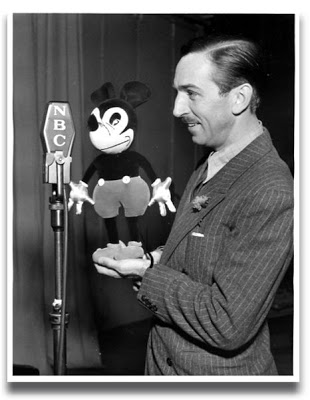
May 15 - The Mickey Mouse Theater of the Air
 |
| Image courtesy fredallensotrhome.blogspot.com |
 |
| Image courtesy 2719hyperion.blogspot.com |
After the last show aired, Theater of the Air quietly disappeared. Walt was too busy working
on Pinocchio to devote any time to it and he wasn’t enamored of the radio to
begin with (he felt his characters had to be seen to truly be enjoyed). But, for a few months at the beginning of 1938, kids got a regular dose of Disney without having to leave their living rooms, something that wouldn't happen again for seventeen years (and then everyone would see the characters).
Wednesday, February 13, 2019
February 7 - Wayne Allwine and Russi Taylor

On this day, in 1947, Wayne Anthony
Allwine was born in Glendale, California. His professional career begins, like all great
scripted careers do, in the mail room at the Walt Disney Studio in 1966. If we
were indeed making a movie of this story, we would almost certainly have a
scene in which the 19-year-old Wayne approaches sound effects guru Jimmy
MacDonald who takes an envelope from Walt Disney and hands it to Wayne, just so
we can get all three of them in the frame together. It’s a moment that probably
never actually happened, even though Wayne and Walt’s times did overlap for
several months, but it would be a scene the audience would later remember and
say to themselves “Ah. Foreshadowing.”
Wayne moved
up from the mail room and landed in the Sound Effects department, apprenticing
under Jimmy MacDonald. He became a pretty good sound effects editor. You can
hear his work on Disney films like Splash
and Three Men and a Baby as well as
films he did for other studios like Innerspace
and Star Trek V. But in late 1976 he
began apprenticing under Jimmy for an entirely different reason.
 |
| Image copyright Disney |
Jimmy was
nearing retirement at that point and was going to be leaving behind a large
hole to fill. He’d been doing the voice of Mickey Mouse since taking over from
Walt in 1947. An audition was held and his already protégé, Wayne, won the
role. Jimmy began coaching him and Wayne made his debut as the Big Cheese
recording the opening title bits for The
New Mickey Mouse Club in 1977. From that point on, Wayne was the mouse for
the next 32 years. He made his big screen debut in Mickey’s Christmas Carol and voiced the role in everything from Who Framed Roger Rabbit to The Lion King 1 ½.
Movies,
television series and specials, parades, you name it and Wayne was kept as busy
as he could handle doing it. He also did a handful of other voices (you didn’t
think squeaking was his only talent, did you?) including a Henchman in The Black Cauldron and Thug Guard #2
(not to be confused with #1, completely different guy) in The Great Mouse Detective.
 |
| Image courtesy of historybyzim.com |
On a
personal note, life began to imitate art for Wayne starting in 1986. It was
decided that Minnie Mouse would start talking again (she hadn’t had any lines
for several years) and an audition was held. Russi Taylor won the role. She
recalls meeting Wayne in a hallway one day and his excitement over having a
Minnie for the first time. Both were in failing marriages (his third). After
their not-so-wedded-blisses ended, they began hanging out together outside of
the recording booth. They fell in love, just like the mice they played, and got
married in 1991, not like the mice they played. They kept it quiet in order to
make their nuptials about them and not their characters (people went a little
crazy even back then when they heard that Mickey and Minnie were married), but
they did live happily ever after for the next two decades.
 |
| Image courtesy of me. |
Praised by
many for bringing Mickey out of the world of bland falsetto and into nuanced
deliveries and a multi-faceted personality, Wayne did some of his best work on
the video game series Kingdom Hearts.
He was heard daily on the Disney
Channel’s Mickey Mouse Clubhouse and
can still be heard every fifteen minutes in the Mickey’s PhilharMagic attraction at the Magic Kingdom. In 2008,
both Wayne and Russi were made official Disney Legends for their outstanding
stewardship of Mickey and Minnie’s legacies. On May 18, 2009, Wayne passed away
at his home in Los Angeles, California, finally losing a battle he’d been
fighting for several years with diabetes. He was only 62.
To date, Wayne is the person who voiced Mickey
the longest of the four talents who’ve done it (regularly) so far and, with all
the media outlets that exist today, the most prolific (Russi is, by far, the
longest Minnie). Bret Iwan took up the mantle after Wayne’s death. Bret was
hired because of Wayne’s failing health and was supposed to understudy Wayne,
just as Wayne understudied Jimmy, but the two never actually got to meet. So
far Bret’s doing just fine. Most people never realized that a change occurred
and only time will tell if Bret hangs on to the gig longer than Wayne, or if
the third voice really is the charm.
Thursday, February 7, 2019
February 1 - Jimmy MacDonald
 |
| Image courtesy of wikipedia.com |
Jimmy was a master at finding ways to produce the sounds that were needed for any given situation. Sometimes it was something as simple as flopping down in a chair in someone's office, liking the creaking noise the chair produced and commandeering the chair for his department. Other times Jimmy had to create gadgets in his workshop to get the sound he was looking for. He would build thousands of noise makers over the years to give life to everything from Evenrude's unique buzz in The Rescuers to the sound of the forest fire that take's the life of Bambi's mother.
 |
| Image copyright Disney |
 |
| Image copyright Disney |
 |
| Image copyright Disney |
 |
| Image copyright Disney |
Friday, January 4, 2019
January 1 - The Rose Parade

On this day, in 1890,
the Valley Hunt Club staged the very first Rose Parade in Pasadena, California.
Held annually every year since then (even during both World Wars), the Rose
Parade has become a fixture on New Year’s Day for hundreds of millions of people
around the world. Except, of course, for those occasions when the parade
happens on January 2. When are those occasions, you might scratch your head and
ask. Whenever the first falls on a Sunday. The organizers of the fourth parade
didn’t want to disturb the horses tethered outside of church services, so they
delayed for twenty-four hours, creating a tradition that continues to today.
 |
| Image courtesy of remembertherosebowl.com |
The best part of the parade, in my opinion, is how beautiful
and creative the floats are. Right from the beginning, the organizers wanted to
celebrate the mild climate of their fair city and covered their horse drawn
carriages with live roses and other flowers. Today, it’s mindboggling to me how
far float designers have moved beyond flowers. Seeds, grasses, bark, skins, you
name it, every conceivable part of a plant is used to evoke all kinds of
surfaces on gorgeous, colorful and, quite often, whimsical scenes. If you can’t
tell, I really like this parade.
 |
| Image courtesy of disneyhistoryinstitute.com |
Disney has a long history with the Rose Parade. It all
started at the 39th Parade on January 1, 1938. The theme that year
was Playland Fantasies. Snow White and
the Seven Dwarfs had been triumphantly playing at the Carthay Circle
Theatre for a week and a half and fit in perfectly. The live action model for
Snow White, Marjorie Belcher, rode the float with the same costumed characters
of the dwarfs that graced the film’s premiere.
In 1955, the 66th parade featured a float based
on attractions from Disneyland, even though the park was still several months
away from opening. Helms Bakery sponsored the float which boasted over 7,000
pink roses. In addition to the float, the Firehouse Five Plus Two, a jazz group
made up of studio employees including Ward Kimball and Frank Thomas (two of the
Nine Old Men), joined in the procession.
 |
| Image courtesy of the official Disney Parks blog |
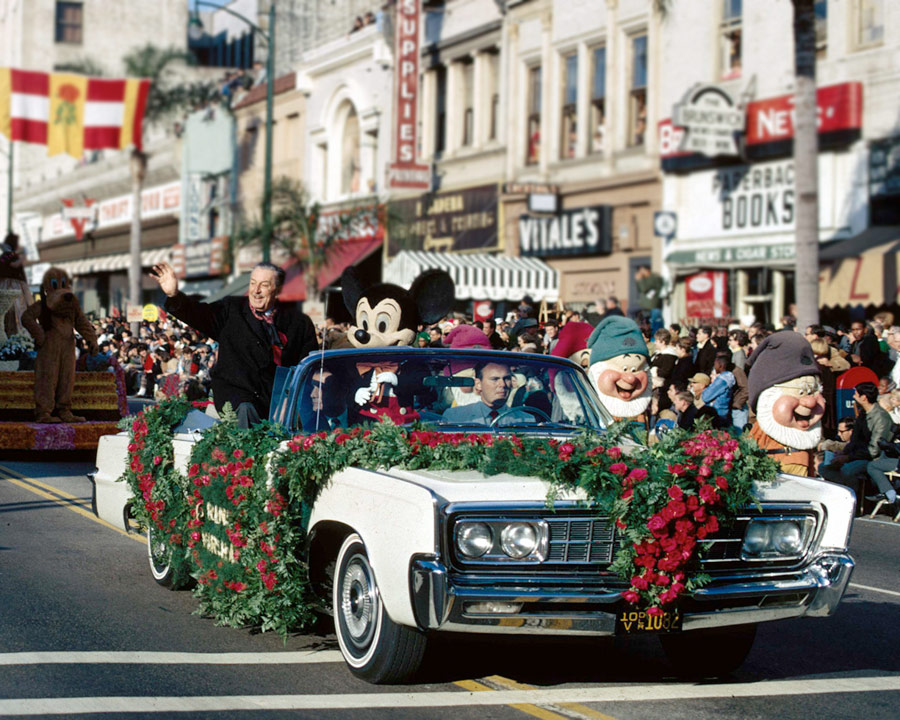
Eleven years later, the 77th Grand Marshal of the
Rose Parade would be none other than Walt Disney himself. He proudly rode at
the front of the parade with Mickey Mouse by his side. Interestingly, one of
the spectators that year would be a young John Lasseter, future co-founder of
Pixar, and another would be Pat Burke, one of the top future Imagineers.
In 1980, Disneyland was once again part of the parade when
they presented a special pre-parade show celebrating the park’s 25th
Anniversary. As part of the festivities, the Firehouse Five Plus Two was
enticed out of retirement to make an encore Rose Parade appearance.
In 2000, another Disney became Grand Marshal of the Rose Parade.
This time it was Walt’s nephew, and longtime Disney Board member, Roy E.
Disney.
 |
| Image courtesy of caltech.edu |
For the 115th Rose Parade in 2004, Disneyland
Resort once again sponsored a float. This one was based on its newest
attraction, the Twilight Zone Tower of Terror. Rising 100 feet above the street,
this float would be the tallest in parade history.
Mickey Mouse would serve as the 116th Grand
Marshal just a year later. Disneyland Resort’s 50th anniversary advertising
campaign would also kick off during the commercial breaks of the parade’s
television coverage. The following year a float with recreations of the castles
from each of Disney’s five magical theme parks from around the world was
featured.
Disney would have a small presence in the 2007 parade. A
representation of Disneyland’s monorail would be part of the City of Anaheim’s sesquicentennial
float. Six years later, a float based on Disneyland Resort’s newest area, Cars Land,
would ride down Colorado Boulevard.
 |
| Image courtesy of KPCC |
And, finally, in 2016, the longest, most massive float of
the parade that year consisted of three distinct parts: a Frozen castle followed by Sleeping Beauty’s Castle (decorated for
Disneyland’s 60th anniversary) with the Millennium Falcon bringing
up the rear.
Year after year, the Tournament of Roses Parade (as it’s
officially known) never fails to please, even in those years when it pours. And
whenever Disney enters a float, it’s sure to be something spectacular. I, for
one, look forward to all the collaborations between the two in the years to
come.
Tuesday, November 27, 2018
November 23 - Fred Moore

Fred started out in the Shorts Department (mainly because the Features department wouldn't exist for several more years). He became an expert at drawing the studios scrappy little mouse. He was also the main animator for the Silly Symphony of The Three Little Pigs. Walt's comment after seeing the finished Pigs was "at last, we have achieved true personality in a whole picture." The picture won the Oscar for Best Animated Short in 1934. Fred would work on over 35 shorts, earning another Oscar and an additional Oscar nomination in the process.
 |
| Image copyright Disney |
 |
| Image copyright Disney |
 |
| Photo taken from traditionalanimation.com |
Fred left the Disney studio for two years in the late Forties to work for Walter Lantz's studio, where he helped redesign another iconic character, Woody Woodpecker. His life would be tragically cut short during work on Peter Pan when he and his second wife, Virginia, were in a head-on collision returning from a football game in November 1952. Fred would survive long enough to make it to St. Joseph's Hospital in Burbank, across the street from the Disney studio. 14 years later, Walt would pass away in the same building. For all of his genius at the drawing board, Fred would be given the Winsor McCay Award in 1983 and be made an official Disney Legend in 1995.
Monday, November 19, 2018
November 17 - Les Clark

 |
| Photo borrowed from moma.org |
When it came time to launch the Silly Symphony series, Les was an integral part of the team, animating the iconic dance of The Skeleton Dance. He would continue his fancy footwork when Snow White and the Seven Dwarfs was in production as the animator charged with making the dwarfs dance with Snow White. For the next few decades, Les would have a hand in every major animation project the studio did. From Pinocchio to Make Mine Music, he was a lead animator. Starting with Song of the South, he began to fill the directing animator role and did so on Fun and Fancy Free, Melody Time, Cinderella, Alice in Wonderland, Peter Pan and Lady and the Tramp. Les was a sequence director on Sleeping Beauty and contributed to 101 Dalmatians.
 |
| Photo lifted from exploratorium.edu |
After 48 years of making magic with Disney, Les retired in 1976. Just a few years later, he would pass away from cancer on September 12, 1979 in Santa Barbara, California. For his immense body of work, the plucky Venice soda jerk would become an official Disney Legend alongside his fellow Nine Old Men and his one-time mentor Ub Iwerks in 1989.
Monday, September 10, 2018
September 10 - Bret Iwan

When Mickey Mouse was first created and needed a voice because sound had come to the movies, the Disney Studio didn't have to go far to find someone to do it. Walt himself stepped up to the mic and falsettoed his way through dozens of shorts and even a few features. It was always a source of pride for Walt that he shared a voice with his little mouse.
By 1946 however, the demands of leading a growing company meant that Walt just didn't have time to spend in a recording studio anymore. After the "Mickey and the Beanstalk" segment of Fun and Fancy Free, Walt had to hand squeaking duties off to someone else.
A sound effects master and veteran musician for the company, Jimmy MacDonald became Mickey's second official voice. You might remember him if you ever saw the pre-show video to the sound effects show at Disney-MGM Studios. Jimmy gave voice to most of Mickey's words from 1946 until he retired in 1977. I say most because occasionally Walt would still sneak in a voice over before his death.

Thus enters young Bret Iwan, a greeting card artist and official voice number four. The crazy thing is that Bret had been hired to understudy Wayne as his health declined. Unfortunately, Wayne died before Bret ever had a chance to meet him. Bret did received Russi's blessing though and continues to work with her right up to the present. And since Bret turns the ripe old age of 36 today, I'm guessing he'll be performing M. Mouse for decades to come.
Wednesday, September 5, 2018
September 5 - Oswald the Lucky Rabbit

Walt Disney knew his successful series of shorts, The Alice Comedies, was nearing the end of its run. He and Ub Iwerks had taken them as far as they could technically and the cost to produce them was rising. Walt needed something new to keep his little studio going and he figured it should be pure animation for this next venture. Luckily, his distributor, Charles Mintz, and Universal Studios agreed with him. Walt was given a contract to get Universal into the growing animation game.
Flush with new contract money, Walt moved his studio to Hyperion Avenue and got to work. Since there was already a couple of popular cats starring in their own series, Felix the Cat and Krazy Kat, Walt decided to branch out. His new character would be a rabbit. Maybe a lucky rabbit, since he carried not one but two rabbit's feet with him wherever he went. And he would be old. You heard me. Old.
The first short Walt and Ub finished with their new character, Oswald, was called Poor Papa. Universal executives took one look at it and said no thanks! Why? The production quality wasn't very good and why is the main character so old? No one wants to see a geezer bunny in a cartoon. So Poor Papa was scraped, Oswald had several decades pared off his age and Walt and Ub stepped it up on their second effort.The result was Trolley Troubles and it would become their biggest hit yet.
Oswald the Lucky Rabbit was so successful as a franchise, the Disney Studio grew to nearly twenty staff members. Walt was able to pay himself $100 a week and his brother Roy $65. Happy days had come to the brothers. Nine shorts were produced that first year. The studio would produce 17 more the next year before disaster struck.

Walt was constantly worried about getting his contract with Mintz and Universal renewed. That worry intensified when he realized that Mintz was hiring away his own animators behind his back. The whole thing came crashing down around his ears in the spring of 1928, when Mintz informed Walt that he would have to take a 20% budget cut if he still wanted to produce Oswald shorts. Rather than submit to that, and with most of his animators now working for Mintz, Walt declined to sign a new deal and, as he didn't own the rights to his creation, walked away. Supposedly on the train ride home, he would come up with a new character that would completely eclipse Oswald, but since Walt could never tell the story the same way twice, I'll leave that discussion for another time.
Oswald would live on long after the Disney Studio no longer had anything to do with him. Mintz would also produce 26 shorts until Universal decided it no longer needed him and started making them right on their own lot. Walter Lantz, of Woody Woodpecker fame, took over the series and created 142 more shorts, ushering Oswald into the world of sound and, briefly, the world of color. While Oswald never had much of a regular actor to provide his voice, Mickey Rooney did provide it for a while in 1931. Interestingly, when Lantz took the series over, he consulted with Walt about some of the aspects of Oswald. Mickey Mouse had become such a cash cow by then that Walt didn't really care about Oswald anymore and reportedly gave Lantz his blessing to run with the character.

In 2003, the branch of the Walt Disney Company that made video games came up with an idea for an Oswald game. For some reason, the idea stuck with the head of the company, Bob Iger, and he made it a pet project to return the Lucky Rabbit to the Disney fold. After negotiating with Universal, it was announced in 2006 that the two companies would take a page from the sports world and effect a trade: Disney would get the rights to Oswald and the Walt produced shorts, while Universal would get veteran sports announcer Al Michaels for their Sunday Night Football broadcasts. Al was pretty pleased with the deal and even joked "I'll be a trivia answer someday." The video game then became a reality, although before Oswald could put on any airs about his return it was name Epic Mickey.
And that is how Oswald's story ends. After almost 80 years away, guests in the Disney parks can now choose traditional mouse ears or new, hip rabbit ears. If you visit Disneyland, you might be able to actually meet him out and about. While Mickey will always be considered more successful, his older brother Oswald can now play new role and wonder what might have been.
Subscribe to:
Posts (Atom)