Showing posts with label Cinderella. Show all posts

Friday, September 13, 2019

August 26 - Retta Scott

Image courtesy greatwomenanimators.com
On this day, in 1990, Retta Scott passed away in Foster City, California. Born on February 23, 1916 in the tiny town of Omak, Washington (it had less than 1,000 residents at the time), Retta and her family moved four hours east to the Seattle area when she was a fairly young girl. Art was her favorite subject in school and she first thought about doing it as a career when, in the fourth grade, she won a scholarship from the Seattle Art and Music Foundation. She was able to stretch that award into nearly ten years of art classes, continuing to get local training well past her 1934 graduation from Roosevelt High School. Her dedication to honing her craft paid off when she then won a second scholarship, this time for three years of study at the famous Chouinard Art Institute in Los Angeles, California. Retta packed up her belongings, moved a couple of states south and set her sights on becoming a fine artist. She ended up making history.

Image courtesy tumblr.com
While at Chouinard, Retta would spend a lot of her free time at the Griffith Park Zoo, just a short distance from the school. Her bold sketches of the animals there caught the attention of one of her professors. He recommended that she apply for a job at the Walt Disney Studio. Retta said no thanks, cartoons did not appeal to her. The professor explained he had more of the type of artistry present in the recently released Snow White in mind and understood, through some contacts of his, that the studio was looking at doing an adaptation of Bambi next. Retta’s expertise with animal drawings would be a natural fit. Retta was finally convinced to apply and, almost to her surprise, was hired.

Image copyright Disney
Retta began her Disney career in 1938 in the Story Department, a fairly unusual start given that most women at animation studios were almost always relegated to the tediousness of the Ink and Paint Department. Her time spent at the zoo came shining through in her story sketches and character development work. Both David Hand, Bambi’s director, and Walt himself were impressed with the intensity of her drawings. When the movie moved into the actual production phase, Retta was moved into the actual animation department, put under the tutelage of the Legendary Eric Larson and assigned to the sequence where the hunting dogs are chasing Faline. Her amazing work led to a full-fledged on-screen credit as an animator for Bambi, making her the first woman at Disney ever to receive that honor.

Image copyright Disney
Over the next few years, Retta continued on as an animator for both Fantasia and Dumbo (although she gets no official credit on either of those films) as well as contributing to at least two Donald Duck shorts, Donald’s Snow Fight and Donald Gets Drafted (again sans credit). Retta was working on animating the weasels for the studio’s adaptation of The Wind in the Willows when she made an on-screen appearance during the filming of The Reluctant Dragon in 1941 (she presents the film’s star, Robert Benchley with a caricature of him as an elephant). Later that year, as things became increasingly tight for Disney just prior to World War II, she was briefly laid off with a number of other animators, but by the beginning of 1942, she was hired back into the Story Department. She worked on several animated shorts and educational films until she married a submarine commander and retired from Disney in April 1946.

Image courtesy alchetron.com
Retta and her husband, Benjamin Worcester, moved east to Washington, DC where she continued her art career as an illustrator. She would work with the Walt Disney Company several more times over the years, most notably on Little Golden Book editions of Disney movies. Her illustrations for the Cinderella Big Golden Book are what make that book a must have for collectors. She was praised for a picture book that didn't look exactly like the film but yet still felt like it came directly out of it. Other vintage non-Disney Little Golden Books she is famous for include The Santa Claus Book and Happy Birthday.

Image courtesy pastemagazine.com
In the late Seventies, Retta returned to the world of animation when she was hired by Martin Rosen, a British filmmaker, to help animate The Plague Dogs released in 1980 (it's said to be a pretty decent movie in spite of a terrible title). She moved to San Francisco to work on the picture (having divorced her husband around the same time), teaming up with a youngish Brad Bird (who would go on to direct The Iron Giant and The Incredibles). And even though four decades had passed since the last time she had to prove herself in an animator's workroom, the men in the room were reportedly both surprised by her talents and awed by them. Unfortunately, some things take longer to change than we might like.

Image courtesy pinterest.com
After production wrapped up on Dogs, Retta would join another future member of Pixar, Bud Luckey, at his studio, doing animation for commercials like Cookie Crisp Cereal. She worked there until 1985, when she suffered a stroke that spared her life but robbed her of the ability to produce quality work. She would live quietly for another five years before passing away at her home in Foster City. The pioneering animator who helped open doors for generations of women after her was 74. Ten years later, in 2000, Retta would posthumously be declared an official Disney Legend, for reasons that should be fairly obvious.

Tuesday, July 23, 2019

July 20 - Verna Felton

Image courtesy imdb.com
On this day, in 1890, Verna Felton was born in Salinas, California. When she was ten, Verna performed in a San Jose benefit for the victims of the Galveston Flood of 1900. She attracted the attention of the manager of a travelling show in the area, who offered her a contract. Verna's mother declined on her behalf. Shortly thereafter, her father died, leaving the family in bad financial shape. Verna's mother then contacted the show manager, who quickly produced a contract and she spent the remainder of her formative years in the theater.

Verna toured with the Allen Stock Company up and down the West Coast of the United States and Canada. Initially she was billed as "Little Verna Felton, the Child Wonder" but by 1907, she had become one of the company's leading ladies. In 1910, one of the troupe's shows was The Defiance of Doris, which had been written specifically for Verna. By the Twenties, Verna had stopped touring and settled in Vancouver, British Columbia, Canada. She was ensconced in the Empress Theatre there, again as one of their leading ladies.

Image courtesy flickr.com
Verna moved to Hollywood in the Thirties and became a staple on radio programs from coast to coast. She started in 1937 as the mother in The Cinnamon Bear, a serial designed to air between Thanksgiving and Christmas and was rebroadcast every year for decades (you might even be able to find it somewhere in the world this holiday season). From there, Verna moved on to have recurring roles on The Great Gildersleeve, The Jack Benny Program, Point Sublime, The Abbott and Costello Show, The Joan Davis Show, The Judy Canova Show, A Day in the Life of Dennis Day, The Red Skelton Show, December Bride and My Little Margie. She was queen (or aunt or nosy neighbor) of the airwaves for two decades, right up until television began to capture people's imaginations. And she really only slowed down enough to change mediums.

Image copyright Disney
As television clawed its way to the top of America's entertainment heap, Verna rode the wave of radio programs that made the leap. She reprised roles that audiences had only heard her in on the new versions of The Jack Benny Program, The Dennis Day Show and December Bride. Her portrayal of Hilda Crocker on Bride, and its spin-off Pete and Gladys, earned her Emmy nominations in 1958 and 1959. One of Verna's most famous roles came in the early Sixties, when she was a semi-regular on The Flintstones as Pearl Slaghoople, Fred Flintstone's demanding mother-in-law. She also enjoyed guest appearances on I Love Lucy, Wagon Train, The George Burns and Gracie Allen Show and the final episode of Dennis the Menace.

Image copyright Disney
Verna's most enduring body of work, though, came through her long association with the Walt Disney Company. Any one of the characters from her list of Disney voice credits would make a performer proud, but she could boast all nine of them. She started in 1940 with dual roles in Dumbo, playing both the circus' Elephant Matriarch and Mrs. Jumbo, Dumbo's mother. Next, she became everyone's favorite Fairy Godmother in Cinderella, a role she actually reprised twice afterwards on the radio, once for Screen Directors Playhouse and again for Hallmark Playhouse. Verna's next role took a villainous turn when she brought to life the Queen of Hearts in Alice in Wonderland. She followed that up with Aunt Sarah in Lady and the Tramp (her son, Lee Millar, actually voiced Jim Dear), Flora, the red fairy, and Queen Leah in Sleeping Beauty and Eloise in the 1960 short Goliath II. Verna's final role for Disney was as Winifred, Colonel Hathi's wife, in The Jungle Book. All that and she hasn't been granted Legendary status. Shameful.

Verna worked right up to the end of her life (The Jungle Book was actually released posthumously). On the evening of December 14, 1966, she suffered a fatal stroke and passed away, just hours before Walt did the following morning. She was 76.


Thursday, July 11, 2019

July 5 - Mack David

Image courtesy songhall.org
On this day, in 1912, Mack David was born in New York, New York. Growing up in a traditional Jewish family (his parents owned a delicatessen in Brooklyn), Mack had aspirations towards becoming a lawyer. He even spent several years at Cornell University and the law school at St. John’s University trying to make that dream come true. When his younger brother, Hal, was contemplating career paths, and considering going into song writing, Mack did everything he could to discourage him, telling him to choose something with more stability. Which really spreads a thick layer of irony over the outcome of Mack’s own life.

Maybe it was because Hal completely ignored his big brother’s advice, went into the music business and a spirit of competition kicked in or maybe Mack just wanted to see if he could be successful at it, but in the early Forties, Mack began writing songs. He was primarily a lyricist, but he would occasionally write the music as well. Some of his early hits were Just a Kid Named Joe for the Mills Brothers, The Singing Hills for Bing Crosby, Take Me for Jimmy Dorsey, Blue and Sentimental for Count Basie and Sunflower for Frank Sinatra. Not only were those songs originally written for big names but all of them have been covered by other artists over the years as well (Blue and Sentimental alone has appeared on over 100 different albums).


Image copyright Disney
These successful compositions gave Mack the courage to move out to Hollywood and begin writing music for the pictures. In 1950, he, along with writing partners Jerry Livingstone and Al Hoffman, became part of the Disney family in a big way, writing several songs for the studio’s twelfth animated feature, Cinderella. If you ever find yourself humming A Dream Is a Wish Your Heart Makes, Bibbidi-Bobbidi-Boo or The Working Song, you’re familiar with the trio’s work. When the Oscar nominations were announced for that year, Bibbidi-Bobbidi-Boo made the list for Best Song, giving Mack his first award nomination (Mona Lisa from Captain Carey,USA edged him out for the win). As if those songs weren’t enough of a contribution to Disneyana, the boys returned for the next feature, Alice in Wonderland, with The Unbirthday Song.

Image copyright Disney
After his Oscar nominated work with Disney, Mack became a sought after, and highly prolific, songwriter for the next two decades. When the dust settled in the early Seventies, he had credits for lyrics or music (and sometimes both) on over 1,000 songs. He was nominated for an Academy Award seven more times after Cinderella, for his work in The Hanging Tree (1959), Bachelor in Paradise (1961), It’s a Mad, Mad, Mad, Mad World (1961), Walk on the Wild Side (1962), Hush Hush Sweet Charlotte (1964), Cat Ballou (1965) and Hawaii (1966). Unfortunately, he never did get one of the little golden men for his mantel, making him one of the most nominated but never won Oscar honorees. In 1975, Mack was inducted into the Songwriters Hall of Fame

Image courtesy picclick,com
In addition to his film work, Mack also continued to write songs for pop artists (Baby It’s You for the Shirelles and It Must Be You for Gilbert Becaud), television (the theme to Casper the Friendly Ghost) and Broadway (the 1973 musical Molly and 1981’s Sophisticated Ladies). One of his biggest hits was his reimagining of the lyrics to the French song La Vie en Rose, which has been recorded by over 80 artists around the world and featured in dozens of films (I say reimagined because he didn’t write a strict translation of Edith Pilaf’s original lyrics but wrote new ones that honored their spirit).

So after several decades in the songwriting business, Mack had sufficiently put to rest his own fears that it wouldn’t be a very steady work to get into. His little brother, Hal, by the way, also had a long and prolific career doing the same thing (and Hal got into the Songwriters Hall of Fame three years earlier, probably just out of spite). On December 30, 1993, the New York lawyer turned song master passed away quietly in his home in Rancho Mirage, California. He was 81.


Wednesday, May 29, 2019

May 27 - Ken O'Connor

Add caption
On this day, in 1998, A. Kendall O'Connor passed away in Burbank, California. Born on June 7, 1908 in Perth, Australia, Ken began his professional career at the age of 16 as a reporter for the newspaper his father owned. At some point, someone died (he can’t remember who) and no one had a picture of them for their obituary. Ken drew a better than passing portrait of them and became the paper’s resident artist as well. As his interest in art grew, he began taking classes, selling the cartoons and oil paintings his studies produced for spending money. In 1930, Ken’s father started working for the Australian National Travel Association and the whole O’Connor clan moved to San Francisco, California to promote tourism to the Land Down Under. Ken continued his art education at the California School of Fine Arts (now known as the San Francisco Art Institute) and earned money by becoming the art director for a local poster company.

Image copyright Disney
In 1935, the Walt Disney Studio was desperately hiring artists in order to have a staff that could actually create a feature length Snow White and the Seven Dwarfs. Ken’s father encouraged his reluctant son to apply. He was quickly hired as an inbetweener and just as quickly moved into the special effects department. His main job was to be a rotoscoper. Rotoscoping is a process where you make a live action movie of something you want your animated character to do (like dancing) and then make rough tracings of each frame of film. Those rough drawings then get handed off to animators, overdrawn with the character and cleaned up, giving you a much more realistic representation of action than freeforming would. It’s a very tedious process but was probably the best way young Ken could have ever learned about how the process of animation differs from a still life painting. And learn he did.

Image copyright Disney
Following the release of Snow White, Ken became an assistant in the layout department. His first project was the 1937 short Clock Cleaners. Because a Mickey Mouse short can be a lot less realistic than Walt wanted his features to look, Ken could take a lot of artistic license to achieve the effects he wanted. Or as he put it, having learned the rules of perspective at art school, he could violate all of them to make the picture much more dramatic. So he did and everyone noticed. Ken’s incredible work on Clock Cleaners marked the beginning of a brilliantly long career in layout, an area of animation most people don’t even know exists.

Image copyright Disney
A layout artist is quite literally in charge of how you will see everything in an animated movie. They create the backgrounds, or sets, that the action will take place in. They also work with directors to decide what angle the audience will see things from. In live action, a scene can be shot from multiple angles and then cut differently if the first take isn’t something the production team likes. Animation is completely different. If the angle of a scene doesn’t work for some reason, there isn’t different footage that can be spliced in to fix it. What you have is the only thing that was painstakingly drawn. If you look at it and decide it would be better to, say, see a character from the side view instead of dead on, you have to restart the scene from scratch. In the days of hand drawn animation, it was cost prohibitive to do even a small amount of redraws. Determining all that beforehand is the only way to do it. It’s better now with computers and 3D rendering and all that, but even now, better is a relative term.  A good layout artist was and is crucial to creating successful animated movies. It turned out that Ken wasn’t just good, he was one of the best.

Image copyright Disney
For Pinocchio, Ken crafted the overhead shot of the puppet being led astray by Foulfellow and Gideon, parading through the streets of the town. He filmed some live action reference footage to help with that one. For Cinderella, he designed and built a detailed model of the pumpkin coach, which was approved by Walt with zero (that’s right zero) changes, becoming the coach that’s seen in the film. Having the model improved the action of those scenes immensely. For Lady and the Tramp, Ken knew it was going to be important to be able to show things from Lady’s perspective and shot all sorts of reference film from about a foot and a half off the ground. For Alice in Wonderland, he spent hours working out the proper horizons and vanishing points and multiple perspectives for all the scenes featuring playing cards, knowing that if just one of them was off, the whole scene would look wonky. All told, Ken would work on 13 of the 21 animated features that were released during his years with Disney, making invaluable contributions to each and every one of them.

Image copyright Disney
Ken wasn’t only good at camera angles, he was good at coming up with new techniques as well. For the Trees segment of Melody Time, he suggested using pastels on the cels and then coating them with lacquer to keep them from smudging to get the unique look of that scene. In Dumbo, when Timothy and Dumbo get drunk, he knew it would be nearly impossible to keep the colors of the pink elephants consistent. What you are actually seeing there is the color of the background. Each individual cel is painted all black except for an elephant shaped clear spot. A simple but highly effective solution. For the Dance of the Hours segment in Fantasia, he deliberately changed the general motifs of the animation each time the music entered a new movement, going from vertical shapes to elipses to diagonals.

Image copyright Disney
The Shorts Department didn’t let Feature Animation hog all of Ken’s talents over the years. He was part of the teams that created classics like Toot, Whistle, Plunk and Boom, The Whale Who Wanted to Sing at the Met and several of the educational shorts like 1946’s The Story of Menstruation.

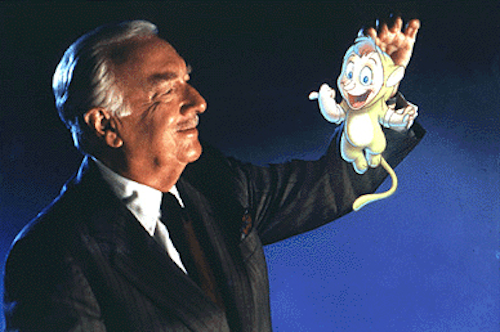
Ken officially retired in 1974, but would continue to consult on a variety of projects. He contributed to the films that became part of the World of Motion and Universe of Energy pavilions at Epcot and the short Back to Neverland, starring Robin Williams and Walter Cronkite, that was a staple of the animation tour at the Disney-MGM Studios for many years. He also spent time as a professor at CalArts, teaching the next generation of animation giants, including Brad Bird, John Lasseter and John Musker. In 1992, for his nearly four decades of making Disney animation the best in the world, Ken was declared a true Disney Legend. Six years later, the Australian reporter who reluctantly turned into an artistic heavyweight would pass away at home from natural causes. He was 90 years old.

Tuesday, April 23, 2019

April 20 - Betty Lou Gerson

Image courtesy otrcat.com
On this day, in 1914, Betty Lou Gerson was born in Chattanooga, Tennessee. Betty’s family spent most of her formative years in Birmingham, Alabama, where her father was a steel company executive. When she was sixteen, the Gerson clan moved to Chicago, Illinois and she got her first taste of performing on a radio show called The First Nighter Program. What made First Nighter different from other serials of the day is that it technically wasn’t a serial. It was the first anthology program meaning a new, complete story was presented each week. If you missed last week’s episode because your cousin was in town and wanted to see the sights, you won’t be confused as to what is happening in this week’s episode, a concept we’re used to but was novel in 1930. Romantic comedies were the usual fare on First Nighter and for the two years she spent with the show, Betty was frequently paired with a young Don Ameche.

Betty’s career didn’t really take off until she was 21 and living in New York City. For the latter half of the Thirties, she became a staple in several radio soap operas. She played the title role in Arthur Grimm’s Daughter, lead the cast as Julia in Midstream, was one of the main Lonely Women and appeared on the radio version of Guiding Light. It wasn’t all melodrama for Betty though, as she continued being the resident romantically comic lead (although some weeks she was comically romantic for a change of pace) on anthologies like Curtain Time and Grand Hotel.

Image copyright Disney
In the mid Forties, Betty changed locations by moving to Los Angeles but continued working in the medium of radio. She reestablished herself on the airwaves in dramas like The Whistler, Crime Classics, Mr. President and Johnny Modero, Pier 23. She also had several roles on Lux Radio Theater including a turn as Glinda the Good Witch in a 1950 production of The Wizard of Oz.

1950 was also the year Betty first became part of the Disney family, when she was cast as the narrator of Cinderella. Her most enduring contribution didn’t come until eleven years later when her voice burst into our eardrums as the deliciously over-the-top Cruella de Vil in One Hundred and One Dalmatians. She also played Mrs. Birdwell, a contestant on the show-within-a-movie, What’s My Crime, that Horace and Jasper watch while the Dalmatians escape from de Vil Manor. Her final Disney role was a rare live action one when she did a cameo in Mary Poppins as an old Crone.

Image copyright 20th Century Fox
Betty was seen on the big screen only a handful of times in her career. For instance, she played Nurse Anderson in the 1958 version of The Fly, Yvonne Kraus in the 1949 anti-communist propaganda film The Red Menace, Kate Peacock in 1959’s The Miracle on the Hills and a half dozen small, mostly uncredited roles in mostly B-Movie film noirs. She did about the same number of live action roles for television, appearing on Perry Mason three times and once each on The Twilight Zone, The Dick Van Dyke Show, Hazel, Wanted Dead or Alive and The Rifleman. In 1966, she retired from acting but not from working. When she married her second husband (her first husband had died the year before), she supported him at his telephone answering service.

In 1996, Betty was made an official Disney Legend not only for trying to skin puppies in the name of fashion but for making us love her as she did it. She came out of retirement just once, in 1997, to provide the voice of Frances the Fish in Cat’s Don’t Dance, the only animated feature ever produced by Turner Feature Animation. Just over a year later, Betty suffered a fatal stroke on January 12, 1999 at her home in Los Angeles. She was 84.

Thursday, February 21, 2019

February 15 - Cinderella

Image copyright Disney
On this day, in 1950, Walt Disney Productions' twelfth animated feature, Cinderella, had its world debut in Boston, Massachusetts. The Disney Studio had limped through World War II. With most foreign markets unavailable (and folks at home focused on making sacrifices for the war effort), the features Disney released during those years had failed to turn much, if any, profit. With a limited staff (most of the guys had enlisted), Walt cobbled shorts together into "package" films just to keep the place open. By the war's end, more than $4 million in debt threatened to force Walt into bankruptcy (again). As the boys returned home, Walt, desperate for a hit, turned attention to the land of fairy tales and implored them to dig up a diamond.

Walt's first take on Cinderella happened in 1922 when he produced a Laugh-O-Gram cartoon based on the French tale. In the early Thirties, he wanted to make a Silly Symphony of the story, but it quickly became apparent that it would be too hard to condense the narrative enough. In 1938, it was decided that Cinderella would probably make a good feature and work began on a script. Ideas were kicked around and refined over the next few years. Production was ready to start in earnest when most work the studio was doing was stopped by order of the United States Government. It wouldn't be until 1948 that Walt blew the dust off Cinderella's script and everyone sharpened their pencils once more.

Image copyright Disney
Cinderella marked the first film that all of Walt's Nine Old Men would work together on as supervising animators. It also marked the first film that Walt wasn't overseeing on a daily basis. He was in England off and on supervising the filming of the studio's first live action picture, Treasure Island.  While that gave the Men more autonomy, it also made the movie more expensive. Every time Walt would show up, he had all sorts of little changes he wanted done to work that was already finished. By October 1949, pencils and paintbrushes had finally been laid down and Cinderella was ready for her coming out party.

Image copyright Disney
The picture was Disney's biggest critical success since Dumbo and its biggest financial success since Snow White and the Seven Dwarfs. Cinderella grossed over $8 million and became the sixth highest grossing film of 1950. It did even better in England, coming in at fifth. Not only did Cinderella wipe out the studio's debt, it provided enough cash flow to last the rest of the Fifties. It received three Academy Award nominations (Best Sound, Best Song and Best Score) and won the Golden Bear (Music Film) at the first Berlin International Film Festival.

Since then, Cinderella has become a staple in the Disney family. She's spawned two animated sequels and a live action adaptation. She even has two castles, one in the Magic Kingdom at Walt Disney World and another in Tokyo Disneyland (never mind the fact that that upstart Aurora has three). She may not be the smartest or the most assertive Disney Princess, but she does possess that special something that means she'll be around for many more years to come.

Thursday, February 7, 2019

February 1 - Jimmy MacDonald

Image courtesy of wikipedia.com
On this day, in 1991, John James MacDonald passed away in his home in Glendale, California from heart failure. Born on May 19, 1906, Jimmy and his parents emigrated to America when he was one month old. After a fifteen day voyage across the Atlantic (I can only imagine how nerve wracking that was with a newborn) the family settled in Pennsylvania. As a young man, Jimmy showed an aptitude for music, especially the drums. He wound up getting a job as a musician on the Dollar Steamship Line (now known as American President Lines). Through his contacts there, he began performing on the recordings for the cartoons made by the Walt Disney Studio. In 1934, Jimmy became one of two people in Disney's newly formed Sound Effects Department, a job he would hold for the next 42 years.

Jimmy was a master at finding ways to produce the sounds that were needed for any given situation. Sometimes it was something as simple as flopping down in a chair in someone's office, liking the creaking noise the chair produced and commandeering the chair for his department. Other times Jimmy had to create gadgets in his workshop to get the sound he was looking for. He would build thousands of noise makers over the years to give life to everything from Evenrude's unique buzz in The Rescuers to the sound of the forest fire that take's the life of Bambi's mother.

Image copyright Disney
Early on in his tenure with Disney, Jimmy began providing voices as well as sound effects. As he put it, the studio could save money by not hiring actors since he was already there and getting paid anyways. It started out with some laughter here and a few barks there. Eventually he just kept getting asked if he could voice something particular, he'd say I don't know, they'd have him try it and he was usually great. For instance, during the long production process on Snow White and the Seven Dwarfs, it was decided at one point to have the dwarfs yodel during their party song. Jimmy was sent into the recording booth to test out a whole bunch of different yodels. Some professional yodelers were brought in for the official soundtrack. When a bunch of changes were made to the scene, rather than bring the professionals in and pay them again, Jimmy was sent back into the booth to record the new stuff. This sort of versatility lead to continuously bigger roles.

Image copyright Disney
The story of how Jimmy landed his biggest role is just as casual. While production was going on for Mickey and the Beanstalk, a short that eventually became part of Fun and Fancy Free, the crew called Walt in to record Mickey's lines. Walt claimed that he just didn't have time for this sort of thing anymore (although his smoking habit was making it increasingly difficult to produce Mickey's falsetto) and they should just call Jimmy. Someone did and said Walt needed to see him. Jimmy tried to think of what he'd done all the way to Walt's office. When he got there, Walt asked him if he'd ever tried to do Mickey. Jimmy said of course not. Walt said give it a try right now. Jimmy worked up his best Mouse and said "Hi Walt, how are you?" Walt said sounds good, gave him a few pointers and sent him off to the booth. He would be the voice of the Boss until 1977.

Image copyright Disney
There have been plenty of other times you've heard Jimmy. For features, he did both Jacques and GusGus in Cinderella, the Dormouse in Alice in Wonderland, the wolf in Sword in the Stone and the hyena in Bedknobs and Broomsticks. In shorts, he played all sorts of animals, from Delores the Elephant to Humphrey the Bear. He only appeared twice in live action parts. He was the Circus Band Drummer in 1960's Toby Tyler and he is seen in silhouette as the timpani player in Fantasia. Outside of work he joined Ward Kimball's jazz band, the Firehouse Five Plus Two, as their drummer.

Image copyright Disney
Fans of the Monster Sound Show, the original sound effects show at the Disney-MGM Studios, might remember seeing Jimmy. The pre-show that played in the queue area was a piece he did with David Letterman, showcasing many of the homemade noise makers he'd made over the years. He even did a little bit of Mickey, even though by that point he'd handed those reigns over to Wayne Allwine (who also started out as a sound effect man). Jimmy had officially retired from the company in 1977. And by retired, I mean there was often several weeks in a row when he didn't come into the studio to consult on a project. In fact, when he passed away fourteen years later, he was preparing sounds that would be used in Splash Mountain. In 1993, Jimmy was posthumously declared an official Disney Legend, even though he was truly one of the few people who are widely regarded as such long before their final curtain.

Friday, January 18, 2019

January 12 - Marc Davis

Image copyright Disney
On this day, in 2000, Marc Fraser Davis passed away in Glendale, California. Marc began life about a hundred miles north of the place he ended it. Born on March 30, 1913 in Bakersfield, California, he was a Californian through and through. Well, mostly. While he attended art classes at the California School of Fine Arts in San Francisco and the Otis Art Institute in Los Angeles, he actually graduated from the Kansas City Art Institute in Missouri. Needless to say, he didn’t spend much more time in Middle America than his schooling took but his presence there at all probably helped start his career working under one of the area’s most famous sons.
Coming on board the Disney juggernaut in 1935, Marc quickly earned the admiration of his fellow animators. Ollie Johnston recalled that, while several people contributed to the design of Snow White, it was Marc who made her walk in grace and beauty.

Marc wasn’t just good at bringing women to life. The consummate draftsman also made animals more believable. It started with his work on Bambi, Faline and Thumper in Bambi. He then gave us Br’er Rabbit, Br’er Fox and Br’er Bear in Song of the South. Bongo in Fun and Fancy Free and Mr. Toad in The Adventures of Ichabod and Mr. Toad round out his furry contributions to the Disney family.  

Image copyright Disney
But truth be told, it really was drawing women where Marc excelled the most. He was so good at grace and beauty, he would often be given the difficult task of animating either the heroine or the villainess in a picture. Over the years, not only did he join Ollie as one of Walt’s Nine Old Men, he earned himself the nickname of Disney’s Ladies Man. Name a major female character from the Fifties and it’s almost a guarantee that Marc animated her. Cinderella, Alice, Tinkerbell, Aurora and Maleficent, and, lastly, Cruella de Vil (who technically didn’t appear until the early Sixties), were all created under Marc’s steady hand. Then, when One Hundred and One Dalmatians wrapped up production, he gave up animation forever.

As the Sixties began, Disneyland was almost constantly being updated and expanded and a huge amount of effort was being put into several projects for the upcoming World's Fair. WED Enterprises (the precursor to Imagineering) was designing and building almost more attractions than they could handle. Marc had made some contributions during the late Fifties to Adventureland's Jungle Cruise and the Mine Train Through Nature's Wonderland. As the excitement in the department continued into the new decade, he decided to devote the rest of his career to designing characters and writing stories for the theme park instead of the silver screen.

Image copyright Disney
Marc still applied the same techniques in his new role. He still spent hours developing characters for an attraction and would use storyboards to plan out what guests would experience. His dedication payed off. As the technology behind Audio-Animatronics developed and matured, Marc would become a master at using them to tell stories. His first big project to open after his career shift was the classic show found in The Enchanted Tiki Room. For the 1964 World's Fair, he had a hand in all four of the attractions that Disney built: Ford's Magic Skyway, Great Moment's With Mr. Lincoln, It's a Small World and The Carousel of Progress.

When the World's Fair was safely behind them, Imagineers returned to creating new experiences for Disneyland. Marc's designs can be seen throughout both Pirates of the Caribbean and the Haunted Mansion, both of which opened in New Orleans Square. He then lent his style to the Country Bear Jamboree and America Sings, which was the replacement attraction for his earlier work Carousel of Progress.

Image copyright Disney
The last several years of Marc's career were spent developing an attraction that was never quite built. It was to occupy a massive area in Frontierland at the Magic Kingdom in Florida. Known as the Western River Expedition, it was supposed to be Florida's answer to Pirates of the Caribbean since, Disney executives reasoned, Floridians wouldn't be interested in pirates because the state was practically built by them. Instead, Marc designed a Western themed ride that would involve buffalo, a stagecoach robbery, a Native American adobe village, and a show with saloon girls, a bank robbery and plenty of cowboys. A mine train roller coaster would be housed in the same show building (yes, it would be the largest one Disney had ever built). From the outside, the building would look like and be called Thunder Mesa Mountain. From all accounts, it would have been a spectacular thing to see. So what happened?

Image copyright Disney
Guests to the Florida Project had one complaint they could all agree on, that's what happened. The question "Where are the pirates?" became the one most asked after the Magic Kingdom opened. So Disney hastily built a version of Pirates of the Caribbean, using a large chunk of the money allocated for Marc's Expedition. Then an economic downturn hit the country. Then Big Thunder Mountain Railroad (part of the plans for the attraction from the beginning) was built using most of the land that was to go to Expedition. And that was basically it. All the sketches and models that Marc slaved over were relegated to the research vault. Not to despair too much, though. Plenty of Imagineers have snuck elements of Marc's designs into other attractions including Splash Mountain and Expedition Everest, and I'm sure will continue to do so as often as they can.

In 1978, Marc retired after an incredible 43 year career with the Walt Disney Company.  He was named an official Disney Legend in 1989 for all of his iconic contributions to both the world of animation and beloved attractions that endure to this day. Shortly after he passed away, he was honored once more when CalArts established the Marc Fraser Davis Scholarship Fund, ensuring that creative genius will be able to flourish far into the future.

Friday, January 11, 2019

January 8 - Iwao Takamoto

Image courtesy of illustrationhistory.org
On this day, in 2007, Iwao Takamoto passed away from a heart attack in Los Angeles, California. Born in the same city on April 29, 1925, Iwao graduated from Thomas Jefferson High School when he was just 15. Shortly thereafter, Pearl Harbor was bombed, World War II began and Iwao's family was imprisoned in the Manzanar internment camp with tens of thousands of other Japanese Americans. Luckily for him (and for us), he learned the basics of drawing, illustration and animation from two of his fellow prisoners.

When the war ended, Iwao decided to apply for work at the only animation studio he knew the name of, Disney. He was told to submit his portfolio. Having been imprisoned for the four years prior, he of course didn't have one. He bought two notebooks and spent a weekend filling them with sketches of literally everything he saw. Those sketches did the trick and he was hired as an assistant animator in 1945. Iwao contributed to several features during his sixteen years with the company, both as animator and as character designer. He would spend a good deal of his Disney career working directly under Milt Kahl, one of Walt's Nine Old Men, on projects like Cinderella, Peter Pan, Lady and the Tramp, Sleeping Beauty and 101 Dalmatians.

Image copyright Disney
In 1961, Iwao left Disney to join Hanna-Barbera Productions. As cartoon television series seemed to bloom on every network throughout the rest of the decade, Iwao left his indelible mark on the genre. He would hold several positions at Hanna-Barbera but his work as a character designer remains the most visible and therefore most impressive. His highlights reel started with Astro, the Jetson's dog in 1962. A few years later, his next big hit was Penelope Pitstop, who starred in Wacky Races and its spinoff show, The Perils of Penelope. But his most enduring character by far is another canine, Scooby-Doo.

Image copyright Hanna-Barbera
When asked how he came up with Scooby's look, Iwao once said that a woman at the studio owned great danes and enthusiastically showed him pictures of them, pointing out all their features. He then drew every aspect of the dogs the opposite of what they were in reality. Instead of a straight back and legs and a small chin, Scooby got a hump back, bowed legs and a large mug. Iwao even purposely made him the wrong color. And yet it somehow all works. Michael Mallory, a Hanna-Barbera historian, makes the claim that if Scooby had looked any different, more like an actual Airedale say, the show probably wouldn't have lasted more than one season. Instead, because of Iwao's genius, Scooby had been on a screen, big or small, almost continuously since his creation.

Image copyright Hanna-Barbera
Iwao would eventually move into the director's chair. One of his biggest projects was the 1973 feature film, Charlotte's Web, which he co-directed with Charles Nichols. He once said one of the hardest things he ever did was creating a spider with a look that inspired people to care about it. The film, which featured songs by the Sherman Brothers, received mixed reviews, with most critics calling out the obviously quick television type animation. But, really, what else would you expect from Hanna-Barbera?

After producing series like The Smurfs, The Addams Family and Hong Kong Phooey, Iwao would settle into the role of Vice President of Creative Design. He was in charge of all of Hanna-Barbera's merchandise and oversaw all the design work going on in the Animation Art Department.  When Time-Warner merged with Hanna-Barbera's parent company, Turner Broadcasting in 1996, Iwao became Vice President of Special Projects for Warner Brothers Animation. He held this position for the remainder of his career.

Iwao received two major honors from his peers during the latter part of his life. The first came in 1996 when he was given the Windsor McCay Award, a lifetime achievement statue given out each year at the Annie Awards. The second came in 2005 when the Animation Guild bestowed upon him their Golden Award for his more than five decades in the field. The ultimate honor, though, may have happened when he passed away in 2007. For the next week, Adult Swim, on the Cartoon Network, displayed "Iwao Takamoto (1925-2007)" as one of their bumpers. I think Iwao would have approved.

Thursday, November 22, 2018

November 19 - Eleanor Audley

Photo courtesy of Flickr.com
On this day, in 1905, Eleanor Zellman was born in New York City, New York. Not much is known about her birth or her early life. What we do know is that at the age of 20 she made her Broadway debut in 1926’s Howdy, King, changing her name to Eleanor Audley. For the remainder of the Twenties and all of the Thirties, Eleanor regularly appeared on stage in such shows as 1933’s Pigeons and People, 1934’s Ladies’ Money and 1937’s Susan and God. She made the transition to radio in the Forties, with recurring roles on My Favorite Husband, The Story of Dr. Kildare and Father Knows Best. She even played Cinderella’s stepmother for Hallmark Playhouse.

Photo copyright Disney 
Eleanor’s film career began in 1950 with Three Secrets and Gambling House as she continued her tradition of playing rather snobbish and overbearing characters. Just four years later she would roll onto the small screen, showing up on shows ranging from I Love Lucy to Perry Mason to Mister Ed. Her most famous television role was on Green Acres as Eddie Albert’s disapproving mother, a bit of a stretch since she was only five years older than Eddie.


Photo copyright Disney
Eleanor made three fabulous contributions to the Disney family. She first played Lady Tremaine in Cinderella. It wasn’t exactly a reprisal of her radio effort in the same role but the earlier production probably helped. She next turned up the villain dial as Maleficent in Sleeping Beauty. For both of the evil ladies, Eleanor was not only filmed as the live-action model for the characters but the animators designed their looks to closely resemble her. For her third Disney role, Eleanor went less overtly evil as the voice of Madame Leota in the Haunted Mansion.

Eleanor passed away on November 25, 1991 in North Hollywood, California from respiratory failure. She was 86.