Showing posts with label Lady and the Tramp. Show all posts

Tuesday, August 6, 2019

August 4 - Don DaGradi

Image courtesy pinterest.com
On this day, in 1991, Don DaGradi passed away in Friday Harbor, Washington. Born on March 1, 1911, on the East Coast in New York City, Don actually spent most of his childhood growing up on the West Coast in San Francisco, California. After graduating from high school, he took his artistic talents south to Los Angeles and the Chouinard Art Institute. He honed his skills for a few years before joining the Walt Disney Studio in the mid-Thirties, at the height of the Great Depression, as a background painter. He was quickly bumped up to the Story Department, where he contributed gags and minor plot points to many of the studio’s shorts produced at the time.

Image copyright Disney
As the studio grew, Don's responsibilities grew as well. By 1940, he was the production designer on Dumbo. Throughout World War II, he was put in charge of layouts for in the Shorts Department (really the only thing the studio was producing in those lean years). His work can be seen in classic films including Der Fuehrer’s Face and Victory Through Air Power. Following the war, Don added features to his plate as the layout artist for The Three Caballeros, Make Mine Music and Fun and Fancy Free.  At the end of the Forties, he started designing the color schemes and the overall feel of features. He sharpened the look of The Adventures of Ichabod and Mr. Toad, Cinderella, Alice in Wonderland and Peter Pan.

Image copyright Disney
As successful as all of Don’s endeavors were up to this point, he didn’t really start hitting his stride until he became a senior member of the story department in the mid-Fifties. He has a full story credit on Lady and the Tramp and contributed additional story elements to Sleeping Beauty (as well as being part of that production’s design team). Then, in 1959, he made the leap into live action movies and blossomed like never before.

Don’s Legendary co-workers, the Sherman Brothers, once said that he wrote scripts with a sketch pad and pencil, meaning that Don’s pictures were worth more than a thousand words. He could draw a quick picture of what a scene looked like in his head and everyone else could see it too. Pages of words could flow from each drawing, most of the time with very little effort. Don’s first effort in the live action arena was at Walt’s personal request. He designed and wrote the underground cavern scenes in Darby O’Gill and the Little People. He followed that up by developing sequences in The Absent-Minded Professor, Pollyanna, Kidnapped and The Parent Trap. For the sequel to Professor, Son of Flubber, Don teamed up with the Legendary Bill Walsh, completely writing that film’s script between the two of them. It was a professional match made in heaven that would last until Don’s retirement nearly a decade later.

Image copyright Disney
After Flubber, Don and Bill created the script for what is arguably the Walt Disney Studio’s magnum opus, as far as live action films go. Mary Poppins turned out to be as whimsically delightful as it is because of the two men wrote it. Don is credited with creating the visions of everything from people popping out of chimneys and flying through the air to how a tea party on the ceiling might look. His sense of wonder paid off. Audiences have adored the film since its debut and it was honored with five Academy Awards. Don and Bill’s script had also been nominated for an Oscar but lost out to Beckett.

Image courtesy davelandblog.blogspot.com
The overwhelming success of Mary Poppins basically gave Don and Bill carte blanche as screenwriters. While they would never reach those same heights again, they add several more classic Disney films to their resumes. Over the next seven years, the duo wrote Lt. Robin Crusoe, U.S.N., Blackbeard’s Ghost, The Love Bug, Scandalous John and Bedknobs and Broomsticks.

During his career, Don was also tapped to occasionally do some moonlighting over in Imagineering. He designed costumes for Disneyland cast members including the outfits the resident marching band wore. He also designed the look of the exteriors of attractions, like Mr. Toad’s Wild Ride, keeping them in line with the looks he helped create for the animated features they were based on. And then, in 1970, after 34 years of making magic on and off the silver screen, the man who often described himself as a misplaced cartoonist retired from Disney.

Image courtesy flckr.com
Don and his wife of many years, Betty, moved north to the state of Washington, enjoying their post-work life away from the hubbub of Hollywood for the next two decades. When Don passed away in August 1991, it was just a few months before his old company would honor him, and his writing partner Bill, as official Disney Legends. He might have been 80 years old at his death, but in his heart he still saw magic everywhere he looked.


Wednesday, May 29, 2019

May 27 - Ken O'Connor

Add caption
On this day, in 1998, A. Kendall O'Connor passed away in Burbank, California. Born on June 7, 1908 in Perth, Australia, Ken began his professional career at the age of 16 as a reporter for the newspaper his father owned. At some point, someone died (he can’t remember who) and no one had a picture of them for their obituary. Ken drew a better than passing portrait of them and became the paper’s resident artist as well. As his interest in art grew, he began taking classes, selling the cartoons and oil paintings his studies produced for spending money. In 1930, Ken’s father started working for the Australian National Travel Association and the whole O’Connor clan moved to San Francisco, California to promote tourism to the Land Down Under. Ken continued his art education at the California School of Fine Arts (now known as the San Francisco Art Institute) and earned money by becoming the art director for a local poster company.

Image copyright Disney
In 1935, the Walt Disney Studio was desperately hiring artists in order to have a staff that could actually create a feature length Snow White and the Seven Dwarfs. Ken’s father encouraged his reluctant son to apply. He was quickly hired as an inbetweener and just as quickly moved into the special effects department. His main job was to be a rotoscoper. Rotoscoping is a process where you make a live action movie of something you want your animated character to do (like dancing) and then make rough tracings of each frame of film. Those rough drawings then get handed off to animators, overdrawn with the character and cleaned up, giving you a much more realistic representation of action than freeforming would. It’s a very tedious process but was probably the best way young Ken could have ever learned about how the process of animation differs from a still life painting. And learn he did.

Image copyright Disney
Following the release of Snow White, Ken became an assistant in the layout department. His first project was the 1937 short Clock Cleaners. Because a Mickey Mouse short can be a lot less realistic than Walt wanted his features to look, Ken could take a lot of artistic license to achieve the effects he wanted. Or as he put it, having learned the rules of perspective at art school, he could violate all of them to make the picture much more dramatic. So he did and everyone noticed. Ken’s incredible work on Clock Cleaners marked the beginning of a brilliantly long career in layout, an area of animation most people don’t even know exists.

Image copyright Disney
A layout artist is quite literally in charge of how you will see everything in an animated movie. They create the backgrounds, or sets, that the action will take place in. They also work with directors to decide what angle the audience will see things from. In live action, a scene can be shot from multiple angles and then cut differently if the first take isn’t something the production team likes. Animation is completely different. If the angle of a scene doesn’t work for some reason, there isn’t different footage that can be spliced in to fix it. What you have is the only thing that was painstakingly drawn. If you look at it and decide it would be better to, say, see a character from the side view instead of dead on, you have to restart the scene from scratch. In the days of hand drawn animation, it was cost prohibitive to do even a small amount of redraws. Determining all that beforehand is the only way to do it. It’s better now with computers and 3D rendering and all that, but even now, better is a relative term.  A good layout artist was and is crucial to creating successful animated movies. It turned out that Ken wasn’t just good, he was one of the best.

Image copyright Disney
For Pinocchio, Ken crafted the overhead shot of the puppet being led astray by Foulfellow and Gideon, parading through the streets of the town. He filmed some live action reference footage to help with that one. For Cinderella, he designed and built a detailed model of the pumpkin coach, which was approved by Walt with zero (that’s right zero) changes, becoming the coach that’s seen in the film. Having the model improved the action of those scenes immensely. For Lady and the Tramp, Ken knew it was going to be important to be able to show things from Lady’s perspective and shot all sorts of reference film from about a foot and a half off the ground. For Alice in Wonderland, he spent hours working out the proper horizons and vanishing points and multiple perspectives for all the scenes featuring playing cards, knowing that if just one of them was off, the whole scene would look wonky. All told, Ken would work on 13 of the 21 animated features that were released during his years with Disney, making invaluable contributions to each and every one of them.

Image copyright Disney
Ken wasn’t only good at camera angles, he was good at coming up with new techniques as well. For the Trees segment of Melody Time, he suggested using pastels on the cels and then coating them with lacquer to keep them from smudging to get the unique look of that scene. In Dumbo, when Timothy and Dumbo get drunk, he knew it would be nearly impossible to keep the colors of the pink elephants consistent. What you are actually seeing there is the color of the background. Each individual cel is painted all black except for an elephant shaped clear spot. A simple but highly effective solution. For the Dance of the Hours segment in Fantasia, he deliberately changed the general motifs of the animation each time the music entered a new movement, going from vertical shapes to elipses to diagonals.

Image copyright Disney
The Shorts Department didn’t let Feature Animation hog all of Ken’s talents over the years. He was part of the teams that created classics like Toot, Whistle, Plunk and Boom, The Whale Who Wanted to Sing at the Met and several of the educational shorts like 1946’s The Story of Menstruation.

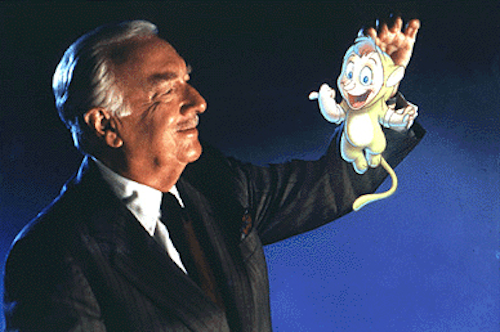
Ken officially retired in 1974, but would continue to consult on a variety of projects. He contributed to the films that became part of the World of Motion and Universe of Energy pavilions at Epcot and the short Back to Neverland, starring Robin Williams and Walter Cronkite, that was a staple of the animation tour at the Disney-MGM Studios for many years. He also spent time as a professor at CalArts, teaching the next generation of animation giants, including Brad Bird, John Lasseter and John Musker. In 1992, for his nearly four decades of making Disney animation the best in the world, Ken was declared a true Disney Legend. Six years later, the Australian reporter who reluctantly turned into an artistic heavyweight would pass away at home from natural causes. He was 90 years old.

Sunday, May 26, 2019

May 25 - Barbara Luddy

Image courtesy mubi.com
On this day, in 1908, Barbara Luddy was born in Great Falls, Montana. Information about Barbara's early life is scarce, but we do know that she did some singing on the vaudeville circuit as a child and was educated at the Ursuline Convent there in Great Falls. She broke into silent movies in 1925 as Janet in Columbia Pictures' An Enemy of Men. She would appear in several more films over the next few years before becoming a world traveler as part of the cast of an Australian production of Lombardi, Ltd in 1929.

Barbara began a prolific career in radio upon her return to the United States. Her longest running role was as lead female for seventeen years on The First Nighter Program, a show generally credited with being the first to run a different, complete story each week. She starred opposite Les Tremayne from 1936 until 1943 and then opposite Olan Soule until the program went off the air in 1953. Barbara was also part of the cast of the more dramatic Chicago Theater of the Air, played Veronica Gunn in the comedic Great Gunns and appeared on several soap operas, including Lonely Women, The Road of Life and Woman in White. As radio began to give way to television, she had a handful of appearances on early shows like Hazel and Dragnet, but nothing much beyond that.

Image copyright Disney
Barbara joined the Disney family in 1955 when as the original voice of Lady in Lady and the Tramp. She returned four years later as Merryweather, the blue fairy, in Sleeping Beauty. For 1961's One Hundred and One Dalmatians she brought Rover to life and played the dual roles of Mother Rabbit and Mother Sexton in 1973's Robin Hood. Her longest running role for Disney started in 1966. Debuting in Winnie the Pooh and the Honey Tree, Barbara brought the mother figure of the Hundred Acre Wood, Kanga, to life for the next eleven years, including the shorts Winnie the Pooh and the Blustery Day, Winnie the Pooh and Tigger, Too and the combined feature The Many Adventures of Winnie the Pooh in 1977.

Barbara passed away on April 1, 1979 in Los Angeles, California from complications brought on by lung cancer. She was 70 years old.

Tuesday, May 14, 2019

May 13 - Burny Mattinson

Image courtesy d23.com
On this day, in 1935, Burnett Mattinson was born in San Francisco, California. Burny’s father, Bernie (the spelling of the second syllable is the only way to keep them apart), was a jazz drummer who later became a session drummer for Elvis Presley. When Burny was five, he saw his first animated film, Pinocchio, and fell completely in love with the medium. Every waking minute was spent drawing Disney characters on everything and dreaming of one day getting paid to do it. In 1945, Burnie’s jazz band broke up and he moved the family moved to Los Angeles. Burny barely made it through high school before he applied for a job at the Walt Disney Studio. In classic movie style, he was hired as part of the mail room in 1953, although he dreamed of one day actually meeting an animator. It didn’t take long for him to exceed his wish and actually become one.

Image copyright Disney
Burny got the opportunity to become an inbetweener in the Features Department in 1954. His first project was Lady and the Tramp. By 1959, he was an assistant animator for Sleeping Beauty. Following the end of production on 1961’s One Hundred and One Dalmatians, Burny became number two to Eric Larson, one of Walt’s Nine Old Men. The pair worked together on The Sword in the Stone, Mary Poppins, The Jungle Book and The Aristocats.

Image copyright Disney
By the early Seventies, Burny, who’d never had any formal art training, was good enough to be on his own. He was a full-fledged character animator on Robin Hood and Winnie the Pooh and Tigger Too. As the decade came to a close, Burny moved from the animation desk to the Story Department. He was a lead storyboard artist for The Rescuers and received a story by credit for The Fox and the Hound.

Burny expanded the number of hats he wears by adding producer and director on Mickey's Christmas Carol, the first original Mickey Mouse cartoon to be released in theaters in three decades. He contributed a few story elements to The Black Cauldron but mostly stayed away from that mess by concentrating on the alternative project that a large chunk of the staff was doing, The Great Mouse Detective. Burny started out as a co-director on Mouse with John Musker, but when Michael Eisner became studio head partway through production and cut the budget and moved up the release date, he became the film's producer and John co-directed with Ron Clements for the first time. Since Mouse, Burny has worked as a story man, starting with most of the movies that made up the Disney Renaissance, including Beauty and the Beast, Aladdin, The Lion King, Pocahontas, The Hunchback of Notre Dame, Mulan and Tarzan.  

Image courtesy d23.com
In 2008, Burny was declared an official Disney Legend, but even though he'd been with the company for five and a half decades at that point, the honor may have been given a little prematurely. He was made senior story supervisor on the 2011 Winnie the Pooh feature, returned to doing storyboards for Big Hero 6 in 2014 and did it again for Zootopia in 2016. You see, Burny still works at Disney full time, even today. He is officially the longest continuous cast member in the company's history. They had to make a special statue for his 65th anniversary last year because no one had ever made it that far before. And he still loves coming in to work every day. Will he retire anytime soon? Well, he's has an idea for another feature length vehicle for Mickey that he's been trying to get made for a while now. So if that project gets the green light, maybe. But until then, someone better start designing his 70th statue...

Monday, May 13, 2019

May 11 - Albert Hurter

On this day, in 1883, Albert Hurter, Jr. was born in Zurich, Switzerland. The eldest of three sons, Albert was inspired to become an artist by his father, a technical drawing teacher at Zurich’s Berufsschule. At a young age, he was diagnosed with rheumatic heart disease, brought on by rheumatic fever (which can occur after getting strep throat). The series of diseases is something that would be easily curable by the early 1900’s, but which did irreversible damage to Albert’s heart, not killing him outright, but shortening his life considerably. Luckily, the disease didn’t keep him from living in the meantime.

Image courtesy wikipedia.com
In 1903, Albert moved to Berlin to begin his formal art training. He studied diligently for seven years, returning to Switzerland shortly before Albert Senior died. Partly to escape from the overwhelmingly fond memories of his father (and partly because that’s where an exciting new art form was starting to explode), Albert soon moved to America, taking up residence in New York City. He began working in animation at the Barre-Bower Studio on the Mutt and Jeff shorts in 1912. Six years later, he suddenly left Barre-Bower (and the animation business altogether), apparently over continuous disagreements with his fellow co-workers (although what exactly those fights were supposedly about, no one really knows).

Image courtesy bpib.com
Albert moved west to Southern California. For the next decade he eked out a living, designing clothes, furniture and magazine layouts for whoever would pay him. In 1931, he reconnected with Ted Sears, an old co-worker from his Barre-Bower days, who was then working for the Walt Disney Studio. Disney was always looking for new talent and hired Albert on Ted’s word. It quickly became apparent that Albert was a genius when it came to anthropomorphizing both animals and objects. Walt moved him into the Story Department (which, including Albert, now had three members) and turned him loose. Albert also sketched quickly and with great proliferation. Given a simple story idea (like "The Three Little Pigs"), he could go into seclusion for days, coming out the other side with dozens (if not hundreds) of characters, gags, settings, props, animal sidekicks, etc.

Image courtesy pinterest.com
Albert worked mostly on the Silly Symphonies, but when features came along, his fingers are all over Snow White and the Seven Dwarfs, Pinocchio, Dumbo and Fantasia. It's almost impossible to overstate how many characters that came out of the studio in the Thirties and early Forties had their origin in Albert's brain. It's as equally impossible to pinpoint specific bits of animation that can be considered 'Albert's,' since most of his work was more on the concept end. Not only could he come up with all sorts of variations on a theme, his sketches often inspired the animators around him to explore new directions and themes. And the grounding he got in classic art back in Berlin elevated everything Disney did to artistic heights Mutt and Jeff could only dream of.

image courtesy bpib.com
One of the few characters that didn't change a whole lot from his early sketches was the first Disney Princess, Snow White. He nailed her right from the beginning. A big chunk of his ideas, though, ended up getting used on different projects from the one that gave birth to them. One general rule of thumb around the studio was that nothing Albert drew should ever be thrown away because eventually a project will come along that it will be perfect for. Albert's weak heart finally give out on him on March 28, 1942, but his sketches would continue to influence the look of Disney films for over a decade longer, showing up in Peter Pan and Lady and the Tramp.

In his will, Albert, who never married or had any children, designated money to publish a book of his work, leaving it up to his old pal, Ted Sears, to make it happen. Ted toiled away faithfully and honored his friends last wish. Seven years after Albert's death, He Drew As He Pleased was published, featuring over 700 of his doodles, drawings and incredible concepts. I've only seen a fraction of what's in it but what I have seen is absolutely delightful (it is out of print but copies are available on Amazon for around $250). I really get the feeling that if Albert had lived longer or been slightly later in Disney history, made it past World War II perhaps, he would be better known. But, regardless of his lack of fame, his talent and influence are undeniable. Without Albert, the Disney we know and love, might never have existed.

Wednesday, May 8, 2019

May 6 - Joe Grant

Image courtesy disney.fandom.com
On this day, in 2005, Joe Grant passed away in Glendale, California. Born on May 15, 1908 in New York City, Joe and his family moved to Los Angeles, California when he was two. His father was a newspaper art editor, which gave Joe exposure to the possibilities of the art world from an early age. Following high school, Joe attended classes at the famed Chouinard Art Institute. His first professional gig was drawing caricatures of celebrities for a local newspaper. One of the readers of that paper was Walt Disney, who was impressed enough with Joe’s style to invite him to submit some caricatures for incorporation into the 1933 short Mickey’s Gala Premier.

Image copyright Disney
The success of Joe’s work in Gala led to him being offered a full time job with the Walt Disney Studio as production on Snow White and the Seven Dwarfs was ramping up. Joe was given the task of designing the Queen and her alter ego, the Wicked Witch. Supposedly the old hag’s appearance (but not, presumably, her evil intent) was fashioned after a woman who lived across the street from Joe at the time. He continued working on character designs for Pinocchio before switching over to the story department when production began on Fantasia. Not only did Joe help develop the plot of several of the segments in Fantasia, he assisted in helping Walt and Leopold Stokowski choose what music would be used in the first place.

Image copyright Disney
Joe received credit for co-writing the script on his next two films, Dumbo and Saludos Amigos. As World War II raged on, he went back to the Shorts Department (of course so did everyone else, really; even the features during that period were just shorts that had been cobbled together). His input can be seen in the propaganda shorts The New Spirit, Reason and Emotion and the Academy Award winning Der Fuehrer’s Face. Following the war, Joe served as Production Supervisor on Make Mine Music. He then began working in earnest on a story he’d first conceived of in 1937. While watching the antics of his English springer spaniel after his daughter was born, he made some sketches and wrote a bare bones plot for a film that was known for years as Lady, after his spaniel. Even though Joe tinkered with the story off and on for almost a decade, Walt was never quite satisfied with the direction it was taking. After reading a 1945 short story, Happy Dan, the Cynical Dog, Walt thought that merging it with Joe’s story just might do the trick and Lady and the Tramp was born.

Image courtesy one1more2time3.wordpress.com
Joe didn’t stick around to see his story develop into a classic film, though. He left Disney in 1949, six years before Lady hit theaters, but not because of any animosity or hard feelings. Wanting a new challenge in his life, Joe left to open his own ceramics studio. Some years later, he started up his own greeting card company. Throughout the years, no matter what else he was doing, he would still occasionally come over to the Disney lot to consult on a character’s design or a particularly sticky situation in a movie’s plot, chat with the boys and then return to his pots or cards.

In 1989, when Joe was 81, the age when most people have long since retired, he was apparently looking for another new challenge. Whether it was because the Disney Renaissance was just starting to hit its stride making animation exciting again or Joe just missed the good old days, he returned to work at Disney, forty years after he left. And not just on a consulting basis, but actual full time work. He would come into the studio at least four days a week from then until his death, over fifteen years later.

Image copyright Disney
Joe became part of the Visual Development team on Beauty and the Beast. From there he added Character Design back into his repertoire and did both tasks on The Lion King, Pocahontas, The Hunchback of Notre Dame, Hercules and Tarzan. He added to the stories of Mulan and Lilo and Stich and came up with the concept of giving yo-yos to a flock of flamingoes for the Carnival of the Animals sequence in Fantasia 2000 (making him the only person to contribute new material to both Fantasia movies). In 1992, long before he was done making significant contributions to the company but decades after he had started, Joe was declared an official Disney Legend

Image copyright Disney
Joe’s final project was a short called Lorenzo, which he thought up after observing another pet of his, this time a cat, after it had been in a fight with two poodles. He thought What would happen if my cat lost its tail and what would that look like set to tango music?  Lorenzo was initially supposed to be part of a third Fantasia film, but when that project fell apart it was released on its own in 2004. The following year it received an Oscar nomination and won the Annie Award for Best Animated Short. Just over two months later, Joe was sitting at his drawing desk at home (it being one of the few days he didn’t go to the studio), doing one of the things he loved most in this world, when he suffered a fatal heart attack. The Legendary story man was just nine days short of his 97th birthday.

Wednesday, April 17, 2019

April 16 - Victor Haboush

Image courtesy cartoonbrew.com
On this day, in 1924, Victor Haboush was born in Cleveland, Ohio. When Victor was just one, his family moved to Indianapolis, Indiana where his father, a Lebanese immigrant, opened a grocery store. Like most teens whose parents own a business, Victor and his brothers got to spend many an hour working (or as he put it, slaving) away with dad. Joining the Coast Guard part way into World War II didn’t mean less work, but it did mean a change of location. Victor ended up being part of the forces that stormed the beaches of Normandy and, once he’d survived that ordeal, switched theaters and spent the remainder of his tour in the Pacific. One of his brothers wasn’t so lucky; he suffered a mortal wound at Leyte. During the war, Victor’s parents moved to Los Angeles, so after he was discharged, he moved into their new home and began attending the Art Center College of Design in Pasadena on the G.I. Bill.

While toiling away at his classes, Victor’s teacher and mentor, Lorser Feitelsen, introduced him to Eyvind Earle, a former Art Center student and current background artist at the Walt Disney Studios. Eyvind was impressed with Victor’s talent and submitted his name to the powers that be at work. The studio was desperately looking for new blood and hired him as an inbetweener at $35 a week. One week into his new job, when it became apparent just how well he could draw, Victor was transferred to the Layout Department and his salary jumped to $160 a week (a mind boggling sum to his dad, especially when all they were asking him to do was draw). He started in his new position in March 1952 on the very tail end of production on Peter Pan.

Image copyright Disney
Victor’s first real project, and his first screen credit, came on the next animated feature, Lady and the Tramp. He then teamed up with Ward Kimball on two shorts from the Adventures in Music series (okay, it was supposed to be a series but only two were ever produced): Melody and Toot, Whistle, Plunk and Boom. The latter film won the 1954 Academy Award for Best Short Subject (Cartoon) and is still frequently shown in classrooms today to teach kids about the different kinds of instruments. Victor rounded out the Fifties working under Wilfred Jackson on Sleeping Beauty. He estimates he spent over six months just drawing the thorn forest (and another several weeks trying to teach others the proper way to depict thorns growing).

Image copyright Disney (not that they'll admit it)
Victor was also a part of Disney’s short lived Commercials Department in the mid Fifties. Working closely with Tom Oreb, he produced ads for Cheerios, Hudson cars and Peter Pan peanut butter, among other products. Walt never cared for the work the department did and shut the department down only months after starting it up (reportedly to give his niece something to do).

By the time he was neck deep in thorns, Victor had already begun doing some freelance work, mostly on television commercials. In 1960, after doing some very early concept drawings for 101 Dalmatians, he left Disney to join Hanna-Barbera as one of the first folks on team producing The Flintstones. Unfortunately, he didn’t get along with Bill Hanna and he took a lot longer to get things done than his new studio could afford (no spending six months on thorns here), so he got fired only a few weeks into the job. While he would occasionally return to do a bit of work on The Flintstones or The Jetsons, and was instrumental in developing the Mr. Magoo series for television over at United Productions of America, Victor mostly used his newfound unemployment as a catalyst to start his own company.

Image courtesy youtube.com
In the mid-Sixties, Victor Haboush and Associates burst onto the commercial scene. Over the next thirty years, Victor would create over 1,500 ads for a wide variety of clients, winning all kinds of Clios and Gold Lions at Cannes. Some of his more memorable campaigns include the "Crashing Bell" series for Taco Bell, "The Hook" series for Kibble N' Bits, the Jonathan Winters ads for Hefty Bag, a whole slew of McDonald's commercials (including "How the Hamburglar Got His Stripes" and "The Day Birdie the Early Bird Learned to Fly") and spots for Schlitz Malt Liquor featuring their Bull. Through it all, he credited his remaining brother as the foundation of the company as the COO with all the business sense.

After three decades of incredible work in advertising, Victor had had enough. He hung up his professional cap and retired to paint full time. He was coaxed back into the world of animation one more time. Brad Bird managed to convince him to do some concept art and character development for his 1999 film The Iron Giant. For the next decade, he quietly made his art, working and reworking each image until it met with his satisfaction. He passed away on May 24, 2009 at the age of 85.


Sunday, January 27, 2019

January 21 - Peggy Lee

On this day, in 2002, Norma Deloris Egstrom passed away in Bel Air, California. Norma was born on May 26, 1920 in Jamestown, North Dakota as the seventh child (of eight) of a station agent for a railroad and a stay-at-home mom. She first professional gigs as a singer were on local radio station KOVC. At one point she had her own show which she was paid for in food (a local restaurant was her sponsor). During high school, she made appearances on WDAY out of Fargo. It was there that one of the DJs changed her name from Norma to Peggy Lee, a moniker she would keep for the rest of her life. At the age of 17, Peggy left North Dakota to seek her fortune in Los Angeles, California.

Her first break came when she was singing in a joint called the Doll House in Palm Springs. She'd already developed her signature sultriness when she decided that rather than out shout the patrons, she'd tickle their eardrums for attention instead. An agent from Chicago, Frank Bering, heard her and offered up a spot in The Buttery Room, the nightclub in the Ambassador Hotel. Once she moved to Chicago, Benny Goodman caught her act. Benny was losing his singer and decided that Peggy should be the replacement. She joined the big band in 1941 and spent two years belting out tunes with them, including a pair of 1943 films, Stage Door Canteen and The Powers Girl. That same year she married a guitarist in the orchestra, Dave Barbour, and had a number one hit with Why Don't You Do Right? She left the band in the spring, fully intending to be nothing more than a wife and mother. Fortunately, her husband was able to eventually persuade her otherwise.

Image copyright Warner Brothers
By 1947, Peggy had begun to write songs again and make an occasional recording. The following year, her retirement officially ended when her album Manana became the top selling record of the year. She hit the radio waves again as co-host of The Chesterfield Supper Club and make frequent appearances on both Jimmy Durante's and Bing Crosby's shows. She then recorded one of her most popular songs, Fever, to which she added her own lyrics about Romeo, Juliet, John Smith and Pocahontas. The song cemented her relationship with Capitol Records, whom she would deal with for most of the next three decades.

In 1952, Peggy starred opposite Danny Thomas in a remake of The Jazz Singer. Three years later she played an alcoholic singer, Rose Hopkins, in Pete Kelly's Blues, earning herself an Oscar nomination for Best Supporting Actress.

Image copyright Disney
Peggy joined the Disney family in 1955 in a big way as an integral part of Lady and the Tramp. Not only does she provide the voice for four characters in the film but she wrote the songs as well. You here her as Darling, the jailhouse pup Peg and both the Siamese Cats, Si and Am. She herself sings La La Lu, He's a Tramp, What Is a Baby? and The Siamese Cat Song throughout the movie as all of her different characters. Peggy was also the reason that Lady and the Tramp was out of print for so long on home video back in the day. Under her contract with Disney, she retained the rights to all transcriptions of her songs in the picture. In 1988, she sued claiming that videotape editions were transcriptions. This was an issue as the movie had already been released and had sold really well (which I'm sure fueled the law suit). It quickly went back in the vault and after three years of legal wrangling, the company settled with her for $3.2 million. Tramp wouldn't be released again until 1998.

Peggy would continue to release records, write songs and perform well into the Nineties. Near the end of her career, she would sometimes sing from the confines of a wheelchair, but she still put on a hell of a show. She was nominated for a dozen Grammy Awards over her lifetime, winning Best Contemporary Vocal Performance in 1969 and a Lifetime Achievement Grammy in 1995. In 1999, she was inducted into the Songwriters Hall of Fame. After years of poorly managed diabetes and declining health, she would suffer a fatal heart attack at her home in 2002. She was 91.

Friday, January 11, 2019

January 8 - Iwao Takamoto

Image courtesy of illustrationhistory.org
On this day, in 2007, Iwao Takamoto passed away from a heart attack in Los Angeles, California. Born in the same city on April 29, 1925, Iwao graduated from Thomas Jefferson High School when he was just 15. Shortly thereafter, Pearl Harbor was bombed, World War II began and Iwao's family was imprisoned in the Manzanar internment camp with tens of thousands of other Japanese Americans. Luckily for him (and for us), he learned the basics of drawing, illustration and animation from two of his fellow prisoners.

When the war ended, Iwao decided to apply for work at the only animation studio he knew the name of, Disney. He was told to submit his portfolio. Having been imprisoned for the four years prior, he of course didn't have one. He bought two notebooks and spent a weekend filling them with sketches of literally everything he saw. Those sketches did the trick and he was hired as an assistant animator in 1945. Iwao contributed to several features during his sixteen years with the company, both as animator and as character designer. He would spend a good deal of his Disney career working directly under Milt Kahl, one of Walt's Nine Old Men, on projects like Cinderella, Peter Pan, Lady and the Tramp, Sleeping Beauty and 101 Dalmatians.

Image copyright Disney
In 1961, Iwao left Disney to join Hanna-Barbera Productions. As cartoon television series seemed to bloom on every network throughout the rest of the decade, Iwao left his indelible mark on the genre. He would hold several positions at Hanna-Barbera but his work as a character designer remains the most visible and therefore most impressive. His highlights reel started with Astro, the Jetson's dog in 1962. A few years later, his next big hit was Penelope Pitstop, who starred in Wacky Races and its spinoff show, The Perils of Penelope. But his most enduring character by far is another canine, Scooby-Doo.

Image copyright Hanna-Barbera
When asked how he came up with Scooby's look, Iwao once said that a woman at the studio owned great danes and enthusiastically showed him pictures of them, pointing out all their features. He then drew every aspect of the dogs the opposite of what they were in reality. Instead of a straight back and legs and a small chin, Scooby got a hump back, bowed legs and a large mug. Iwao even purposely made him the wrong color. And yet it somehow all works. Michael Mallory, a Hanna-Barbera historian, makes the claim that if Scooby had looked any different, more like an actual Airedale say, the show probably wouldn't have lasted more than one season. Instead, because of Iwao's genius, Scooby had been on a screen, big or small, almost continuously since his creation.

Image copyright Hanna-Barbera
Iwao would eventually move into the director's chair. One of his biggest projects was the 1973 feature film, Charlotte's Web, which he co-directed with Charles Nichols. He once said one of the hardest things he ever did was creating a spider with a look that inspired people to care about it. The film, which featured songs by the Sherman Brothers, received mixed reviews, with most critics calling out the obviously quick television type animation. But, really, what else would you expect from Hanna-Barbera?

After producing series like The Smurfs, The Addams Family and Hong Kong Phooey, Iwao would settle into the role of Vice President of Creative Design. He was in charge of all of Hanna-Barbera's merchandise and oversaw all the design work going on in the Animation Art Department.  When Time-Warner merged with Hanna-Barbera's parent company, Turner Broadcasting in 1996, Iwao became Vice President of Special Projects for Warner Brothers Animation. He held this position for the remainder of his career.

Iwao received two major honors from his peers during the latter part of his life. The first came in 1996 when he was given the Windsor McCay Award, a lifetime achievement statue given out each year at the Annie Awards. The second came in 2005 when the Animation Guild bestowed upon him their Golden Award for his more than five decades in the field. The ultimate honor, though, may have happened when he passed away in 2007. For the next week, Adult Swim, on the Cartoon Network, displayed "Iwao Takamoto (1925-2007)" as one of their bumpers. I think Iwao would have approved.