Showing posts with label CalArts. Show all posts

Wednesday, June 26, 2019

June 18 - Alex Hirsch

Image courtesy hollywoodreporter.com
On this day, in 1985, Alexander Robert Hirsch was born in Piedmont, California. As a junior at Piedmont High School, Alex had his first brush with fame when he won the school's infamous Bird Calling Contest and got to appear on the Late Show with David Letterman. After graduation, he went to CalArts. He spent the summer after that junior year working on a stop motion animation film for Laika (of Coraline fame) ended up in the dust bin. Alex's first job after graduating in 2007 was with the Cartoon Network as a storyboard artist and writer for The Marvelous Misadventures of Flapjack. His writing partner on that gig was Pendleton Ward, the creator of Adventure Time.

Image copyright Disney
Following the end of Flapjack's run, Alex teamed up with Maxwell Atoms and Justin Rolland (the creator of Rick and Morty) to develop Fish Hooks, an animated series that aired on the Disney Channel for three seasons. He also served as the modest hit's creative director during its run. It was his next project, also for the Disney Channel, that struck gold.

While at CalArts, Alex started developing a series about twin kids who get sent to spend the summer with their great-uncle in a mysterious town in the American Northwest. It was semi-autobiographical, based on vacations with his own twin sister to visit his grandfather. He even created a low budget, low quality 11 pilot of sorts. Somehow he knew that the property was just right for Disney. He even turned down an offer from Dreamworks. When he showed his film to executives at the Disney Channel, as Fish Hooks was winding down, they loved it, bought it and put it into production. On June 15, 2012, Gravity Falls made its debut, pulling in rave reviews and better than average Disney Channel ratings. The quirky, endearing show, bolstered by the performance of Kristen Schaal as Mabel Pines (the female twin), became a cult classic almost right out of the gate. Alex not only oversaw its production but provided several voices for the show as well, including Gruncle Stan, Soos and Bill Cipher.

Image copyright Disney
Gravity Falls slowly aired it's first season of shows over a couple of years on the Disney Channel before moving to Disney XD for its second season. After just 40 episodes, Alex announced that the series would be wrapping up in order to do right by the characters by not overstaying their welcome. Over the course of its run, Gravity Falls was nominated for numerous awards, including a Peabody Award, and won several Annie Awards. A few months after the final episode aired in February 2016, Alex announced a world wide treasure hunt based on the series. The goal was to find a statue of Alex's character, Bill Cipher. It was discovered in Reedsport, Oregon and the celebration of the end of the hunt mysteriously coincided with a release party of a Gravity Falls book. The book was a hit and spent almost a year on the best seller list.

Image courtesy theverge.com
Since the end of Gravity Falls, Alex has kept busy. He lent his voice to the Disney Channel series Phineas and Ferb. He co-wrote Detective Pikachu, the Pokemon movie starring Ryan Reynolds. He contributed story bits to the Academy Award winning Spiderman: Into the Spider-Verse. In February 2018, he released a Gravity Falls graphic novel that was considered a continuation of the recurring plot threads from the series. Since August of last year, he has been under a multi-year contract with Netflix to develop content for the streaming giant. There hasn't been any word yet on what he's cooking up, but we can assume it will be delightfully weird and look forward to binge watching all of it. Happy birthday, Alex!

Wednesday, May 29, 2019

May 27 - Ken O'Connor

Add caption
On this day, in 1998, A. Kendall O'Connor passed away in Burbank, California. Born on June 7, 1908 in Perth, Australia, Ken began his professional career at the age of 16 as a reporter for the newspaper his father owned. At some point, someone died (he can’t remember who) and no one had a picture of them for their obituary. Ken drew a better than passing portrait of them and became the paper’s resident artist as well. As his interest in art grew, he began taking classes, selling the cartoons and oil paintings his studies produced for spending money. In 1930, Ken’s father started working for the Australian National Travel Association and the whole O’Connor clan moved to San Francisco, California to promote tourism to the Land Down Under. Ken continued his art education at the California School of Fine Arts (now known as the San Francisco Art Institute) and earned money by becoming the art director for a local poster company.

Image copyright Disney
In 1935, the Walt Disney Studio was desperately hiring artists in order to have a staff that could actually create a feature length Snow White and the Seven Dwarfs. Ken’s father encouraged his reluctant son to apply. He was quickly hired as an inbetweener and just as quickly moved into the special effects department. His main job was to be a rotoscoper. Rotoscoping is a process where you make a live action movie of something you want your animated character to do (like dancing) and then make rough tracings of each frame of film. Those rough drawings then get handed off to animators, overdrawn with the character and cleaned up, giving you a much more realistic representation of action than freeforming would. It’s a very tedious process but was probably the best way young Ken could have ever learned about how the process of animation differs from a still life painting. And learn he did.

Image copyright Disney
Following the release of Snow White, Ken became an assistant in the layout department. His first project was the 1937 short Clock Cleaners. Because a Mickey Mouse short can be a lot less realistic than Walt wanted his features to look, Ken could take a lot of artistic license to achieve the effects he wanted. Or as he put it, having learned the rules of perspective at art school, he could violate all of them to make the picture much more dramatic. So he did and everyone noticed. Ken’s incredible work on Clock Cleaners marked the beginning of a brilliantly long career in layout, an area of animation most people don’t even know exists.

Image copyright Disney
A layout artist is quite literally in charge of how you will see everything in an animated movie. They create the backgrounds, or sets, that the action will take place in. They also work with directors to decide what angle the audience will see things from. In live action, a scene can be shot from multiple angles and then cut differently if the first take isn’t something the production team likes. Animation is completely different. If the angle of a scene doesn’t work for some reason, there isn’t different footage that can be spliced in to fix it. What you have is the only thing that was painstakingly drawn. If you look at it and decide it would be better to, say, see a character from the side view instead of dead on, you have to restart the scene from scratch. In the days of hand drawn animation, it was cost prohibitive to do even a small amount of redraws. Determining all that beforehand is the only way to do it. It’s better now with computers and 3D rendering and all that, but even now, better is a relative term.  A good layout artist was and is crucial to creating successful animated movies. It turned out that Ken wasn’t just good, he was one of the best.

Image copyright Disney
For Pinocchio, Ken crafted the overhead shot of the puppet being led astray by Foulfellow and Gideon, parading through the streets of the town. He filmed some live action reference footage to help with that one. For Cinderella, he designed and built a detailed model of the pumpkin coach, which was approved by Walt with zero (that’s right zero) changes, becoming the coach that’s seen in the film. Having the model improved the action of those scenes immensely. For Lady and the Tramp, Ken knew it was going to be important to be able to show things from Lady’s perspective and shot all sorts of reference film from about a foot and a half off the ground. For Alice in Wonderland, he spent hours working out the proper horizons and vanishing points and multiple perspectives for all the scenes featuring playing cards, knowing that if just one of them was off, the whole scene would look wonky. All told, Ken would work on 13 of the 21 animated features that were released during his years with Disney, making invaluable contributions to each and every one of them.

Image copyright Disney
Ken wasn’t only good at camera angles, he was good at coming up with new techniques as well. For the Trees segment of Melody Time, he suggested using pastels on the cels and then coating them with lacquer to keep them from smudging to get the unique look of that scene. In Dumbo, when Timothy and Dumbo get drunk, he knew it would be nearly impossible to keep the colors of the pink elephants consistent. What you are actually seeing there is the color of the background. Each individual cel is painted all black except for an elephant shaped clear spot. A simple but highly effective solution. For the Dance of the Hours segment in Fantasia, he deliberately changed the general motifs of the animation each time the music entered a new movement, going from vertical shapes to elipses to diagonals.

Image copyright Disney
The Shorts Department didn’t let Feature Animation hog all of Ken’s talents over the years. He was part of the teams that created classics like Toot, Whistle, Plunk and Boom, The Whale Who Wanted to Sing at the Met and several of the educational shorts like 1946’s The Story of Menstruation.

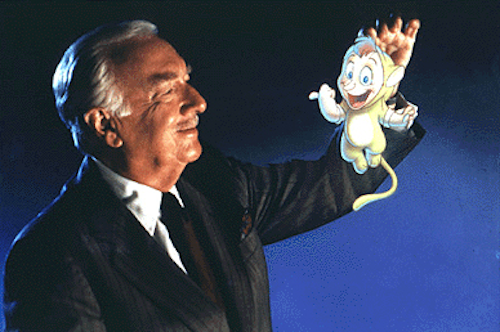
Ken officially retired in 1974, but would continue to consult on a variety of projects. He contributed to the films that became part of the World of Motion and Universe of Energy pavilions at Epcot and the short Back to Neverland, starring Robin Williams and Walter Cronkite, that was a staple of the animation tour at the Disney-MGM Studios for many years. He also spent time as a professor at CalArts, teaching the next generation of animation giants, including Brad Bird, John Lasseter and John Musker. In 1992, for his nearly four decades of making Disney animation the best in the world, Ken was declared a true Disney Legend. Six years later, the Australian reporter who reluctantly turned into an artistic heavyweight would pass away at home from natural causes. He was 90 years old.

Saturday, May 4, 2019

May 3 - California Institute of the Arts

On this day, in 1969, a groundbreaking ceremony was held as Lillian Bounds Disney turned over the ceremonial first shovelful for the new campus of the California Institute of the Arts. CalArts, as it is usually called, was incorporated in 1961, but it's story actually began forty years earlier. In 1921, Nelbert Murphy Chouinard founded an art school in Los Angeles, California. The whole point of the Chouinard Institute of Art was to bring some prestige to the West Coast art scene. It worked, with the help of another fledgling company that came along in 1928.

Image courtesy arroyomonthly.com
Walt Disney's relationship with Chouinard began almost as soon as his studio did. By 1929, Walt was making sure his inexperienced animators were taking weekly classes at the Institute. He knew that the better his staff became at their craft, the better his studio would do. By the early Thirties, instructors from Chouinard were coming to the Disney lot to teach classes. By the mid Thirties, Walt was treating the school like a personal breeding ground for new talent, filling the ranks of the Snow White team as fast as he could with its graduates. And that's how things went for the next two decades. Dozens, if not hundreds, of Disney artists attended classes there over the years, including several of Walt's Nine Old Men, Mary Blair and Imagineer Herbert Ryman. More than a couple also taught classes.

Image courtesy laconservancy.com
In the mid Fifties, Nelbert Chouinard suffered a terrible stroke and was unable to continue in her duties as head of the school. Walt said not a problem and the Disney Studio basically took over the administration of the place (Walt wasn't about to let go of the best trainers his staff ever had). But even with the administrative and financial help of Disney, the Chouinard Institute was struggling to stay open at the turn of the Sixties.  At the same time, the Los Angeles Conservatory of Music was also hitting hard times. Seeing an opportunity to expand Chouinard's scope and strengthen both arts schools, Walt proposed that they merge into one entity. The leadership of both institutions agreed and CalArts was born, at least on paper.

Image courtesy disneyavenue.wordpress.com
When it was incorporated in 1961, CalArts became the first school of higher learning in the country to offer degrees to both the visual arts and the performing arts. It offers both under- and post-graduate studies in Art, Critical Studies, Dance, Film, Music and Theater. Its first board of directors included Roy O. Disney, Roy E. Disney, Chuck Jones, HR Haldeman (of Watergate fame), Meredith Wilson (creator of The Music Man) and Ralph Hetzel (then vice president of the Motion Picture Association of America), among others. But the process of combining the fortunes of the two schools wasn't a quick one. It wasn't until eight years later that construction could begin on a combined campus.

Image courtesy scvhistory.com
Mother nature did her best to derail the new campus, dumping massive amounts of rain on the site throughout 1970 and rocking the area with a 6.5 magnitude earthquake in February 1971, but CalArts persevered and moved in during the month of November that same year. Over the next few years the school experienced almost constant upheaval in its administration. The first president, Robert Corrigan, fired most of the instructors from Chouinard and instituted a very laid back atmosphere with cyclical rather than sequential curriculum. He lasted a year. The next president, William Lund (Walt's son-in-law), fired more than 15% of the staff, imposed structured schedules and force the school to operate on a budget. He lasted three years. In 1975, Robert Fitzpatrick took over and offered the school enough stability to find its footing and begin thriving (he lasted 12 years).

Image courtesy pixar.fandom.com
CalArts became and remained for Disney what Chouinard had been before it: a breeding ground for new talent. The list of modern Disney artists that have been through the Institute is quite extensive and includes John Laseter, Brad Bird, Kirk Wise, Tim Burton, Glen Keane, Gary Trousdale, Andrew Stanton, Pete Doctor, John Musker and many (many) more. Going to CalArts doesn't guarantee you a job at Disney, nor are you automatically excluded if you don't, but it sure does help to grease the wheels.

The last thing we need to talk about when it comes to CalArts is the infamous classroom A113. Currently the first year graphics design studio, classroom A113 has also been used extensively by first year Character Animation students and has become an inside joke in the industry. The moniker A113 appears literally every where you look in animated films and television shows. Sometimes it's a license plate number, sometimes it's an apartment number or on a billboard, sometimes it's harder to incorporate it into a story. In Finding Nemo, for instance, you see it as the model number of the camera the scuba diver uses to take a picture before capturing Nemo. In WALL-E, the directive given to prevent Autopilot from ever returning to earth is, you guessed it, code A113. A113 has appeared in everything from The Simpsons to South Park to an episode of Dr. Who. So the next time you're watching your favorite bit of animation, be on the lookout for A113. Chances are, it's in there somewhere.

Saturday, March 16, 2019

March 13 - Joe Ranft

Image courtesy collider.com
On this day, in 1960, Joseph Henry Ranft was born in Pasadena, California. As a kid, Joe developed two great passions in his life: magic and film. By the time he was 15, he was a member of the Magic Castle Junior Group (which, as anyone who is into magic knows, is a big deal). Unlike most of the members of that group, who go on to become professional magicians, Joe felt the pull of comedic storytelling a little bit more and enrolled at CalArts to study character animation. Working alongside fellow students like John Lasseter and Brad Bird, Ranft eventually caught the eye of Disney with a student film called Good Humor. After graduating in 1980, he moved right into the Television Department at the Disney Studios (knowing full well that if it didn't work out, he always had a bit of magic in his back pocket to rely on).

Image copyright Pixar
The first five years of Joe's career weren't exactly what anyone would call auspicious. He worked on all kinds of projects, developing stories and creating storyboards to go along with them, but none of them were ever actually produced. Eventually Joe was transferred into the Feature Animation Department where he had the good fortune to apprentice under one of Walt's Nine Old Men, Eric Larson and his prospects picked up considerably. Joe spent the rest of the Eighties and early Nineties working on the stories of films like Oliver and Company, The Little Mermaid, Beauty and the Beast, Aladdin and The Lion King. He was Story Supervisor on The Rescuers Down Under and Storyboard Supervisor for The Nightmare Before Christmas and James and the Giant Peach.

Image copyright Pixar
In 1991, Joe's old schoolmate, John Lasseter, asked him to join his new venture, a studio called Pixar. The move earned Joe his only Oscar nomination (for Best Original Screenplay on Toy Story). In addition to being Story Supervisor on Toy Story and A Bug's Life, he began to get more heavily into voice work (hey, Pixar was a small place at the time; everyone had to do multiple things). He'd already provided some screams in Beauty and the Beast and was Igor, Dr. Finkelstein's assistant, in The Nightmare Before Christmas, but now he actually got dialogue. Joe is the voice of Lenny the Binoculars in Toy Story, Heimlich in A Bug's Life, Wheezy in Toy Story 2, Pete "Claws" Ward in Monsters, Inc., Jacques the Shrimp in Finding Nemo, and Doggy Loggy in Chicken Little.

In the early Aughts, Joe was elevated to co-director on Cars. He provided the voices for Red and Peterbilt, but never got to see them on the big screen. Tragically, on August 16, 2005, Joe was a passenger in car that lost control, crashed through a guardrail and fell 130 feet into the Navarro River in Mendocino County, California. Joe and the car's driver were killed on impact. Both Cars and Tim Burton's Corpse Bride (which Joe had been executive producer for) were dedicated to his memory. He was posthumously made a Disney Legend in 2006 and given the Windsor McCay lifetime achievement award at the 2016 Annie Awards. He was only 45 at the time of his death and was a loss felt throughout the entire industry.

Tuesday, January 8, 2019

January 5 - Jack Hannah

Image courtesy of cartoonresearch.com
On this day, in 1913, John Frederick Hannah was born in Nogales, Arizona. Another Legend that it's hard to find background information on (other than he enjoyed hunting with his dad), we pick Jack's story up in 1931. He'd made his way to Los Angeles and was attending the Art Guild Academy. As a student, one of the first jobs he managed to get was designing movie posters for local theaters. As the Great Depression ground on, Jack made a visit to the Walt Disney Studio to try for a job. His portfolio was deemed good enough and, in 1933, he began his animation career as an inbetweener on Mickey Mouse shorts.

Jack had moved up to full animator by 1937, when his contributions to The Old Mill helped win an Academy Award for the studio. After slaving over the drawing board for 12 more shorts, Jack moved over to the story department and started writing for Donald Duck shorts. From 1939-43, he wrote 27 stories for the cantankerous fowl, sometimes collaborating with the legendary Carl Barks, including Donald Gets Drafted (where we learned Donald's middle name is Fauntleroy). Jack and Carl would also work together on the first couple of Donald comic books. Carl would leave the studio for the comic world full time, but Jack stuck around and became a director.

Image copyright Disney
The 1944 short Donald's Off Day was the onset of Jack's spectacular run of feathered mayhem surrounding the perennial second banana at the Disney studio. Over the next decade, he would helm 94 shorts, most of them featuring Donald. Jack would introduce the world to classic foils for his fowl friend, including Chip and Dale and Humphrey the Bear. He was so prolific in developing Donald's character that more than one Disney historian has referred to him as "Donald Duck's Other Daddy."

As the studio began winding down short production in the mid Fifties, Jack tried to make the transition to television. He was able to direct several episodes of the Disneyland series, all of them involving Donald, usually having conversations with Walt. He tried to get Walt to let him direct more live-action projects, but claims that Walt had him pigeon-holed as an animation guy and wouldn't do it. Whether or not that was true, Jack would retire from the Disney Studio in 1957, mildly disgruntled. He wouldn't stop working though.

Image courtesy of 2917hyperion.blogger.com
Following his departure from Disney, Jack went to work for another animation legend, Walter Lantz. For the next several years, he directed Woody Woodpecker shorts and became Assistant Director on Lantz's television project, The Woody Woodpecker Show. In 1963, he retired a second time.

By the mid Seventies, Disney was starting to feel the pinch as all of the original crew of animators were retiring (or passing away) and a vacuum was being created with no readily available replacements. Studio executives approached Jack with a proposal to jump start the Character Animation program at Cal Arts. He teamed up with T. Hee to create it and actually taught classes himself for the next eight years. Countless members of the current pantheon of animators cut their teeth studying under Jack and the fabulous Cal Arts program.

In 1992, Jack was made an official Disney Legend, not only for all his shepherding of Donald but for basically ensuring the continuation of the medium in general. Two years later, he would pass away on June 11, 1994 in Burbank, California. He was 81.

Tuesday, October 9, 2018

October 9 - Pete Docter

On this day, in 1968, Peter Hans Docter was born in Bloomington, Minnesota. Pete grew up in a musical family. His mother taught music, his father was a choral director, one sister became the violinist in the Cavani String Quartet and the other plays cello for the Metropolitan Opera. Pete, on the other hand, preferred to pretend he was Indiana Jones in and around the creek beside their house or made short animated films with the family video camera. Even though he was a tall, gangling, kind of socially awkward kid, he may have turned out the best of the whole family.

Pete went to the University of Minnesota posing as a major in philosophy. In his spare time, Pete made art. A lot of art. So much art that, after only a year of being philosophical, he transferred to the California Institute of the Arts. While there, Pete created three films utilizing traditional animation techniques: Palm Springs, Next Door and Winter. Next Door was awarded a Student Academy Award, which for those of you who don't know (I didn't) is an actual Oscar given to college students. Since his further successes have occurred, all three films have been preserved by the Academy Film Archive.

As Pete was getting ready to graduate from CalArts, his best job offers were from the producers of The Simpsons and a fledgling company named Pixar. While he knew almost nothing about Pixar other than the fact that he liked a few of their shorts, the traditional animation student chose the computer animation company. So at the age of 21, literally the day after his college graduation, Pete started working for Pixar as only the third animator the company ever employed.

Because of his age and relative inexperience, Pete wasn't initially given a whole lot to do. It wasn't long though, before the head of Pixar, John Lasseter, began to realize just the kind of guy he'd been lucky enough to hire. Even though he was brought in as an animator, Pete began doing additional things like writing, sound recording and orchestra scoring. For Pixar's first feature, Toy Story, he was one of only three key scriptwriters. Buzz Lightyear (one of my favorite characters) is, in part at least, based on Pete. He would go on to co-author A Bug's Life, Toy Story 2 and Monsters, Inc., which was also his directorial debut. A debut that was nominated for all kinds of awards. True, it didn't win any of those awards but Pete would soon change that.

Pete once again contributed his writing skills to WALL-E, garnering an Oscar nomination for Best Original Screenplay and winning a Nebula award. His next project, for which he co-wrote the script, directed and played the voices of Kevin and Campmaster Strauch, was 2009's Up. Pixar always brings the feels in their movies, but Up was the first time I (and pretty much every other adult) actually had to stifle sobs in a movie theater. And not just at the end of the movie, but the beginning too. Thanks Pete. It was an awesome experience. The Academy thought so, too, not only giving Up the Oscars for Best Original Score and Best Animated Feature, but also nominating it for Best Picture period. Pete also won an Annie Award for directing.

At this point, Pete's role began shifting again. He started playing more of an executive role at Pixar. His next few credits would in fact be as Executive Producer on the shorts Dug's Special Mission and Party Central and the feature Monsters University. His directing days weren't quite over though. He would return to that role for 2015's Inside Out. Pete also co-wrote the script based on a story idea he'd help develop and provided the voice for Father's Anger. Once again, Pete delivered a delightfully touching, highly inventive story. Once again, he won the Best Animated Feature Oscar, the Annie Award for directing and, this time, added the Annie Award for writing.

All in all, for the three films Pete's directed for Pixar, he enjoys an average rating of 97% fresh on Rotten Tomatoes and, on an average budget of $155 million, has an average gross of over $723 million. For you math whizzes, that means his three movies have grossed over 2 billion dollars. Which means Pete knows what he's doing. A very good thing for Pixar. You may have heard about the controversy surrounding the company's founder, John Lasseter, and his subsequent departure. You may have also wondered what was going to happen to the level of quality that Pixar would be able to sustain going forward. You don't have to worry. Pete has John's job now and (you knew I was going to say this at some point) the Docter is in.

A fantastic addendum to Pete's story: One of my all-time favorite attractions was in the Wonders of Life pavilion at Epcot. For anyone who remembers it, Cranium Command was a hilarious look at the various systems of the human body as seen from the inside. It was totally the inspiration for Inside Out, not because Pete was a fan of it, because Pete actually worked on the animation for it. The story behind Command is a crazy one that I hope to post about in the future, but part of that story is how a young Pete Docter, before he graduated from CalArts and became a legend at Pixar, was pulled in to help hurriedly finish its animation in time for its grand opening.

Also on this day, in American history: Mary Ann Shadd Cary