Showing posts with label Alice in Wonderland. Show all posts

Friday, September 13, 2019

August 25 - Tim Burton

Image courtesy thesun.co.uk
On this day, in 1958, Timothy Walter Burton was born in Burbank, California. It’s hard to say what influenced Tim’s decidedly quirky, fairly macabre worldview the most, but the fact that his mother once owned a gift shop themed entirely around cats gives us a good start (although growing up at the epicenter of the entertainment industry would probably have darkened even the perkiest of kids). Tim began experimenting with stop motion animation in his backyard at a fairly young age. He spent a lot of time making soundless super 8 films that could have been spent shoring up his mediocre grades, but then we might not have ever gotten to experience some of my favorite movies.  Tim’s grades were good enough, however, to allow him to move on from Burbank High School to study character animation at CalArts, and really that’s all that matters in the long run.


While at CalArts, Tim wrote, directed and drew the animation entirely by himself for an animated short that caused quite a stir among his fellow students. Stalk of the Celery Monster depicted an unconventional dentist office that employed the titular monster as a sort of dental hygienist. Only fragments of it survive, but in the minute and a half that does, you can see most of the signature Burton aesthetics are already in place. Which really makes what happened next kind of strange: because of the glimmers of strange brilliance evident in Celery Monster, Disney offered Tim an animation apprenticeship.

Image copyright Disney
At the tail end of the Seventies, Tim started a relationship with the Walt Disney Company that, quite frankly, was doomed from the beginning. Over the next several years, he would be tried out in several different roles, none of which bloomed into anything. He spent time as an animator on The Fox and the Hound. He was moved to the art department and became a conceptual artist on The Black Cauldron, except none of his concepts were ever used (and that film could have used a whole lot of different concepts). He was given storyboard, graphic design and even some art direction work. None of it seemed to fit. And things didn’t get any better when Tim worked on projects of his own.

Image copyright Disney

In 1982, Tim was able to complete his first short, a stop-motion animated piece called Vincent. It’s a brilliant six minute poem about a little boy who likes to pretend that he is Vincent Price and the best part is that Tim got Vincent Price to narrate it. Disney played it for two weeks in exactly one theater in Los Angeles before the movie Tex (remember that one? Yeah, neither do I). Tim then directed a live action adaptation of Hansel and Gretel for The Disney Channel. Given a distinctly Japanese flavor, the movie features and all Asian cast and culminates in a kung fu fight (even though that martial art is really Chinese) between the siblings and the wicked witch. Disney aired it one time on Halloween 1983 with little warning and no promotion. Tim’s next project was the 1984 live action short Frankenweenie. It’s both a spoof and an homage to the original Frankenstein. Although Frankenweenie was later seen in the United Kingdom in front of Baby: Secret of the Lost Legend (another film you won’t remember, although this one you don’t want to), it was never shown in the United States, in spite of the fact that it cost nearly $1 million to produce. Those two facts apparently gave whoever in management who didn’t like Tim all the ammunition they needed. He was accused of wasting company resources on a picture that was deemed too scary for kids and fired. The good news for his fans is that the spark that fueled his subsequent fire had already been made.

Image courtesy nytimes.com
Paul Reubens was one of the few people who actually got to see Frankenweenie and he loved it. Paul was looking to put his popular character Pee-wee Herman into a big screen romp of some sort and decided that Tim was just the guy to direct it. Tim in turn asked one of his favorite rock stars, Oingo-Boingo front man Danny Elfman, to write the music. The rest, as they say, is history. Pee-Wee’s Big Adventure was a bona-fide hit, taking in $40 million on an $8 million budget, putting Paul, Tim and Danny firmly on the entertainment map and Tim and Danny forged a relationship that has seen Danny score all but three of Tim’s films.

Image courtesy usatoday.com
Tim took a breather, directing some episodes of a new version of Alfred Hitchcock Presents and , before moving on to another feature film. He took a quirky script that was languishing around the offices of Warner Brothers, gave it a rewrite with a lot more comedy thrown in, cast a bunch of folks who were relatively unknown (but wouldn’t be for much longer) and spent the most money he’d ever been allowed to, $15 million. The result was Beetlejuice, a classic comedy that grossed over $74 million worldwide and convinced Warner Brothers that Tim was ready for what they called the big leagues: they gave him the greenlight on his version of a Batman movie.

Image copyright Warner Brothers
Tim had been developing his concepts for the Caped Crusader for a couple of years before getting the go ahead. He was making his superhero a much darker entity than the Superman of the Seventies and wasn’t afraid to court controversy. He insisted on making Batman a regular guy who used super gadgets and cast Michael Keaton, who he’d just worked with on Beetlejuice, as his lead over the objections of every fanboy out there who cried over a comedic actor landing the role. Then he cast Jack Nicholson as his villain, who came with a cloud of demands that threatened to overwhelm the production. Tim then had to constantly butt heads with Warner Brothers’ management to keep the tone of the whole thing from getting campy. And then the budget ballooned from thirty million dollars to forty-eight. The whole thing could have been a disaster. But it wasn’t. Batman opened to good critical reviews, Keaton and Nicholson were both praised for their performances and the film grossed over $400 million. Tim was now an established Hollywood director, one that even Disney was willing to listen to.

Image courtesy scrapsfromtheloft.com
As Tim was ramping up production on what is arguably his best film to date, Edward Scissorhands, he couldn’t forget about a little project he’d left behind when he’d been forced out of Disney. It was a three page poem, titled The Nightmare Before Christmas, that he first thought would make a great children’s book but might also work as a half hour television special. He asked around about it and discovered that Disney still owned the production rights to it. However, his former company was interested in talking to him about producing something based on it (isn’t it amazing what success will do for people’s perceptions of you?). Tim was interested but had a magnum opus to finish first. He hired a young Johnny Depp for his lead, converted a Florida subdivision into a giant movie set (in one scene you can see a sign for Publix in the background; that might not mean something to most of you but Floridians love it) and managed to get Vincent Price in for his last major film scene before he passed away. Edward Scissorhands is probably the most autobiographical film that Tim has ever made and is one of his biggest critical successes as well.

Image copyright Disney
After Edward, Tim found himself with two projects on his plate. At Disney, The Nightmare Before Christmas was becoming a feature length film. At Warner Brothers, a second Batman movie was being developed. Wanting to avoid the tediousness of three years of stop motion animation work, Tim opted to produce Nightmare and direct Batman Returns. He handed the reins of his holiday extravaganza over to another former Disney animator, Henry Selick, who created one of my favorite films of all time. Nightmare did moderately well at the box office in its initial run but has since become a cult classic that seems to continue to grow with each passing year. In a karma fueled twist of irony, Tim’s name, once derided at Disney for being too dark and weird (and therefore easily fireable), had to be put in front of Nightmare’s title in an attempt to draw in his growing fan base. Three years later, Tim and Henry would collaborate again (as producer and director respectively) for Disney’s second big stop motion feature, 1996’s James and the Giant Peach.

Image copyright Warner Brothers
Meanwhile, over at Warner Brothers, Tim demanded and received total control over Batman Returns. The result, much to the dismay of studio executives, was an even darker movie than the first one, with overtly sexual overtones. The sequel was a critical and financial success (albeit at half the rate of the original) but left management too worried about the direction Tim was taking the superhero. For the third installment, they relegated him to the role of producer only and after that he wasn’t even allowed to do that. I’m not saying the franchise suffered because of that decision, but I’m guessing we wouldn’t ever have had to see Batman and Robin if things had gone down differently.

In the decades since leaving Gotham City, Tim has directed 14 more films, all but one of which have been commercially successful. The lone money loser, Ed Wood, is actually one of his biggest critical successes (and a Touchstone Pictures movie). It’s a pretty good film but it’s also a biopic about an obscure director of terrible movies. If you aren’t interested in the subject (and even now, most people would be hard pressed to tell you who exactly Ed Wood is), you just aren’t going to care. Outside of that, Tim’s movies over the years have appealed to a wide swath of the viewing public. Whether you’re interested in summer popcorn fare (Planet of the Apes, Miss Peregrine’s Home For Peculiar Children), quirky bios (Big Eyes) or more of his signature macabre (Sleepy Hollow, Corpse Bride, Dark Shadows), he’s done something for just about every taste, a sentiment boosted by the fact that his films have grossed over $4 Billion. That figure has been greatly helped along by the three pictures he’s done for Disney since Nightmare: a live action Alice in Wonderland, an animated Frankenweenie and, his latest project, a live action Dumbo which have a combined box office of nearly $1.5 Billion (and, incidentally, are all kind of remakes that were done in the opposite medium from the originals). There is currently no word on what might be up Tim’s sleeve for his next project, but we know that whatever it is, it will not only be fun to watch, but probably more than a little bit off the beaten Hollywood path and that makes the anticipation just that much sweeter. Happy 61st birthday, Tim!

Thursday, July 11, 2019

July 5 - Mack David

Image courtesy songhall.org
On this day, in 1912, Mack David was born in New York, New York. Growing up in a traditional Jewish family (his parents owned a delicatessen in Brooklyn), Mack had aspirations towards becoming a lawyer. He even spent several years at Cornell University and the law school at St. John’s University trying to make that dream come true. When his younger brother, Hal, was contemplating career paths, and considering going into song writing, Mack did everything he could to discourage him, telling him to choose something with more stability. Which really spreads a thick layer of irony over the outcome of Mack’s own life.

Maybe it was because Hal completely ignored his big brother’s advice, went into the music business and a spirit of competition kicked in or maybe Mack just wanted to see if he could be successful at it, but in the early Forties, Mack began writing songs. He was primarily a lyricist, but he would occasionally write the music as well. Some of his early hits were Just a Kid Named Joe for the Mills Brothers, The Singing Hills for Bing Crosby, Take Me for Jimmy Dorsey, Blue and Sentimental for Count Basie and Sunflower for Frank Sinatra. Not only were those songs originally written for big names but all of them have been covered by other artists over the years as well (Blue and Sentimental alone has appeared on over 100 different albums).


Image copyright Disney
These successful compositions gave Mack the courage to move out to Hollywood and begin writing music for the pictures. In 1950, he, along with writing partners Jerry Livingstone and Al Hoffman, became part of the Disney family in a big way, writing several songs for the studio’s twelfth animated feature, Cinderella. If you ever find yourself humming A Dream Is a Wish Your Heart Makes, Bibbidi-Bobbidi-Boo or The Working Song, you’re familiar with the trio’s work. When the Oscar nominations were announced for that year, Bibbidi-Bobbidi-Boo made the list for Best Song, giving Mack his first award nomination (Mona Lisa from Captain Carey,USA edged him out for the win). As if those songs weren’t enough of a contribution to Disneyana, the boys returned for the next feature, Alice in Wonderland, with The Unbirthday Song.

Image copyright Disney
After his Oscar nominated work with Disney, Mack became a sought after, and highly prolific, songwriter for the next two decades. When the dust settled in the early Seventies, he had credits for lyrics or music (and sometimes both) on over 1,000 songs. He was nominated for an Academy Award seven more times after Cinderella, for his work in The Hanging Tree (1959), Bachelor in Paradise (1961), It’s a Mad, Mad, Mad, Mad World (1961), Walk on the Wild Side (1962), Hush Hush Sweet Charlotte (1964), Cat Ballou (1965) and Hawaii (1966). Unfortunately, he never did get one of the little golden men for his mantel, making him one of the most nominated but never won Oscar honorees. In 1975, Mack was inducted into the Songwriters Hall of Fame

Image courtesy picclick,com
In addition to his film work, Mack also continued to write songs for pop artists (Baby It’s You for the Shirelles and It Must Be You for Gilbert Becaud), television (the theme to Casper the Friendly Ghost) and Broadway (the 1973 musical Molly and 1981’s Sophisticated Ladies). One of his biggest hits was his reimagining of the lyrics to the French song La Vie en Rose, which has been recorded by over 80 artists around the world and featured in dozens of films (I say reimagined because he didn’t write a strict translation of Edith Pilaf’s original lyrics but wrote new ones that honored their spirit).

So after several decades in the songwriting business, Mack had sufficiently put to rest his own fears that it wouldn’t be a very steady work to get into. His little brother, Hal, by the way, also had a long and prolific career doing the same thing (and Hal got into the Songwriters Hall of Fame three years earlier, probably just out of spite). On December 30, 1993, the New York lawyer turned song master passed away quietly in his home in Rancho Mirage, California. He was 81.


Sunday, July 7, 2019

June 27 - Kathryn Beaumont

Image courtesy famousbirthdays.com
On this day, in 1938, Kathryn Beaumont was born in London, England. The daughter of a singer and a dancer, Kathryn was exposed to show business from the moment she was born. When the Germans began bombing London during World War II, she relocated to Northern Wales with her mother in 1941. Through her parents' contacts she made an uncredited appearance in a British romantic comedy, It Happened One Sunday, in 1944. When she returned to London at the war's end, Kathryn was offered a contract with MGM, who was looking to capitalize on American's war time fascination with all things British. The Beaumonts relocated to Los Angeles, California in order to fulfill that contract, but it never really panned out. She had small parts in On an Island With You, which starred Jimmy Durante, Challange to Lassie, and the 1949 production of The Secret Garden, which turned out to be child star Margaret O'Brien's last film and led to Kathryn's Disney debut, albeit in a roundabout way.

Image courtesy kathrynbeaumont.com
Margaret O'Brien was quickly outgrowing her career, which apparently everyone but her mother could see. As her contract with MGM was nearing it's end, Margaret's mom tried to toughly renegotiate it by saying the studio should resign her for more money or let her go so she could make more money somewhere else. MGM immediately agreed to let her go, which should have been a red flag to Mrs. O'Brien. Being released from her contract meant that Margaret was available to play Alice in the Walt Disney Studio's Alice in Wonderland. Walt announced the casting and Mrs. O'Brien saw that announcement as a chance to ask for more money. A heated discussion ensued (some would call it a shouting match). At the end of it, Margaret was unemployed, Kathryn, who had also just been let out of her MGM contract, was auditioned and, four hours later, offered the role. In later years, Disney tried to say that Kathryn was the choice all along because she was British enough to stay true to the British story but not too British that American audiences would be put off. I say bullox. Margaret wasn't British at all and that's just a story to cover up a bad casting choice. At any rate, the problem was fixed and fixed well.

Image courtesy youtube.com
Not only did Kathryn provide the voice for Alice but she filmed all the live action reference for the animators as well, which ended up being a little more than she bargained for. With all the crazy twisting and turning Alice had to do because of falling down rabbit holes (and various other hallucinatory moves), the live action shots actually made Kathryn quite nauseous. She was literally spun and twirled and dropped using all sorts of contraptions in order for the animators to get perspectives (and I'm sure facial expressions) just right. It wasn't enough to put her off performing as Alice however. She continued to be part of the movie's press events and was even there for the studio's first television production, One Hour in Wonderland.

Image copyright Disney
Following an extended press tour, Kathryn returned home to be offered a role in Disney's next animated feature, Peter Pan. She accepted the role of Wendy Darling and once again agreed to do the live action reference filming, once again ending up out of her comfort zone. This time around, the animators wanted shots of people flying through the air, so they rigged their three kids up on wires and suspended them high enough to film them from below. Kathryn has a fair to middling fear of heights and recalls feeling safe in the harness but that the stage looked really far away. Once again, she survived the ordeal and was more than happy to assist the studio with press events.

Following Peter Pan, Kathryn went off to high school where she joined the student government but shied away from the Drama Club. She was then accepted into the University of Southern California as an education major. During the summers throughout college, she continued her relationship with Disney, making appearances and recording voice overs for theme park attractions. When she graduated from USC, she became a teacher at a local elementary school and almost never looked back. I say almost because there was a handful of times when a student wondered why they recognized their teacher's voice and actually figured out why. It was a era before home video so Kathryn was safe most of the time, it was only during a periodic rerelease of one of her movies (or a showing on television) that anyone would make the connection. She lost touch with the Disney stuio and happily taught in relative anonymity for nearly thirty years.

Image copyright Disney
In 1983, in preparation for the 30th anniversary of Peter Pan, Disney tracked Kathryn down and was surprised to find her practically in their backyard. She reacquainted herself with the company and began making appearances again, as well as making new recordings of Alice and Wendy. When the Alice in Wonderland ride at Disneyland was refurbished and given a new soundtrack, Disney was able to get the original voice to do it. She also recorded all sorts of bits for various parades and video games. In 2005, she officially retired from acting a second time, turning all future recording duties over to Hynden Walch. In 1998, for embodying the quintessential classic Disney heroine, Kathryn was declared an official Disney Legend. She currently resides in Southern California with her husband of 34 years, Allen.

Friday, June 14, 2019

June 7 - Del Connell

Image courtesy npr.org
On this day, in 1918, Del Connell was born in Sixteen Mile Stand, Ohio. His birthplace gets its name from the distance it is from downtown Cincinnati (it's still a burg of only a couple thousand residents). Del didn't live in Ohio very long, though, as his family moved to Los Angeles, California when he was only one. He first graduated from South Pasadena High School before attending Pasadena Junior College as an art student.

As another one of the great Disney artists who responded to an ad in the paper, Del joined the studio in 1939. Since his area of art expertise tended more towards the three dimensional variety, he was assigned to the Character Model Department. It's the job of a modeler to take an animator's 2D drawings of a character and sculpt a 3D figure of it called a maquette. The animator will then use the maquette to help him draw the character with better perspective from any angle. Del created maquettes for Dumbo, The Reluctant Dragon, Fantasia and Lady and the Tramp.

Image copyright Disney
By 1940, Del was moving into the Story Department. He wrote and made storyboards for a short titled The Pelican and the Snipe (it wouldn't go into production until 1944) and began working with Bill Peet on adapting Alice in Wonderland for the big screen. After a year spent creating storyboards for Alice, World War II came along and Del was drafted into the United States Army. He was stationed in Panama, where he spent most of his time up in blimps making detailed maps of the canal. He never stopped writing, though. While in the tropics, he wrote The Cold Blooded Penguin and sent it to the Disney Studio. Walt loved it, bought it for $500 and it eventually became the opening sequence of The Three Caballeros.

Image copyright Disney/Western
Del returned to the Disney Studio at the end of the war in 1945. He took up working on the story for Alice in Wonderland again while simultaneously trying to adapt The Pied Piper of Hamelin (that feature would never be produced). In the early Fifties Del worked with Bill Peet again, this time on the script for the Academy Award nominated short Ben and Me. His final project working directly for Disney was as an artist and writer on early versions of the first souvenir guest guide for Disneyland.

In 1954, Del began working for Western Publishing, a huge comic book company. He worked mostly in the licensed character division, which included Disney comics as well as characters from Hannah-Barbera, Walter Lantz Studios, Warner Brothers and MGM. Over the next three decades, Del wrote and edited the scripts for thousands of comic book stories, creating all sorts of characters in the process. For Disney alone, he originated Daisy's nieces (April, May and June), turned Goofy into his popular SuperGoof persona and gave Goofy his ancestor, Mighty Knight. He also created several original series including Wacky Witch and The Close Shaves of Pauline Peril. His original series Space Family Robinson was eventually adapted into the television show Lost in Space. For twenty years, starting in 1968, Del wrote and drew the daily Mickey Mouse newspaper comic strip. During the same time he became Western's editor-in-chief of their west coast comic book division.

Image copyright Western Publishing
After retiring from Western Publishing in the late Eighties, Del began working on an idea called The Historables, aimed at teaching history to young kids. He spent the next twenty years developing characters like Marie Ant-toinette. In 2012, a company was developing internet based apps for kids using Del's ideas, but the project didn't pan out. In 2011, Del was nominated for the Bill Finger Award given out at the San Diego Comic Con. The award is named after the uncredited co-creator of Batman and is used to honor comic artists who have gone under appreciated over the years. Since most of Del's work at Western was uncredited, three out of the four judges for the Finger Award had never heard of him. Needless to say, once they learned his story, Del was declared the year's winner and one of the judges quipped the award was one of the few times he ever had his name on anything. Unfortunately, Del was suffering from advanced Alzheimer's at the time and was unable to accept the award in person. He was reportedly lucid enough at one point, though, that he was aware of the nomination and was able to name several people he thought deserved the accolade more than he did. Shortly after receiving his honor, Del passed away on August 12, 2011. He was 93.

Wednesday, May 29, 2019

May 27 - Ken O'Connor

Add caption
On this day, in 1998, A. Kendall O'Connor passed away in Burbank, California. Born on June 7, 1908 in Perth, Australia, Ken began his professional career at the age of 16 as a reporter for the newspaper his father owned. At some point, someone died (he can’t remember who) and no one had a picture of them for their obituary. Ken drew a better than passing portrait of them and became the paper’s resident artist as well. As his interest in art grew, he began taking classes, selling the cartoons and oil paintings his studies produced for spending money. In 1930, Ken’s father started working for the Australian National Travel Association and the whole O’Connor clan moved to San Francisco, California to promote tourism to the Land Down Under. Ken continued his art education at the California School of Fine Arts (now known as the San Francisco Art Institute) and earned money by becoming the art director for a local poster company.

Image copyright Disney
In 1935, the Walt Disney Studio was desperately hiring artists in order to have a staff that could actually create a feature length Snow White and the Seven Dwarfs. Ken’s father encouraged his reluctant son to apply. He was quickly hired as an inbetweener and just as quickly moved into the special effects department. His main job was to be a rotoscoper. Rotoscoping is a process where you make a live action movie of something you want your animated character to do (like dancing) and then make rough tracings of each frame of film. Those rough drawings then get handed off to animators, overdrawn with the character and cleaned up, giving you a much more realistic representation of action than freeforming would. It’s a very tedious process but was probably the best way young Ken could have ever learned about how the process of animation differs from a still life painting. And learn he did.

Image copyright Disney
Following the release of Snow White, Ken became an assistant in the layout department. His first project was the 1937 short Clock Cleaners. Because a Mickey Mouse short can be a lot less realistic than Walt wanted his features to look, Ken could take a lot of artistic license to achieve the effects he wanted. Or as he put it, having learned the rules of perspective at art school, he could violate all of them to make the picture much more dramatic. So he did and everyone noticed. Ken’s incredible work on Clock Cleaners marked the beginning of a brilliantly long career in layout, an area of animation most people don’t even know exists.

Image copyright Disney
A layout artist is quite literally in charge of how you will see everything in an animated movie. They create the backgrounds, or sets, that the action will take place in. They also work with directors to decide what angle the audience will see things from. In live action, a scene can be shot from multiple angles and then cut differently if the first take isn’t something the production team likes. Animation is completely different. If the angle of a scene doesn’t work for some reason, there isn’t different footage that can be spliced in to fix it. What you have is the only thing that was painstakingly drawn. If you look at it and decide it would be better to, say, see a character from the side view instead of dead on, you have to restart the scene from scratch. In the days of hand drawn animation, it was cost prohibitive to do even a small amount of redraws. Determining all that beforehand is the only way to do it. It’s better now with computers and 3D rendering and all that, but even now, better is a relative term.  A good layout artist was and is crucial to creating successful animated movies. It turned out that Ken wasn’t just good, he was one of the best.

Image copyright Disney
For Pinocchio, Ken crafted the overhead shot of the puppet being led astray by Foulfellow and Gideon, parading through the streets of the town. He filmed some live action reference footage to help with that one. For Cinderella, he designed and built a detailed model of the pumpkin coach, which was approved by Walt with zero (that’s right zero) changes, becoming the coach that’s seen in the film. Having the model improved the action of those scenes immensely. For Lady and the Tramp, Ken knew it was going to be important to be able to show things from Lady’s perspective and shot all sorts of reference film from about a foot and a half off the ground. For Alice in Wonderland, he spent hours working out the proper horizons and vanishing points and multiple perspectives for all the scenes featuring playing cards, knowing that if just one of them was off, the whole scene would look wonky. All told, Ken would work on 13 of the 21 animated features that were released during his years with Disney, making invaluable contributions to each and every one of them.

Image copyright Disney
Ken wasn’t only good at camera angles, he was good at coming up with new techniques as well. For the Trees segment of Melody Time, he suggested using pastels on the cels and then coating them with lacquer to keep them from smudging to get the unique look of that scene. In Dumbo, when Timothy and Dumbo get drunk, he knew it would be nearly impossible to keep the colors of the pink elephants consistent. What you are actually seeing there is the color of the background. Each individual cel is painted all black except for an elephant shaped clear spot. A simple but highly effective solution. For the Dance of the Hours segment in Fantasia, he deliberately changed the general motifs of the animation each time the music entered a new movement, going from vertical shapes to elipses to diagonals.

Image copyright Disney
The Shorts Department didn’t let Feature Animation hog all of Ken’s talents over the years. He was part of the teams that created classics like Toot, Whistle, Plunk and Boom, The Whale Who Wanted to Sing at the Met and several of the educational shorts like 1946’s The Story of Menstruation.

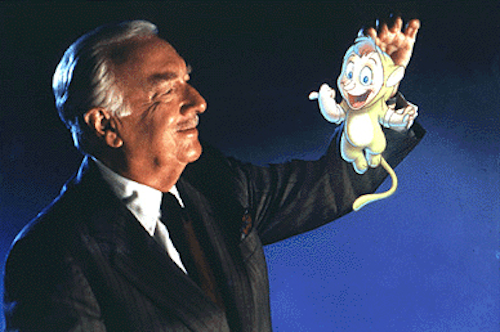
Ken officially retired in 1974, but would continue to consult on a variety of projects. He contributed to the films that became part of the World of Motion and Universe of Energy pavilions at Epcot and the short Back to Neverland, starring Robin Williams and Walter Cronkite, that was a staple of the animation tour at the Disney-MGM Studios for many years. He also spent time as a professor at CalArts, teaching the next generation of animation giants, including Brad Bird, John Lasseter and John Musker. In 1992, for his nearly four decades of making Disney animation the best in the world, Ken was declared a true Disney Legend. Six years later, the Australian reporter who reluctantly turned into an artistic heavyweight would pass away at home from natural causes. He was 90 years old.

Tuesday, May 7, 2019

May 4 - Ken Walker

On this day, in 1921, Kenneth David Walker was born in Salt Lake City, Utah. At some point, Ken's family moved to Southern California. I say some point because Ken is one of those folks who did some great work over the decades, but wasn’t well known outside of his industry. That means it can be fairly easy to pull together his professional credits, but there isn’t a whole lot of personal information available. After graduating from North Hollywood High School, he went right to work at the Walt Disney Studio as an inbetweener.

Ken’s first project was helping to finish up production on Fantasia. When World War II broke out, he, like much of the younger staff, did his patriotic duty and joined the United States Navy, spending most of time in the Pacific Theatre. When the war was over, he returned to Disney and became an assistant to Ward Kimball, one of Walt’s Nine Old Men. By the end of the Forties he was an animator in his own right, working on Alice in Wonderland. Ken also worked on a number of Pluto shorts including 1951’s Plutopia and 1952’s Pluto’s Party. It was during production on Plutopia that he appeared on You Asked For It, a television show that answered viewer mail. On the episode with Ken, someone wanted to know how animation was created and he was introduced as one of the Studio’s top animators (incidentally, the picture of Ken above is a screen shot from that clip; I couldn’t find a better picture of him). He might have been the studio’s choice to make a television appearance in 1950, but, for whatever reason (rumor has it he made a bad name for himself in a labor dispute), his career with the studio was over in 1952.

Image courtesy youtube.com
At this point, we lose sight of Ken for more than a decade. We know he did some work for Columbia Pictures. We know he became a member of the Director’s Guild of America. And that’s about it. There isn’t any concrete information on him again until 1965, when he founded his own production company, NYC Totem Productions, which survived under his ownership until 1971. During this period, Ken worked on television shows like Milton the Monster and The Pink Panther Show. He was also the director of Seeds of Discovery, a short his company produced in 1966.

Image courtesy sites.google.com
As the Seventies rolled in, and Ken’s own company went belly-up, he began working for Depatie-Freleng Enterprises, co-founded by Warner Brothers great Friz Freleng. Ken’s credits with DFE include the television series Bailey’s Comets, the special The Bear Who Slept Through Christmas, two educational shorts, The Incredible Indelible Magical Physical  Mystery Trip and The Magical Mystery Trip Through Little Red’s Head (both part of the ABC After School series) and Clerow Wilson’s Great Escape (starring Flip Wilson), all produced between 1973-74. He also was part of the team that did the animated bits for The Mad Magazine TV Special (although it was deemed too crude and never aired). In 1975, he turned to Hanna Barbera as part of the team that produced The Great Grape Ape Show.


Image courtesy cartoonbrew.com
In 1981, at the age of 60, Ken founded a second company, The Funny Bone Film Company, which he owned and operated for the next two decades. During this period, he reteamed with DFE to animate the Emmy winning special The Grinch Grinches the Cat in the Hat in 1982. He also returned to Hanna Barbera as an animator for their 1982 feature film Heidi’s Song. Ken was a director on the 1994 series Skeleton Warriors and an animator for 1992 Kim Basinger movie Cool World. One of the final credits of a career that spanned six decades was as a production designer on the 2000 special It’s the Pied Piper, Charlie Brown. On August 18, 2012, Ken passed away at his home in Laguna Hills, California. He was 91.

Tuesday, March 19, 2019

March 15 - J. Pat O'Malley

Image courtesy behindthevoiceactors.com
On this day, in 1904, James Patrick Francis O'Malley was born in Burnley, Lancashire, England. His professional career began in 1925 as a singer going by the name of Pat O'Malley. In 1930 he joined Jack Hylton and his orchestra, eventually recording more than 400 songs that were popular at the time. In 1935, Hylton crossed the pond to America bringing Pat with him. The move didn't pan out for the orchestra, but Pat stayed in the States and began a long acting career, changing his name to J. Pat O'Malley to avoid confusion with another actor.

Over the next four decades, Pat became a prolific character staple in Hollywood. From his first role as a fish peddler in 1940's Captain Caution to his last as the landlord in 1981's Cheaper to Keep Her, he made a comfortable living admirably filling in the little gaps of dozens of films and television shows. Some of his notable film roles include Hynes in Lassie Come Home, Ratliff in The Long, Hot Summer with Paul Newman, and Muldoon in A House Is Not a Home with Shelly Winters. On television he guest starred on everything from The Adventures of Kit Carson to The Dick Van Dyke Show to a memorable turn on The Twilight Zone to playing Carol Brady's father on The Brady Bunch.

Image copyright Disney
Pat is a venerated member of the Disney family. His first roles for the studio came in 1949 for the package film The Adventures of Ichabod and Mr. Toad. He played Cyril Proudbottom, Mr. Winkie, a Policeman and the Paper Boy. Two years later he gave voice to Tweedle Dee, Tweedle Dum, the Walrus, the Carpenter and Mother Oyster in Alice in Wonderland. For 1961's One Hundred and One Dalmatians he was Jasper Badun and the Colonel. He provided the voice for several of the cockney characters in the Jolly Holiday section of Mary Poppins including the Master of the Hounds and the Pearly Drummer. Unfortunately, he is also credited with being Dick Van Dykes dialect coach, so that awful accent of Bert's is at least partially Pat's fault. His final credited voice roles for Disney were as the vulture Buzzie and stuffy old Colonel Hathi in The Jungle Book (he did manage to sneak in an uncredited turn as the blacksmith dog in Robin Hood).

Image copyright Disney
Pat played a big part in the Spin and Marty serial that was shown as part of The Mickey Mouse Club. For three years, he played Perkins, Marty's butler and the Triple R Ranch's assistant cook. You can also catch a glimpse of Pat in the 1963 comedy Son of Flubber as a sign painter.

Throughout the Seventies, Pat continued popping up on television series like Emergency!, Three's Company and Barney Miller, with his last appearances on both big and small screens occurring in 1981. On February 27, 1985, just two weeks before his 81st birthday, Pat passed away from cardiovascular disease at his home in San Juan Capistrano, California.

Thursday, March 14, 2019

March 10 - Richard Haydn

On this day, in 1905, George Richard Haydon was born in Camberwell, London, England. While he would eventually become a prolific character actor (after dropping all of his first name and the o from his last), Richard’s career did not get off to a rousing start. He began in show business as a ticket seller at the Daily Theatre in London. He finally landed a comedic role in a musical revue but the show flopped. Deciding maybe the theater wasn’t for him, he moved to Jamaica and became an overseer on a banana plantation. After a hurricane wiped out the plantation, he returned to England, unsure of what to do with his life. While he tried to figure that out, he kept picking away at the whole acting thing. In 1926, he was cast in a West End production of Betty of Mayfair which led to his first roles on radio and, finally, some success.
Image courtesy forums.tcm.com
It was on the radio that Richard developed and perfected the basic character he would play variations of for the rest of his life: a stuffy fellow with a nasally voice and a tendency to over enunciate. His most famous version of this character was Professor Carp, a fish expert and momma’s boy, on The Charley McCarthy Show. The professor was so popular that Richard wrote a book about him in 1954, The Journal of Edwin Carp. His numerous radio appearances led him back to stage in 1939 when he hopped the pond and made his Broadway debut in Noel Coward’s Set to Music opposite Beatrice Lillie. The success of that show brought Richard a contract with 20th Century Fox. Throughout the Forties, he played mostly comedic supporting roles to great acclaim. Some of his highlights include Professor Oddly in 1941’s Ball of Fire, Rogers the butler in 1945’s And Then There Were None and Mr. Appleton in 1948’s Sitting Pretty.

Image copyright 20th Century Fox
Richard continued his role as character actor extraordinaire into the Fifties but began adding television shows to his resume. His career began slowing down in the Sixties but some of his most well known performances come from that decade. In 1960, he played Bartlet Finchley in an episode of The Twilight Zone called "A Thing About Machines." 1962 was the year he portrayed William Brown in the classic Mutiny on the Bounty. In 1965 he was Max Detweiler in The Sound of Music. He reprised Professor Carp on episode of The Dick Van Dyke Show and had a famous (if somewhat off color by today's standards) turn as a Japanese businessman on Bewitched. Richard made his last appearance on film (although his voice would go uncredited as Bookworm in 1985's The Hugga Bunch) in one of my favorite films, Young Frankenstein, in 1974. He plays Herr Falkstein, the lawyer at the beginning of the picture trying to convince Gene Wilder of his true heritage.

Image copyright Disney
Richard has two Disney credits to his name. The first happened in 1951 as the voice of the marvelously haughty Caterpillar in Alice in Wonderland. I'm pretty sure that no one else would have been able to make exactly three inches high sound like a giant. His other role is somewhat lesser known. In 1967, Disney released a comedic Western musical (of sorts) complete with songs by the Sherman Brothers and yet I'd wager not many people have heard of it. It even starred Roddy McDowall, Suzanne Pleshette and Karl Malden. The picture is called The Adventures of Bullwhip Griffin and Richard plays Quentin Bartlett, an actor who has his map to a gold mine stolen by a villainous Malden.

Richard never liked the whole Hollywood scene all that much. He'd never gotten married (although he was engaged for a few months in 1943) and spent most of his spare time reading and gardening. Sometime on April 25, 1985, while alone at his home in Pacific Palisades, California, he suffered a fatal heart attack. His body was donated to the University of California, Los Angeles medical department for science. He was 80 years old.

Wednesday, December 5, 2018

November 30 - Dick Huemer

On this day, in 1979, Richard Martin Huemer passed away in Burbank, California. Dick is one of those animators who was around for the early days of cartoons, did almost every job connected to cartoons and helped make the genre what it is. I would also wager that no one outside of real animation aficionados has any idea who he is.

Born January 2, 1898 in New York, New York, Dick was a student at P.S. 158 in Brooklyn. After graduating from high school, he attended the National Academy of Design and the Beaux-Arts Institute of Design, both in New York City. His first job in animation was at Raoul Barre's Studio in 1916. Seven years later, he'd moved over to the Max Fleischer Studio as an animation director where he also helped develop the character of Koko the Clown. By 1930, Dick had moved to Hollywood and taken a position at the Charles Mintz Studio, pumping out Oswald the Lucky Rabbit cartoons. Three years later, Dick joined Oswald's original studio, Disney, and stayed there for the next four decades.

Image copyright Disney
In his early years with Disney, Dick worked as an animator on Silly Symphonies like The Tortoise and the Hare and Mickey Mouse shorts like Lonesome Ghosts. Fellow animator Ward Kimball said his favorite piece of Dick's animation was Donald Duck in The Band Concert. Dick then directed a few shorts including 1938's The Whalers and 1939's Goofy and Wilbur. He moved on as a story director for features starting with Fantasia. Kimball, only partially tongue in cheek, credits Dick with introducing Walt to music that wasn't Sousa marches and therefore giving Fantasia some quiet, sophisticated moments it might not have had otherwise.

Image copyright Disney
Dick's writing skills came in handy on several of the features the studio produced during the Forties and early Fifties. The Reluctant Dragon, Saludos Amigos, Make Mine Music, Peter and the Wolf, and Alice in Wonderland all benefited from his talents. The technique he employed while co-writing Dumbo may have been instrumental in getting the picture made. Instead of submitting a completed storyboard like typically happened, Dick and his writing partner, Joe Grant, kept giving Walt storyboard chapters that usually ended in a cliff hanger. Walt enjoyed them so much, his enthusiasm for the project just kept growing.

In 1948, Dick left the Disney company to draw a comic strip called The Adventures of Buck O'Rue and create animated commercials for the new medium of television. After three years of freelancing, he returned to Disney to elevate the studios television projects and help with its burgeoning publishing division. Dick's creation of a number of episodes breaking down and explaining the animation process for the Disneyland series rank among the finest work he ever did. He also adapted 20,000 Leagues Under the Sea and the Tru-Life Adventure movies into books (or into a new book version in 20K's case). He began writing a Tru-Life comic strip in 1955 and continued it until he retired in 1973.

In 1978, Dick received the Windsor McCay Award for lifetime achievement at that year's Annie Awards. A year later, the man who was there for the birth of animation, suffered through the medium's growing pains and helped shape it into what we all know and love today, passed away at the age of 81. In 2007, Dick was made an official Disney Legend.