Showing posts with label Roy E Disney. Show all posts

Wednesday, July 3, 2019

June 24 - Roy Oliver Disney

Image courtesy allears.net
On this day, in 1893, Roy Oliver Disney was born in Chicago, Illinois. The third son (behind Herb and Ray) of Elias and Flora Disney, Roy experienced much of the same childhood his younger brother Walt did, just as someone eight years older. After Walt was also born in Chicago, the family moved to a farm in Marceline, Missouri, where they welcomed the only sister in the bunch, Ruth. After struggling with farm life for a while (though the impact those years would have on Walt were incalculable), Elias moved the family again, this time to Kansas City, and started his two younger sons on the journey of a lifetime.

image courtesy thisdayindisneyhistory.com
One of the shared experiences Roy and Walt got to have together was providing the labor on a paper route their father managed to buy for the Kansas City Star in 1911. Roy was eighteen at the time and, twice a day, he and his ten year old brother delivered papers to nearly 2000 customers. Two hours in the morning, two more in the evening, no matter the season, no matter the weather. The work was miserably tiresome for the brothers, although it did seem to create a work ethic within them and a bond between them that lasted for the rest of their lives. Needless to say, once Roy graduated from Manual Training High School in 1912, he stopped slinging papers for a living and joined his older brother Ray at the First National Bank of Kansas City as a clerk.

 In 1917, when the United States was finally pulled into World War I, Roy signed up for the Navy and shipped out to win one for democracy. Unfortunately, he caught tuberculosis along the way and was discharged in 1919 to come home and recuperate. For health reasons, Roy relocated to a hospital in Los Angeles, California. He was now in the perfect place to help his little brother pick up the pieces when his bottom fell out just a few years later.

Image copyright Disney
When Laugh-O-Gram Studios, Walt's first business in Kansas City, went bankrupt in 1923, he took all his worldly possessions with him to live with an uncle in Southern California to regroup. After making a few brash claims, he was able to sell his idea for a series mixing animation and live action to an actual distributor, but he had a problem. Walt knew that he didn't have much of a head (or interest) in the day to day running of a business, hence having to declare bankruptcy. He also knew someone who did. With his new contract in hand, Walt visited Roy in the hospital and convinced him to become the money man in a new joint venture between the brothers. Still fairly weak, Roy checked himself out of the hospital the very next day and the Walt Disney Studio was born.

Image courtesy pinterest.com
It truly was the partnership of Roy and Walt that turned the studio from a dream into a multi-million dollar company. The two brothers were each other's opposite and compliment at the same time. Over the decades, a pattern formed. Walt would get some crazy idea in his head, like a feature length animated movie or a theme park, and dive headlong into it. Roy would try to reign Walt in, actually discourage him from following some scheme, do a lot of yelling and ultimately find a way to pay for everything. The arguments between them sometimes reached legendary proportions. But, in the end, they wholly trusted each other.

Not that there weren't a lot of really great times. In 1928, they bought adjacent lots and built houses together. They witnessed each other's weddings, went on vacation together, celebrated the birth of children (Roy E. Disney came along in 1930) and grieved together (like when their mother, Flora, passed away in 1938). By 1929, Walt had bought out Roy's share in the studio, so while they weren't technically partners anymore, they were lifelong equals. Roy was the company's first CEO, long before he was officially given that title in 1968. And when Walt passed away in December 1966, Roy was left to grieve alone for the first time in six and a half decades.

The irony of the last several years of Roy's life, is that he meant to spend them enjoying retirement. After all the hard work he'd put in keeping the Walt Disney Company financially solvent, he certainly deserved it. But after Walt's death, Roy felt an obligation to finish what the brothers had started in Florida. Roy had been there for the big press conference announcing Disney World just a few months earlier after all.  So he delayed his retirement and oversaw the biggest building project the company had ever undertaken. He insisted on one seemingly small change however. The Florida Project would officially be called Walt Disney World, a final tribute to his younger sibling. 

Image courtesy jaysenheadleywrites.com
When the dust had finally settled and the Magic Kingdom, complete with a handful of hotels, opened on October 1, 1971, Roy was on hand to officially dedicate everything, just as Walt had done at Disneyland sixteen years before. When all the pomp and ceremony was over, he quietly retired, handing the reigns of the company he'd help found over to the next generation of leadership. Unfortunately, he didn't get to enjoy his twilight years for very long. Whether the stress of building another theme park used up the last bit of life in him, or just the fact that he was eight years older than his little brother and had outlived him by several years, Roy passed away from an intracranial  hemorrhage on December 20, 1971. He was 78.

Roy is enshrined on windows on Main Street USA in both Disneyland and Walt Disney World for obvious reasons. A less well known tribute to him comes in the form of a stone lantern, currently part of the Japan pavilion at Epcot. When Walt Disney World opened, the company was starting negotiations to build a park in Japan. Emperor Hirohito personally presented Roy with the lantern as a symbol of future prosperity. It was on display at the Polynesian Resort for a decade before being relocated when Epcot opened. There isn't a plaque commemorating it that I know of, you just have to know what it is (and now you do). You can also find a life size statue of him, sitting on a bench with Minnie Mouse, in the Magic Kingdom's Town Square, at the opposite end of Main Street from the statue of Walt. Both men were responsible for making the magic happen. Without either one, the studio would have failed. Thankfully, they had each other and it didn't have to.

Monday, March 25, 2019

March 23 - Norman Palmer

Image courtesy d23.com
On this day, in 2013, Norman Palmer passed away in his sleep at his home in Northridge, California. Norm was born on October 7, 1918 in Santa Ana, California the fourth generation of his family to be native to the area. He graduated from Hollywood High School in 1937 and became a projectionist for the Walt Disney Studio the following year. After six months on the job, he moved into the Editing Department and stayed there for the rest of career.

Image copyright Disney
After helping edit features like Pinocchio and Fantasia, World War II came along and Norman did his patriotic duty, enlisting in the United States Navy. He quickly became part of the Field Photo branch and began working with the likes of legendary director John Ford. He spent most of his tour editing films for the Joint Chiefs of Staff in Washington but he did spend some time on the front as an aerial photographer doing reconnaissance work.

When the war was over, Norman returned to Burbank and resumed his editing duties for Disney. It wasn't long before a young lady in the Ink and Paint Department caught his eye. In December 1947, Barbara Major became Mrs. Norman Palmer and happily remained his wife until her death 52 years later.

Image copyright Disney
As the Fifties began, Norman made two important contributions to the company. First, he created a whole new genre of wildlife pictures with the Tru-Life Adventure series. His ability to edit thousands of hours of raw footage down into entertaining nature films, perfectly paired with just the right music, set the standard for years to come. It's really his editing that won Oscars for movies like The Living Desert, Water Birds and In Beaver Valley. Second, he took on the potentially thankless task of mentoring the boss' kid. When Roy E. Disney joined his father and uncle's company, he started in the Editing Department and learned everything he needed to know from Norman.

After the Tru-Life Adventures ran their course, Norman continued editing other live action movies for the studio like The Incredible Journey, The Gnome-Mobile and The Shaggy D.A. He also edited more than two dozen episodes of the Wonderful World of Color (and all its later versions) right up to his retirement in 1983. In 1998, for his 45 years of hit making genius in the editing room, Norman was made an official Disney Legend. He also received a posthumous homage in the video game Bendy and the Ink Machine: one of the game's characters is a projectionist named Norman Polk. He was 95 when he died.

Monday, March 11, 2019

March 7 - Michael Eisner

Image courtesy hollywoodreporter.com
On this day, in 1942, Michael Dammann Eisner was born Mount Kisco, New York. Michael came from money. His mother was an heir to the American Safety Razor Company. His great-grandpa Eisner owned a successful clothing company. Becoming a businessman was his destiny. But first, of course, he had to suffer through living on Park Avenue in Manhattan and attending private boys' schools (which can actually be a living form of hell at times). Michael graduated from Denison University in Granville, Ohio in 1964 with a degree in English. Wait, what? In English? That's right. Michael is more of a liberal arts creative type than a traditional business man (which makes some of what's to come even more painful, but I get ahead of myself).

Image courtesy hollywoodreporter.com
Michael began his career in television programming. He spent a little time at NBC, did a brief stint at CBS and then, just to round out his resume, became Assistant to the National Programming Director at ABC, where he settled in for a while. By 1976, he'd risen to the rank of Senior Vice President in charge of Programming and Development. At this point, Barry Diller, who'd first hired Michael into ABC before leaving for Paramount Pictures, lured Michael away from the television network. His new title was now President and CEO. Paramount flourished under Michael. You may have heard of some of the things they produced during the Eisner years: Raiders of the Lost Ark, Ordinary People, Star Trek films, Grease and Beverly Hills Cop. Paramount was no stranger to the small screen either, bringing us Happy Days, Lavern and Shirley, Cheers and Family Ties. As marvelous a time as it was at Paramount in the late Seventies and early Eighties, across town, another studio was having a much different experience.

image courtesy jimhillmedia.com
Since the deaths of its founding pair of brothers, the Walt Disney Studio had not been doing well. By 1984, the company was on the verge of being taken over, split into pieces and sold to the highest bidder. If that had happened, Disney would have ceased to exist. Roy E. Disney, Walt's nephew, had cobbled together a coalition of investors to stave that scenario off and brought in Michael from Paramount (who was actually looking for a new job, having just been passed over for promotion) and Frank Wells from Warner Brothers to be CEO and President, respectively. The move literally saved the company from extinction.

Image courtesy muppet.wiki.com
The coming of Michael and Frank was like the second coming of Walt and Roy. Michael took control of the creative side of Disney while Frank concentrated more on the financial side. Michael even became the public face of Disney by hosting a new version of the long running anthology series, The Wonderful World of Disney, just like the founder did. He hired Jeffrey Katzenberg as head of the film division which helped jump start the Disney Renaissance. He created Touchstone Pictures to broaden the types of movies the company produced. And, as profits began to rise, he began buying up other entities, including ESPN and his old employer, ABC. Moving into the Nineties, everything looked so rosy for Disney under Michael that he formulated a ten year vision he called the Disney Decade, with ambitious plans in every sector. That is, naturally, when things began to unravel.

In 1994, Frank was killed in a helicopter crash. Around that time, Michael suffered a massive heart attack. Katzenberg lobbied for Frank's position, but Roy Disney threatened a shareholder fight if he got it, so Katzenberg left to start his own studio, Dreamworks, poaching as much talent as he could on the way out. Michael brought in Mike Ovitz as President, but Mike only lasted 14 months before getting a massive payout to leave, sparking lawsuits that dragged on for a decade. And to top it all off, EuroDisneyland, which had opened in 1992, was hemorrhaging money and threatening to drag the whole company into the pit of despair.

In the midst of all this turmoil, Michael began making serious missteps. He added the role of President to his duties for a time, which meant that he was in charge of creativity and finances, never a good plan. He failed (and some would say refused is actually the word we're looking for) to create a succession plan. Without great people in charge of individual business units, he began trying to micromanage everything himself, slowly squeezing every ounce of creativity out of the company. Television efforts on ABC began to fail. The film division put out a string of flops. In animation, not only was the renaissance over, but Home on the Range failed to turn a profit. Disney's California Adventure opened to terrible reviews and would take years to become something worth seeing. And eventually, Roy, the man who'd hired Michael in the first place, had had enough.

A very public, very ugly battle between Michael and Roy (who was utilizing a website for his side called savedisney.com) began in 2004. Roy managed to get a whopping 43% of shareholders to vote against keeping Michael on the board of directors. The fight would continue for another year until a beleaguered Michael reluctantly agreed to resign a full year before his contract expired. Although he says that having Bob Iger, the company's current leader, in place convinced him to tender that resignation, there's evidence that the board made Bob his replacement whether he liked it or not. On September 2005, Michael severed all formal ties with the Walt Disney Company after more than two decades of both magnificent high points and devastating low points.

Since leaving Disney, Michael has done all right for himself (helped in no small part by the stock he took with him). From 2006-2009, he hosted his own talk show on CNBC, Conversations with Michael Eisner. He's created an investment firm, The Tornante Company (it's the Italian word for hair-pin turn), that owns an English soccer team, half interest in the Topps Company (the baseball card folks) and produces a hit show on Netflix, Bojack Horseman, among other ventures. In 2010, he published a book, Working Together, describing the great partnerships he (and others) has had over his lifetime and why partnerships succeed (too bad he couldn't remember that advice in the late Nineties). And it's not like his relationship with Disney has remained completely sour. In 2006, the Team Disney building in Burbank was renamed the Michael D. Eisner Building.

Friday, January 4, 2019

January 1 - The Rose Parade


On this day, in 1890, the Valley Hunt Club staged the very first Rose Parade in Pasadena, California. Held annually every year since then (even during both World Wars), the Rose Parade has become a fixture on New Year’s Day for hundreds of millions of people around the world. Except, of course, for those occasions when the parade happens on January 2. When are those occasions, you might scratch your head and ask. Whenever the first falls on a Sunday. The organizers of the fourth parade didn’t want to disturb the horses tethered outside of church services, so they delayed for twenty-four hours, creating a tradition that continues to today.

Image courtesy of remembertherosebowl.com
The best part of the parade, in my opinion, is how beautiful and creative the floats are. Right from the beginning, the organizers wanted to celebrate the mild climate of their fair city and covered their horse drawn carriages with live roses and other flowers. Today, it’s mindboggling to me how far float designers have moved beyond flowers. Seeds, grasses, bark, skins, you name it, every conceivable part of a plant is used to evoke all kinds of surfaces on gorgeous, colorful and, quite often, whimsical scenes. If you can’t tell, I really like this parade.

Image courtesy of disneyhistoryinstitute.com
Disney has a long history with the Rose Parade. It all started at the 39th Parade on January 1, 1938. The theme that year was Playland Fantasies. Snow White and the Seven Dwarfs had been triumphantly playing at the Carthay Circle Theatre for a week and a half and fit in perfectly. The live action model for Snow White, Marjorie Belcher, rode the float with the same costumed characters of the dwarfs that graced the film’s premiere.

In 1955, the 66th parade featured a float based on attractions from Disneyland, even though the park was still several months away from opening. Helms Bakery sponsored the float which boasted over 7,000 pink roses. In addition to the float, the Firehouse Five Plus Two, a jazz group made up of studio employees including Ward Kimball and Frank Thomas (two of the Nine Old Men), joined in the procession.

Image courtesy of the official Disney Parks blog
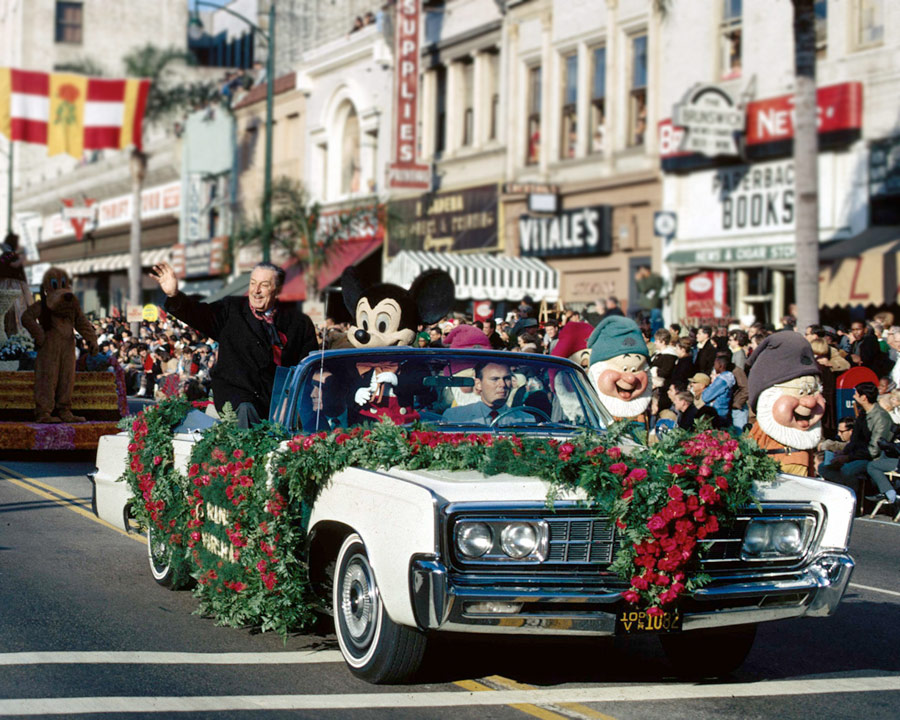
Eleven years later, the 77th Grand Marshal of the Rose Parade would be none other than Walt Disney himself. He proudly rode at the front of the parade with Mickey Mouse by his side. Interestingly, one of the spectators that year would be a young John Lasseter, future co-founder of Pixar, and another would be Pat Burke, one of the top future Imagineers.

In 1980, Disneyland was once again part of the parade when they presented a special pre-parade show celebrating the park’s 25th Anniversary. As part of the festivities, the Firehouse Five Plus Two was enticed out of retirement to make an encore Rose Parade appearance.

In 2000, another Disney became Grand Marshal of the Rose Parade. This time it was Walt’s nephew, and longtime Disney Board member, Roy E. Disney.

Image courtesy of caltech.edu
For the 115th Rose Parade in 2004, Disneyland Resort once again sponsored a float. This one was based on its newest attraction, the Twilight Zone Tower of Terror. Rising 100 feet above the street, this float would be the tallest in parade history.

Mickey Mouse would serve as the 116th Grand Marshal just a year later. Disneyland Resort’s 50th anniversary advertising campaign would also kick off during the commercial breaks of the parade’s television coverage. The following year a float with recreations of the castles from each of Disney’s five magical theme parks from around the world was featured.

Disney would have a small presence in the 2007 parade. A representation of Disneyland’s monorail would be part of the City of Anaheim’s sesquicentennial float. Six years later, a float based on Disneyland Resort’s newest area, Cars Land, would ride down Colorado Boulevard.

Image courtesy of KPCC
And, finally, in 2016, the longest, most massive float of the parade that year consisted of three distinct parts: a Frozen castle followed by Sleeping Beauty’s Castle (decorated for Disneyland’s 60th anniversary) with the Millennium Falcon bringing up the rear.

Year after year, the Tournament of Roses Parade (as it’s officially known) never fails to please, even in those years when it pours. And whenever Disney enters a float, it’s sure to be something spectacular. I, for one, look forward to all the collaborations between the two in the years to come.

Wednesday, December 19, 2018

December 16 - Roy Edward Disney

Image courtesy of wikipedia.com
On this day, in 2009, Roy Edward Disney, son of Roy O. and nephew of Walt, passed away in Newport Beach, California. Born January 10, 1930, Roy would end up being the last member of the Disney family to take an active part in the company his father and uncle created. He graduated from Pomona College, long considered to be the premier liberal arts college on the West Coast, in 1951 and began working in Hollywood, initially as an assistant editor when Dragnet made the move from radio to television. By 1954, he’d joined the family business as an assistant director and producer on the Tru-Life Adventure series. Six years later, Roy would earn an Oscar nomination for a short film he penned, Mysteries of the Deep.

After Walt’s death, Roy was elected to the company’s board of directors, a position he would hold off and on for the next few decades. Fiercely loyal to the ideals of the elder Disneys and staunchly supportive of all things animation, Roy would often have a cantankerous relationship with the company leaders who came after both founders passed away. In 1977, he resigned his position within Walt Disney Productions in protest over the direction the company’s entertainment division had been taking. He knew the string of mediocre-at-best live action movies the company had been throwing out, coupled with the fact that all the old school animators were disappearing without, in his opinion, being adequately replaced, were hurting the company. The Black Cauldron was still a few years away but Roy could see it coming. He retained his position on the board however and several years later, when the company faced a hostile takeover crisis, he stepped up to the plate to save the company.

Image courtesy of wikipedia.com
One of the first things Roy had to do in 1984 was create a group of investors large enough to keep the company together. In order to effectively do this, he resigned from his seat on the board. Once he had the necessary funding in place, he then set about forcing the current company president, Ron Miller, out. I’m sure this move made for some awkward moments at family reunions from that point on as Ron was married to Roy’s cousin (and Walt’s daughter), Dianne Disney. He then was instrumental in getting Frank Wells and Michael Eisner hired as president and CEO. When the dust settled, Roy came back to the company as vice chairman of The Walt Disney Company and chairman of the animation branch. Since Michael and Frank were like the second coming of Walt and Roy O, Roy E was heralded as a savior who put loyalty to the company over personal considerations.

Image courtesy of d23.com
Throughout the remainder of the Eighties and well into the Nineties, the Walt Disney Company experienced a rebirth. Animation hits like The Little Mermaid, Beauty and the Beast and The Lion King flowed out of the studio. All seemed rosy for the company, but tensions brewed behind closed doors. Roy clearly didn’t care for the new studio head, Jeffrey Katzenberg. He felt that Jeffrey took too much credit for recent successes and frequently overstepped his place in the scheme of things. When Frank Wells died in a helicopter accident in 1994, Jeffrey demanded a promotion. Roy told Eisner that he would start a proxy war if that happened. Roy would win this round. Jeffrey would leave the company (albeit with a large monetary payout) but his relationship with Eisner would slowly deteriorate over the next decade. This was partly due to the fact that, rather than replace Frank, Eisner simply took on the financial duties of the company (which was not a good move) and partly because the creative juices seemed to be drying up. Again, Home on the Range was a couple years off, but Roy saw it coming.

Image courtesy of mouseplanet.com
During this cooling off period between Roy and Eisner, a couple of bright spots did occur. In 1998, Roy was surprised when he was made an official Disney Legend. Then in December of 1999, Roy’s pet project, Fantasia 2000, was finally released to theaters. The film had been in production for nine years and was meant to fulfill his uncle’s dream of making the 1940 movie Fantasia an on-going, ever evolving picture. Like its predecessor, Fantasia 2000 combined classical music with high quality animation and mostly inventive story lines. And, like its predecessor, it didn’t do terribly well at the box office.

Image courtesy of nydailynews.com
By 2003, Roy’s relationship with Eisner had not only gone completely south but his influence within the company was evaporating as well, as most of the executives now owed their positions to Eisner. Roy once again resigned his positions with the company and began a second campaign to remove someone he saw as ruining the company from the top spot. Part smear campaign against Eisner, part rally-to-my-last-name-boys bravado, Roy’s efforts eventually worked after he managed to put together a coalition of 43% of shareholders that voted against Eisner at the 2004 meeting. It would take another 18 months of bitter pressure before Eisner would finally resign, but in the end, Roy won that round, too (sort of, Eisner’s second in command, Bob Iger, took the helm). He rejoined the board as Director Emeritus, a non-voting position (although he still retained 1% of all shares) and remained in that position until his death.

In 2008, Roy was diagnosed with stomach cancer, a disease he would battle for over a year before finally succumbing. His passing was truly the end of an era. Other Disneys of his generation were still around, but none of them took an active interest in the company that bears the family name and now even they are gone.