Showing posts with label Tower of Terror. Show all posts

Wednesday, January 9, 2019

January 6 - Disney-MGM Studios

Image copyright Disney
On this day, in 2008, the third Walt Disney World theme park, the Disney-MGM Studios, ceased to exist. Which sounds more dramatic than it really is. The theme park didn’t actually go anywhere, of course, it just suffered a name change to Disney's Hollywood Studios. But that is enough of an excuse to talk about a place that has become near and dear to my heart. The park opened on May 1, 1989 as a theme park, yes, but with a fully operational production studio layered on top. The concept for the park had actually started on a much smaller scale. In the mid-Eighties, Legendary Imagineer Marty Sklar had teamed up with Randy Bright with the task of creating two new pavilions for Future World in Epcot. The two lead a team that came up with plans for a health based pavilion called Wonders of Life and an entertainment pavilion known as the Great Movie Ride. When Michael Eisner became the head of the company, he looked at the Great Movie Ride and thought it might be better to make it the anchor for a third theme park. To that end, Disney signed a licensing agreement with Metro-Goldwyn-Mayer and the Disney-MGM Studios was born, at least on paper.

Image copyright Disney
As plans for the new park grew, it was decided that included would be television and film production facilities, a functional backlot area and an auxiliary animation department to the California studio. The animation studio was the first thing to open and it promptly caused problems. MGM filed a lawsuit claiming they only agreed to a theme park and didn’t know anything about new film productions at the site. The fact that MGM wanted to open (and eventually did open) their own theme park at their hotel in Las Vegas, may have had something to do with it. Disney would file a countersuit over that theme park. In 1992 a federal judge decided that there was enough money to go around that both parks could exist. Only one still operates today, however, making the whole thing an overly expensive, not to mention pointless, spat.

Image copyright Disney
Plans for the new park were further complicated when Universal Studios announced that they were going to build a theme park in Orlando that would be similar to the one that already existed in Southern California. Construction had begun on Disney-MGM in 1987 but was accelerated in order to beat Universal’s opening by as much as possible (Universal’s actual opening was so plagued by problems it might not have mattered, but that’s a discussion for another time).

When Disney’s version of studio opened in 1989, it only had two attractions to offer guests. One was the Great Movie Ride (from the original Epcot brainstorms) and the other was the Studio Backlot Tour, which was part tram ride (through Catastrophe Canyon) and part walking tour. The Little Theme Park That Could proved to be popular, though, and it began to change in subtle ways almost immediately. Part of the backlot, New York Street, was taken off the tram tour and opened to relieve pedestrian traffic as the Streets of America. Bit by bit, pieces of the backlot tour were made into their own attractions, mainly to help with traffic control, including the theater in the Animation Courtyard area that made me love the Studios (more about that in my next post).

Image copyright Disney
The park also began expanding almost from the beginning. Star Tours debuted before the end of that first year. In 1991, the Grand Avenue area opened featuring one of my favorite attractions, Muppet*Vision 3D. The next big expansion opened in 1994 when Sunset Boulevard appeared on the map and dead ended at the Twilight Zone Tower of Terror. Since then all sorts of changes have happened. Actual productions stopped happening (too late to matter to MGM). The animation studio packed its bags and moved to California. The backlot tour systematically phased itself out until it was closed and the entire area was demolished to make way for an expanded Star Wars area. A Pixar street was added with the ever popular Toy Story Midway Mania ride and then even more Pixar was added as Toy Story got it's own land. And then, seventeen months ago, the Great Movie Ride itself closed its doors to make way for a new Mickey Mouse based experience.

Image copyright Disney
When the Great Movie Ride closed, the argument could be made that the Disney-MGM Studios actually did cease to exist at that point, not with the name change nine years earlier. The park has changed and evolved so much since opening day that hardly any of the original park is left. It is poised to change even more later this year with the opening of Star Wars Land (yes, I'm aware it's called Galaxy's Edge, not Star Wars Land, I'm marginal on that name) but that's okay. Change is something Walt expected his theme parks to do and I think Disney's Hollywood Studios has done the best job of embracing that change of any of them. It's gone from being a place where movies are made to being the place that brings movies to life. Will it get another name change as it moves into the future? Bob Iger once hinted as such, some really terrible names were focus grouped and then denials were made about Bob's hint, so I honestly don't know (although I'm still pulling for The Pixstar Ranch). What I do know is that the Disney-MGM Studios... I mean Disney's Hollywood Studios (some habits really do die hard) becomes more relevant and more exciting with every change.

Friday, January 4, 2019

January 1 - The Rose Parade


On this day, in 1890, the Valley Hunt Club staged the very first Rose Parade in Pasadena, California. Held annually every year since then (even during both World Wars), the Rose Parade has become a fixture on New Year’s Day for hundreds of millions of people around the world. Except, of course, for those occasions when the parade happens on January 2. When are those occasions, you might scratch your head and ask. Whenever the first falls on a Sunday. The organizers of the fourth parade didn’t want to disturb the horses tethered outside of church services, so they delayed for twenty-four hours, creating a tradition that continues to today.

Image courtesy of remembertherosebowl.com
The best part of the parade, in my opinion, is how beautiful and creative the floats are. Right from the beginning, the organizers wanted to celebrate the mild climate of their fair city and covered their horse drawn carriages with live roses and other flowers. Today, it’s mindboggling to me how far float designers have moved beyond flowers. Seeds, grasses, bark, skins, you name it, every conceivable part of a plant is used to evoke all kinds of surfaces on gorgeous, colorful and, quite often, whimsical scenes. If you can’t tell, I really like this parade.

Image courtesy of disneyhistoryinstitute.com
Disney has a long history with the Rose Parade. It all started at the 39th Parade on January 1, 1938. The theme that year was Playland Fantasies. Snow White and the Seven Dwarfs had been triumphantly playing at the Carthay Circle Theatre for a week and a half and fit in perfectly. The live action model for Snow White, Marjorie Belcher, rode the float with the same costumed characters of the dwarfs that graced the film’s premiere.

In 1955, the 66th parade featured a float based on attractions from Disneyland, even though the park was still several months away from opening. Helms Bakery sponsored the float which boasted over 7,000 pink roses. In addition to the float, the Firehouse Five Plus Two, a jazz group made up of studio employees including Ward Kimball and Frank Thomas (two of the Nine Old Men), joined in the procession.

Image courtesy of the official Disney Parks blog
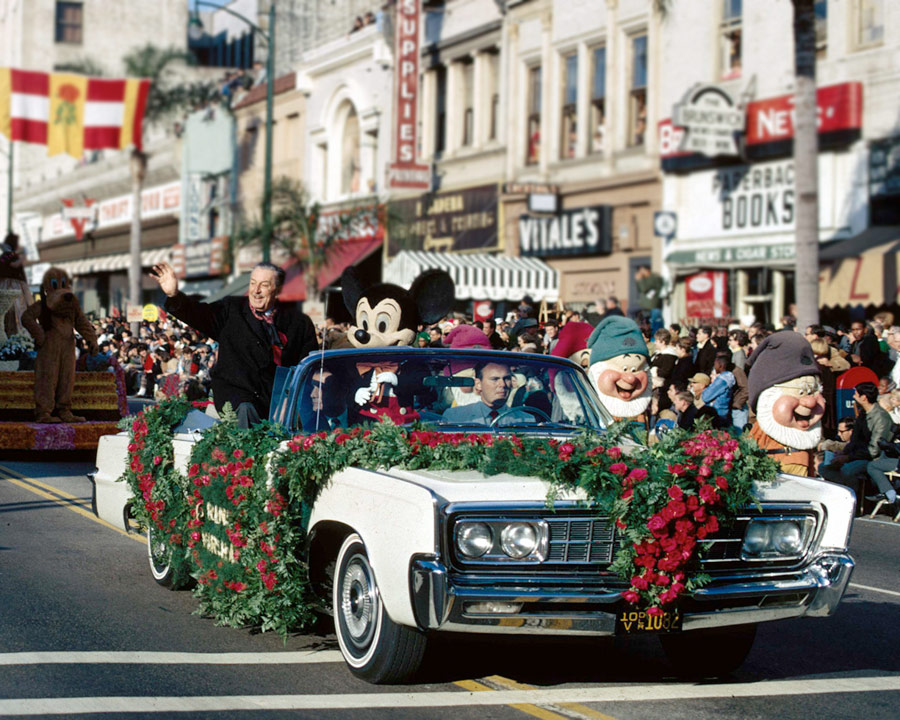
Eleven years later, the 77th Grand Marshal of the Rose Parade would be none other than Walt Disney himself. He proudly rode at the front of the parade with Mickey Mouse by his side. Interestingly, one of the spectators that year would be a young John Lasseter, future co-founder of Pixar, and another would be Pat Burke, one of the top future Imagineers.

In 1980, Disneyland was once again part of the parade when they presented a special pre-parade show celebrating the park’s 25th Anniversary. As part of the festivities, the Firehouse Five Plus Two was enticed out of retirement to make an encore Rose Parade appearance.

In 2000, another Disney became Grand Marshal of the Rose Parade. This time it was Walt’s nephew, and longtime Disney Board member, Roy E. Disney.

Image courtesy of caltech.edu
For the 115th Rose Parade in 2004, Disneyland Resort once again sponsored a float. This one was based on its newest attraction, the Twilight Zone Tower of Terror. Rising 100 feet above the street, this float would be the tallest in parade history.

Mickey Mouse would serve as the 116th Grand Marshal just a year later. Disneyland Resort’s 50th anniversary advertising campaign would also kick off during the commercial breaks of the parade’s television coverage. The following year a float with recreations of the castles from each of Disney’s five magical theme parks from around the world was featured.

Disney would have a small presence in the 2007 parade. A representation of Disneyland’s monorail would be part of the City of Anaheim’s sesquicentennial float. Six years later, a float based on Disneyland Resort’s newest area, Cars Land, would ride down Colorado Boulevard.

Image courtesy of KPCC
And, finally, in 2016, the longest, most massive float of the parade that year consisted of three distinct parts: a Frozen castle followed by Sleeping Beauty’s Castle (decorated for Disneyland’s 60th anniversary) with the Millennium Falcon bringing up the rear.

Year after year, the Tournament of Roses Parade (as it’s officially known) never fails to please, even in those years when it pours. And whenever Disney enters a float, it’s sure to be something spectacular. I, for one, look forward to all the collaborations between the two in the years to come.