Showing posts with label The Sword in the Stone. Show all posts

Saturday, July 6, 2019

June 26 - Woolie Reitherman

Image courtesy alchetron.com
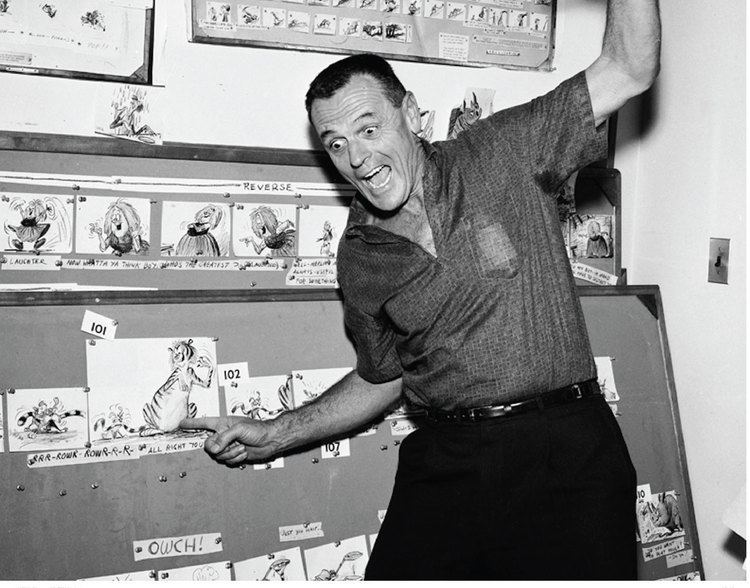
On this day, in 1909, Wolfgang Reitherman was born in Munich, Bavaria, Germany. Woolie, as he was generally known, and his family moved to Southern California when he was but a babe. He graduated from Pasadena Junior College and became a draftsman for the Douglas Aircraft Company. His interest in the more artistic side of drawing felt stifled at Douglas, however, and he began taking classes at the Chouinard Art Institute. Woolie graduated from Chouinard in 1933 and was immediately hired on at the Walt Disney Studio as an animator.

Woolie began in the Shorts Department (of course, it was the only department for a few more years) with his first project, the Silly Symphony Funny Little Bunnies. He then lent his talents to classics like The Band Concert, Elmer Elephant and Goofy and Wilbur. As most of the crew was being pulled into the new Features Department in the mid Thirties, Woolie was tasked with doing all the Magic Mirror sequences for Snow White and the Seven Dwarfs. He continued to mostly work on features from that point on. For Pinocchio, he was in charge of the dramatic parts with Monstro the Whale and he specialized in action sequences after that.

Image courtesy d23.com
Woolie's talent, combined with his seemingly endless amount of energy, helped him rise to the top of studio's animation pool and he became part of the elite group Walt affectionately called his Nine Old Men. He managed to tackle the dinosaur fight in the Rite of Spring part of Fantasia and produce several scenes with Timothy Q. Mouse in Dumbo before World War II interrupted his career. In 1942, Woolie left the studio to join the United States Air Force. He served as a pilot in Africa, India, China and the South Pacific,  becoming an ace and earning both the rank of Major and the Distinguished Flying Cross. He received an honorable discharge in 1946 and returned to work at the Walt Disney Studio.

Image copyright Disney
Following the war, Woolie slipped back into his old role of head animator directing parts of Fun and Fancy Free as well as the Headless Horseman for The Adventures of Ichabod and Mr Toad. Over the next dozen years he directed sequences in Cinderella (Gus Gus and Jacques), Alice in Wonderland (the White Rabbit), Peter Pan (Captain Hook and Tick-Tock Croc), Lady and the Tramp (Tramp and the rat) , Sleeping Beauty (Prince Phillip's fight with Maleficent) and One Hundred and One Dalmatians (the Twilight Bark). Then, in 1963, Walt did something he'd never done before and made Woolie the sole director of The Sword in the Stone (up to that point multiple directors were in charge of various scenes in a film).

Image copyright Disney
Following Stone, Woolie would continue to be sole director of whatever he did. His next project was Winnie the Pooh and the Honey Tree, the studio's first Pooh short. He then helmed The Jungle Book, followed by Winnie the Pooh and the Blustery Day, which won the Academy Award for Best Animated Short. When Walt passed away during the production of those last two films, Woolie was credited as the one that managed to corral everyone's egos and keep them focused on getting the job done without their guiding light of the last thirty years. For the remainder of his career, he also added the role of producer to his resume, the position formerly held by Walt.

Image copyright Disney
Woolie charged on successfully throughout the Seventies, adding his name to the list of the highest grossing directors in the process. He produced and directed Robin Hood, The Many Adventures of Winnie the Pooh and The Rescuers. His career ended on a slightly sour note. His last film for the studio was The Fox and the Hound, for which he was initially slated to co-direct. He had some pretty epic conflicts with Art Stevens, his co-director, however and was taken off the project, being left with a co-producing credit instead. Following that, he tried to get a couple of ideas off the ground only to be vetoed in favor of The Black Cauldron. Seeing the writing on the wall, Woolie chose to retire in 1981 after 47 years making animation magic.

Woolie's life ended tragically just a few years later. On May 22, 1985, the car he was driving veered into a tree blocks away from his Burbank, California home, killing him in the process. He was 75 and the third of the Nine Old Men to pass away. Four years later, Woolie would be officially named a Disney Legend along with the rest of the Men in just the second class of Legend inductees.


Friday, May 24, 2019

May 23 - George Bruns

On this day, in 1983, George Edward Bruns passed away in Portland, Oregon. Born on July 3, 1914 in Sandy, Oregon, George took plenty of music lessons as a child. His innate talent was evident early on as it didn’t take him long to master the piano, the tuba and the trombone. He began attending Oregon State Agricultural College (now known as Oregon State University) in 1932 and played with the ROTC band in order to afford the tuition. For some reason, George was an engineering student but he didn’t stay one for terribly long. By the age of twenty, he’d decided to drop out of school to be a full-time musician (every parent’s dream). Luckily for George (and ultimately the rest of us), that plan worked out for once.

For the rest of the Thirties and the first half of the Forties, George played with various local groups in the Portland area. Following World War II, he started his own band (which included Doc Severenson of The Tonight Show fame) and began playing gigs all over the Northwest. The group had to remain based in Portland because George’s regular job was musical director of radio station KEX. He also served as the bandleader in the ritzy Rose Bowl room at Portland’s Multnomah Hotel and would occasionally play trombone on recordings with the Castle Jazz Band.

Image courtesy vegalleries.com
In 1949, George moved to Los Angeles craving a bigger music scene than Portland could offer. He played tuba in a jazz band (you heard that right, tuba and jazz in the same sentence), created a night club act with his wife, singer Jeanne Gayle, and got the break of a lifetime. In 1953, George was asked to write the music for a short over at United Productions of America, Little Boy with a Big Horn. His work was impressive enough to grab some attention over at the Walt Disney Studio and he was hired the same year to arrange Tchaikovsky’s ballet music and write new score for the upcoming feature Sleeping Beauty.

Image copyright Disney
During production on Sleeping Beauty, Walt discovered he had a small problem in one of the shows that was being created for the Disneyland television show. There was a three and a half minute gap in an episode about this famous frontiersman. Did George think he could maybe write a song to take care of that? So George sat down with lyricist Tom Blackburn and churned out a little ditty called The Ballad of Davy Crockett. The success of that one song would have been more than enough to cement George’s place in Disney history (it certainly was enough to make him the studio’s musical director), but it was only the beginning.

Image copyright Disney
Over the next twenty years, George would score more than forty Disney films and television shows, starting with the remaining episodes of Davy Crockett. He wrote several songs for the first two seasons of The Mickey Mouse Club, including Talent Roundup (with studio nurse Hazel George) and I Want to Be a Fireman. In one four year period, he would receive three Oscar nominations, first for Sleeping Beauty in 1959, then for Babes in Toyland in 1961 and finally for The Sword in the Stone in 1963. His most famous composition (in spite of what fans of Davy Crockett think) is hands down a song that plays on continuous loop at all times somewhere in the world: A Pirate’s Life for Me, penned with the legendary Imagineer X Atencio. His other highlights include the scores of One Hundred and One Dalmatians, The Jungle Book, The Aristocats, The Absent Minded Professor and The Love Bug. In 1973, George was nominated for an Academy Award a fourth time for a song he wrote with lyricist Floyd Huddleston, Love from Robin Hood.


After scoring Herbie Rides Again, George retired from the Walt Disney Studio in 1976. He moved back to the Portland area, became a part-time music professor at Lewis and Clark College and continued to compose and play all of the instruments in his repertoire. He did record a new album of jazz music, but it never got much more than local play time. In May of 1983, George suffered a fatal heart attack at the age of 68. In 2001, for composing a large chunk of the soundtrack guests hear snippets of all around Disney theme parks in every corner of the world, he was posthumously declared an official Disney Legend.

Tuesday, February 5, 2019

January 29 - Bill Peet

On this day, in 1915, William Bartlett Peet was born in Grandview, Indiana. Bill was a typical Midwest boy in that he spent hours with his friends in the woods trying to catch animals, hours hanging around the local train station trying to catch a glimpse of the inner workings of the engines and hours getting in the way of the crews trying to set up the Big Top whenever the circus rolled into town. Bill was atypical in that he did all of those things in order to draw them. And whenever a conductor or crew foreman chased him away from what he was trying to sketch, he had already memorized the scene and could pretty nearly reconstruct it perfectly later on.

Bill wasn't terribly interested in a career as an artist, though, and enrolled at Arsenal Technical High School in Indianapolis. After failing every class but Gym, he reconsidered his life choices and started taking art classes. His talent would earn him a scholarship to attend the John Herron Art Institute at Indiana University. In the very first class he took, Bill met a young woman, Margaret Brunst, who would become Mrs. Peet in 1937, the same year Bill began working for a little animation studio in Burbank, California.

Image copyright Disney
After graduation, Bill heard that Disney was hiring artists, so he sent his portfolio off to California. He was accepted for a one month audition period along with 14 other young hopefuls. At the end of the month, Bill was one of only three who passed the test and he was put to work finishing up whatever needed to be done on Snow White and the Seven Dwarfs. When production on the First Feature was finally over, he moved into the Shorts Department as an inbetweener on Donald Duck cartoons. He was less than thrilled by the position. He submitted some character sketches to the team working on Pinocchio, but apparently it took too long for him to get some feedback. One day Bill stormed out of the studio, shouting "No more lousy ducks!" Fortunately, he had to come back the next day to retrieve a jacket he'd left behind. He found a letter on his desk saying he'd been promoted to the Story Department.

Bill spent the next several years as a sketch artist, turning scripts into storyboards for Pinocchio, Fantasia and Dumbo. By the end of World War II, he was a full fledged story man, one who could not only describe a character or scene but draw it too. He contributed story elements to classics like Song of the South, Cinderella, Lambert the Sheepish Lion, Ben and Me and Peter Pan. Bill and Walt worked closely together during this entire period, with mixed results on a personal level. Both men were not only passionate about their work, but both were unyielding when it came to their opinion on something. A minor quarrel blew up between them during the production of Sleeping Beauty, but it clearly wasn't anything too deeply felt. Walt tasked Bill with developing the script for the next film, One Hundred and One Dalmatians, allowing Bill to become the first person to get solo story credit for a Disney animated feature. He repeated the feat on the studio's next movie, The Sword in the Stone, but Stone wasn't as well received as Dalmatians and their relationship wouldn't survive much longer.

Early in production on The Jungle Book, Bill had taken Rudyard Kipling's stories and woven together what he thought was a masterpiece, leaving many of the darker, more dramatic parts intact. Walt took one look at his script, decided that the next movie was not going to be full of sinister tension and told Bill to lighten the whole thing way up. The argument that ensued became almost legendary. It ended with Walt replacing Bill as Jungle's story man and then Bill leaving the studio on his 49th birthday, January 29, 1964.

Image courtesy of Amazon.com
Following his abrupt departure from Disney, Bill became a highly successful children's author and illustrator. Many of the books he published were based on stories he'd developed for his own kids' bedtimes. His cautionary tale about man's relationship with nature, The Wump World, predated Dr. Seuss' The Lorax by a year. His version of Aesop's The Dove and the Ant, where he changed the dove to an elephant of all things, was adapted into a moderately successful children's musical. All told, Bill published 33 children's books over the two and half decades he was active as an author, some of them still in print today. In 1989, he won the Caldecott Honor Book Award for his autobiography, Bill Peet: An Autobiography. Bill passed away quietly at his home in Studio City, California on May 11, 2002, after having survived a heart attack in the Seventies and throat cancer in the Nineties. He was 87.