Showing posts with label Thurl Ravenscroft. Show all posts

Wednesday, July 3, 2019

June 23 - The Enchanted Tiki Room

On this day, in 1963, the Enchanted Tiki Room began serenading guests in Disneyland's Adventureland. As WED Enterprises (today's Imagineering Department) was working on attractions for the 1964 World's Fair, they were also looking for ways to improve Disneyland. One of the technologies they were developing was a kind of robotics eventually trademarked as Audio-Animatronics (we'll see why they got that name in a bit). The first dive into that pool came when Walt brought a mechanical bird back from a trip to New Orleans and set his Imagineers to trying to upgrade its movements. The team then moved on to a figurine that tap danced like Buddy Epsen. They continued to expand their knowledge, making more and more complex figures and systems. Eventually they would wow audiences with a likeness of Abraham Lincoln at the Fair, but first Walt had his whiz kids work up a little something for Disneyland.


Originally, the Enchanted Tiki Room was going to be a Polynesian themed restaurant, filled with birds and flowers that would sing to guests as they ate. The large fountain in the middle of the theater was supposedly going to be a coffee service station. That plan was quickly abandoned in favor of more Audio-Animatronic figures appearing in a full blown show. Underneath the theater, was an enormous room filled floor to ceiling with all the computers necessary to run all the figures. Because of the enormous amount of heat generated by those computers, the Tiki Room became the first building in Disneyland to include air conditioning. While that might entice guests into the show today, it actually wasn't as much of a selling point in 1963; the technology itself was impressive enough to fill the seats.


Image courtesy electro-tech-online.com
By today's standards, the birds, flowers and totems of the Tiki Room are so basic they aren't even sophisticated enough to be considered quaint. But for guests of the time, watching an entire room seemingly come alive by itself was amazing. How did they do that? was a question pretty much on everyone's lips. A lot of folks today probably think they know how they did that, but most of them would only be partially right at best. The clue comes from how the technology was named, Audio-Animatronics. Yes there an electrical impulse that moved something mechanical, but that impulse was actually initiated by sound.


Image courtesy pinterest.com
Each individual movement requires its own channel and each channel requires its own reel of magnetic tape, that's why figures in the Tiki Room are so simple. Less movements means less reels which means less computers that need to stay synched up. Every movement has two positions, a resting place and a moved place. In other words the movement is either on (moved) or it is off (resting). Each reel of magnetic tape has a certain tone recorded on it that, when played, vibrates a metal reed, closing a circuit, sending a pulse of electricity to a pneumatic (or air driven) valve that causes whatever movement it’s connected to (eye blink, wing flap, mouth opening, etc). When the electrical pulse is spent, the movement returns to its resting position and waits for the next one. The tones are laid out on the tape at precise intervals to make, in the Tiki Room’s case, it appear that all the figures are dancing and singing in time with a recorded soundtrack. That’s why it took an entire room of computers, running hundreds of reels of tape to make the whole thing work. Nowadays, of course, we have fancy computing systems with enough power that you could probably run a set up like the Tiki Room from a couple of laptops (and hardly anyone even knows what magnetic tape is), but in 1963 this was top of the line stuff.


Image courtesy undercovertourist.com
As mind boggling as the technology was, Walt didn’t rely solely on gizmo’s to make the show work. He got the Sherman Brothers to write another earworm, The Tiki Tiki Tiki Room (they were writing their slightly more famous earworm, It’s a Small World, around the same time). He got the best voices he could find for his four macaw stars, half of which actually came from in-house. Wally Boag and Fulton Burley, who played the Mexican bird, Jose, and the Irish bird, Michael, respectively, were regular cast members across the park at the Golden Horseshoe Revue in Frontierland for decades. The quartet is rounded out by Thurl Ravenscroft (who also appears in The Haunted Mansion) as Fritz, the German parrot, and Ernie Newton (who was also the singing voice of Boo-Boo Bear) as Pierre, the French parrot. Walt also had some of his best Imagineers working on how the figures looked, Legends like Harriet Burns and Joyce Carlson. The attention to detail paid off.

Image copyright Disney
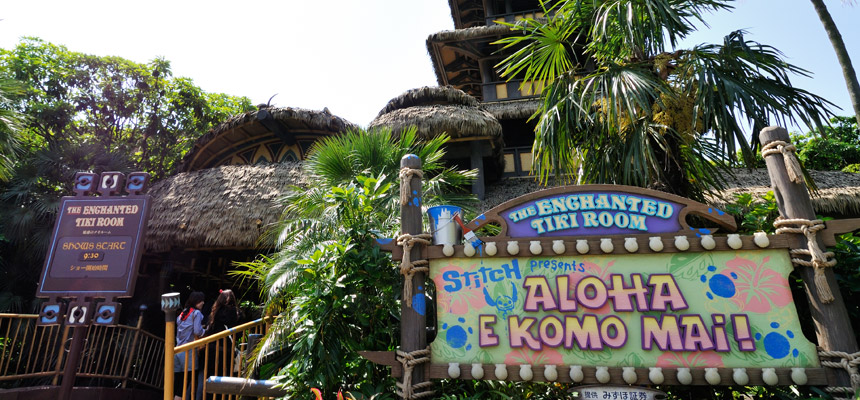
The Enchanted Tiki Room was a hit from the beginning. An extra Audio-Animatronic bird, placed near the entrance in an effort to get people to come see the show, caused traffic jams of guests trying to see just what this new thing was. Interestingly, entrance to the Tiki Room cost an extra 75 cents, supposedly because technically WED Enterprises owned it, not Disneyland, and it was therefore a separate attraction from the rest of the park. The popularity of the show saw an identical version installed in the Magic Kingdom in Walt Disney World right on time for opening day and Tokyo Disneyland was also Enchanted at its opening. The first two Tiki Rooms are still running just as they did back in the day (we won’t talk about the couple of years that Florida’s version was “Under New Management”), albeit with upgrades in the technology that run them, but Tokyo’s has undergone a complete revision. It’s now a Stitch themed Hawaiian show and no longer uses the original theme song. Speaking of which, you know you’re dying to sing a few verses of it, so All together now, in the tiki, tiki, tiki, tiki, tiki room, in the tiki, tiki, tiki…

Thursday, May 23, 2019

May 22 - Thurl Ravenscroft


Image courtesy discogs.com
On this day, in 2005, Thurl Arthur Ravenscroft passed away in Fullerton, California. Born in Norfolk, Nebraska on February 6, 1914, Thurl hit the road soon after high school, landing in Los Angeles, California. He began an art education at the Otis College of Art and Design. While at Otis, he became part of a singing quartet known as the Sportsmen Quartet. They could frequently be heard on Jack Benny’s radio show. Thurl’s first brush with the Walt Disney Studio came in 1940. The singing group he was a part of (it’s usually credited as the Mellomen, but that group didn’t form until 1948, so it may have been the Sportsmen) sang a song for Pinocchio called Honest John. The song was cut from the final film. Some sources claim it only ever existed for promotional purposes, but parts of the melody can be heard underscoring scenes with Foulfellow and Gideon, so who really knows anymore. Thurl himself got to remain in the film, though, as he had also been recorded as Monstro the Whale’s ‘voice.’ 

Image copyright Disney
In 1948 (as near as I can tell), Thurl got together with a few friends a formed a quartet usually known as The Mellomen (they recorded under a variety of names over the years). In addition to singing backup to the likes of Doris Day, Bing Crosby, Peggy Lee and Elvis Presley, the Mellomen made appearances in all sorts of Disney projects. You can hear them as the guards painting the roses red in Alice in Wonderland, pirates and native Americans in Peter Pan, the dogs in the pound in Lady and the Tramp, the elephant patrol in The Jungle Book, the trees in Babes in Toyland, singing the opening to Zorro, as the Honeypot Quartet in the Winnie the Pooh shorts and singing A Pirates Life for Me throughout the Pirates of the Caribbean ride. The group was also featured on several episodes of the Disneyland anthology television series and Disneyland Records albums. The Mellomen performed together well into the Seventies before running out of steam and harmonizing their way into the sunset. 

Image copyright Disney
Thurl not only racked up an impressive list of Disney credits with his quartet, but he holds iconic solo roles, too. In one of them, he actually gets the dubious distinction of being mistaken for Walt Disney more than anyone else, ever. Have you ever had someone try to tell you that one of the singing busts in the graveyard scene of the Haunted Mansion was Walt himself? It’s not. It’s actually Thurl (must be the whole mustache thing). And for those of you who wonder about that sort of thing, his bust has a name: Uncle Theodore. He is also the voice of the drunken pirate in Pirates of the Caribbean, Buff, the American bison head, in the Country Bear Jamboree, and the first mate on the Mark Twain Riverboat. Thurl can also still be heard every half hour or so in The Enchanted Tiki Room as Fritz, the German accented macaw.  

Image copyright Disney
Lest you think that Thurl only soloed when it came to Disney attractions, you might recognize his deep bass from any one of the following Disney films: Paul Bunyan in the short Paul Bunyan (what else), Captain the Horse in One Hundred and One Dalmatians, Sir Bart in The Sword in the Stone, Billy Bass, the Russian Cat, in The Aristocats and Kirby in The Brave Little Toaster series (while not created by Disney, they were distributed by the company). In 1995, Thurl was declared an official Disney Legend for all the incredible voice work he’d done over the years. 

Image copyright Kellogg's
Thurl didn’t do a whole lot of voice work outside of Disney, but what he did do is instantly recognizable. He is the uncredited singing voice of the Grinch in holiday classic How the Grinch Stole Christmas. He sang the song No Dogs Allowed for the 1972 Peanuts special Snoopy Come Home. But one of his most famous roles was one he first did in 1953 and continued doing until 2005, long after he’d retired from everything else. For 52 years, Thurl was the (until the end) uncredited voice behind Tony the Tiger, telling everyone how Grrreat! Kellogg’s Frosted Flakes are. He’s been replaced as Tony since then by Lee Marshall, but if you listen closely to the commercials, every once in a while you can still hear a recycled bit of Thurl. Only a few months after recording his last tagline, the great bass voice succumbed to prostate cancer at his home in Fullerton, California. He was 91.