Showing posts with label Audio-Animatronics. Show all posts

Monday, July 22, 2019

July 18 - Great Moments with Mr. Lincoln

Image copyright Disney
On this day, in 1965, Great Moments with Mr. Lincoln, an Audio-Animatronic show, began wowing guests on Main Street USA in Disneyland.  In the late Fifties, Walt wanted to expand the Main Street USA area of Disneyland, specifically by building an attraction that was a tribute to the Presidents of the United States, all 34 of them up to that point. The problem was that Walt's vision had outpaced the technology of the day. There just was no physical way to create the show he had planned in his head, even if he had unlimited amounts of money to do it. The idea had to be shelved and the expansion never happened.

Several years later, as Disney was signing contracts to provide rides and shows for the 1964 World's Fair, the Imagineers of WED Enterprises brought a prototype of a new technology to show their boss. Since they couldn't make a show with 34 moving Presidents, they'd been focusing on making a single mechanical man in the likeness of Walt's boyhood hero, Abraham Lincoln. The Imagineers had managed to create something that, although quite primitive by today's standards, was kind of magical. Walt was intrigued by it, convinced the state of Illinois they needed it for their Fair pavilion and got them to foot the bill for constructing it.

Image courtesy pinterest.com
The first attraction with Audio-Animatronic technology to open was the Enchanted Tiki Room in 1963. Compared to Great Moments with Mr. Lincoln, though, the Tiki Room is simplicity itself. A few beaks open and close, some wings flutter and eyes blink (granted this occurs on over a hundred different figures at once, but still). As impressed as guests were by singing birds and crooning flowers, they were floored by what what they saw in the Illinois pavilion. Great strides had been made in Audio-Animatronics in a short time. Not only did Lincoln speak and gesture and address different parts of the audience, but HE STOOD UP FROM HIS CHAIR! WHAT IS THIS SORCERY? Audiences marveled at the life-like qualities of the figure in the show and made Illinois one of the must-see attractions of the Fair.

Image copyright Disney
When the last guest had passed through the 1964 World's Fair, the Disney attractions were hands down some of the highlights of the whole affair. They were already pretty much paid for by the pavilions that had commissioned them and were already popular with guests, so it was natural that Walt would want to incorporate them into Disneyland. Three of the four attractions were installed whole while just the Audio-Animatronic dinosaurs from the Ford Pavilion made their way into part of the Disneyland Railroad. Great Moments with Mr. Lincoln found its way to Main Street USA (although it was a duplicate attraction, the original was believed to have been lost when the Illinois pavilion was completely demolished; turns out, the original figure was actually carefully packed up, delivered to California, strangely forgotten and discovered years later in storage), it's a small world took over Fantasyland and the Carousel of Progress landed in Tomorrowland. All four of them can still be seen today.

Image courtesy insidethemagic.net
Great Moments with Mr. Lincoln ran at Disneyland until 1972 before undergoing its first rewrite. The new show that opened in the space, The Walt Disney Story, actually didn't include the figure of Lincoln for the first three years. He was reinstated as part of the show in 1975, after thousands of guests asked where he went. And that's has been his status since then. Eventually a new gets written that leaves old Abe out and eventually he has to be written back in because people love and miss him. You can see him as part of the current show, The Disneyland Story Presenting Great Moments with Mr. Lincoln. His technological aspects have been updated over the years making him still just as cool to watch as when he first stood up to illuminate guests over fifty years ago. Oh, and Walt did finally get that tribute to the Presidents he wanted, he just didn't live long enough to see it happen. You can see it at the Hall of Presidents in Liberty Square at the Magic Kingdom in Walt Disney World (now with forty-five moving figures!).

Wednesday, July 3, 2019

June 23 - The Enchanted Tiki Room

On this day, in 1963, the Enchanted Tiki Room began serenading guests in Disneyland's Adventureland. As WED Enterprises (today's Imagineering Department) was working on attractions for the 1964 World's Fair, they were also looking for ways to improve Disneyland. One of the technologies they were developing was a kind of robotics eventually trademarked as Audio-Animatronics (we'll see why they got that name in a bit). The first dive into that pool came when Walt brought a mechanical bird back from a trip to New Orleans and set his Imagineers to trying to upgrade its movements. The team then moved on to a figurine that tap danced like Buddy Epsen. They continued to expand their knowledge, making more and more complex figures and systems. Eventually they would wow audiences with a likeness of Abraham Lincoln at the Fair, but first Walt had his whiz kids work up a little something for Disneyland.


Originally, the Enchanted Tiki Room was going to be a Polynesian themed restaurant, filled with birds and flowers that would sing to guests as they ate. The large fountain in the middle of the theater was supposedly going to be a coffee service station. That plan was quickly abandoned in favor of more Audio-Animatronic figures appearing in a full blown show. Underneath the theater, was an enormous room filled floor to ceiling with all the computers necessary to run all the figures. Because of the enormous amount of heat generated by those computers, the Tiki Room became the first building in Disneyland to include air conditioning. While that might entice guests into the show today, it actually wasn't as much of a selling point in 1963; the technology itself was impressive enough to fill the seats.


Image courtesy electro-tech-online.com
By today's standards, the birds, flowers and totems of the Tiki Room are so basic they aren't even sophisticated enough to be considered quaint. But for guests of the time, watching an entire room seemingly come alive by itself was amazing. How did they do that? was a question pretty much on everyone's lips. A lot of folks today probably think they know how they did that, but most of them would only be partially right at best. The clue comes from how the technology was named, Audio-Animatronics. Yes there an electrical impulse that moved something mechanical, but that impulse was actually initiated by sound.


Image courtesy pinterest.com
Each individual movement requires its own channel and each channel requires its own reel of magnetic tape, that's why figures in the Tiki Room are so simple. Less movements means less reels which means less computers that need to stay synched up. Every movement has two positions, a resting place and a moved place. In other words the movement is either on (moved) or it is off (resting). Each reel of magnetic tape has a certain tone recorded on it that, when played, vibrates a metal reed, closing a circuit, sending a pulse of electricity to a pneumatic (or air driven) valve that causes whatever movement it’s connected to (eye blink, wing flap, mouth opening, etc). When the electrical pulse is spent, the movement returns to its resting position and waits for the next one. The tones are laid out on the tape at precise intervals to make, in the Tiki Room’s case, it appear that all the figures are dancing and singing in time with a recorded soundtrack. That’s why it took an entire room of computers, running hundreds of reels of tape to make the whole thing work. Nowadays, of course, we have fancy computing systems with enough power that you could probably run a set up like the Tiki Room from a couple of laptops (and hardly anyone even knows what magnetic tape is), but in 1963 this was top of the line stuff.


Image courtesy undercovertourist.com
As mind boggling as the technology was, Walt didn’t rely solely on gizmo’s to make the show work. He got the Sherman Brothers to write another earworm, The Tiki Tiki Tiki Room (they were writing their slightly more famous earworm, It’s a Small World, around the same time). He got the best voices he could find for his four macaw stars, half of which actually came from in-house. Wally Boag and Fulton Burley, who played the Mexican bird, Jose, and the Irish bird, Michael, respectively, were regular cast members across the park at the Golden Horseshoe Revue in Frontierland for decades. The quartet is rounded out by Thurl Ravenscroft (who also appears in The Haunted Mansion) as Fritz, the German parrot, and Ernie Newton (who was also the singing voice of Boo-Boo Bear) as Pierre, the French parrot. Walt also had some of his best Imagineers working on how the figures looked, Legends like Harriet Burns and Joyce Carlson. The attention to detail paid off.

Image copyright Disney
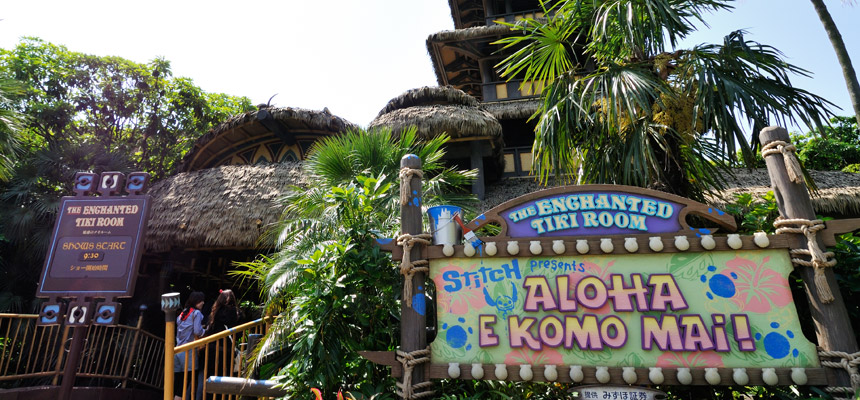
The Enchanted Tiki Room was a hit from the beginning. An extra Audio-Animatronic bird, placed near the entrance in an effort to get people to come see the show, caused traffic jams of guests trying to see just what this new thing was. Interestingly, entrance to the Tiki Room cost an extra 75 cents, supposedly because technically WED Enterprises owned it, not Disneyland, and it was therefore a separate attraction from the rest of the park. The popularity of the show saw an identical version installed in the Magic Kingdom in Walt Disney World right on time for opening day and Tokyo Disneyland was also Enchanted at its opening. The first two Tiki Rooms are still running just as they did back in the day (we won’t talk about the couple of years that Florida’s version was “Under New Management”), albeit with upgrades in the technology that run them, but Tokyo’s has undergone a complete revision. It’s now a Stitch themed Hawaiian show and no longer uses the original theme song. Speaking of which, you know you’re dying to sing a few verses of it, so All together now, in the tiki, tiki, tiki, tiki, tiki room, in the tiki, tiki, tiki…

Saturday, February 16, 2019

February 9 - Bill Justice

On this day, in 1914, William Barnard Justice was born in Dayton, Ohio. Raised in Indianapolis, Indiana, Bill was a student at John Herron Art Institute, now a part of Indiana University. He graduated in 1935 and moved out to southern California. In 1937, he became a part of the Walt Disney Studio. Bill may have started his Disney career as an animator, like all of the company greats, but he would go on to do a little bit of everything (and do it all spectacularly).

Bill lent his animation skills to feature films like Fantasia, The Three Caballeros, Alice in Wonderland and Peter Pan. He's best known in that arena for his work on Thumper in Bambi. He also worked in the Shorts Department, most notably as a lead animator for Chip and Dale.

Image copyright Disney
In the mid-Fifties, Bill started directing. One of his first projects in the director's chair was the opening march for The Mickey Mouse Club. He went on to direct The Truth About Mother Goose in 1957, Noah's Ark in 1959 and A Symposium on Popular Songs in 1962. All three of those shorts were nominated for Academy Awards. He didn't get any statues to put on his mantle, but that's still an impressive run.

Image copyright Disney
In the early Sixties, Bill was busy redesigning character costumes for Disneyland as well as coming up with the floats for the park's first Christmas parade. He also made early sketches for the Main Street Electrical Parade. The natural result of these projects was his transfer into the Imagineering department. That's when Bill became more of an engineer than an animator, although he still remained an artist. He got involved with the development of Audio-Animatronics and was soon an expert on programming them. He would be responsible for the movements of figures in Great Moments with Mr. Lincoln, Carousel of Progress, Mission to Mars, Pirates of the Caribbean, The Haunted Mansion, Country Bear Jamboree and America Sings (just to give some highlights). When Walt Disney World opened, Bill had his hand in the Hall of Presidents and the Mickey Mouse Revue as well.

Image courtesy imaginerding.com
Bill retired from Disney in 1979. In 1992, he published his autobiography, detailing his career, called Justice For Disney. He was made an official Disney Legend in 1996 for his amazing contributions, spanning practically every department in the company for 42 years. In his later years, Bill loved to attend Disneyana conventions, chat with people and (to the annoyance of ever hotel he stayed in) draw Disney characters on linen napkins.He passed away in his sleep at a nursing home in Santa Monica, California on February 10, 2011. He was 97 years 1 day old.

Tuesday, October 23, 2018

October 22 - Roger E. Broggie

On this day, in 1908, mechanical engineer Roger Edward Broggie was born in Pittsfield, Massachusetts. By 1927, he'd moved to a little town just west of Chicago and attended from Mooseheart High School. Roger had taken some machine shop courses while in school and was, quite frankly, a genius when it came to tools and mechanical objects. He moved further west after graduation, landing in  Los Angeles. Roger almost immediately got into the motion picture business, working for companies like Technicolor and Bell and Howell, a company that built things like movie cameras. He soon found himself on the lots of General Service Studios working with such legends as David O. Selznick and Charlie Chaplin.

In 1939, Roger found a position at the Walt Disney Studio, working closely with Ub Iwerks, installing the companies multiplane camera at their new Burbank location. While his official title may have been precision machinist, Roger spent a great deal of his time whipping up special effects with Ub. By 1949, Walt tapped Roger for a special project of his. Both men were avid train enthusiasts and, together, they would create the train for Walt's personal railroad, the Carolwood Pacific, famously located through Lillian's flower beds. Roger is credited with building the Lilly Belle, a 1/8th scale working steam engine for the backyard attraction.

Walt promoted Roger to the Head of the studio's Machine Shop in 1950. He was instrumental in creating the special effects for the epic movie 20,000 Leagues Under the Sea. In 1952, Walt created a new division to oversee the mechanical aspects of Disneyland. Called WED Enterprises at the time, it's been known as Walt Disney Imagineering since 1986. The very first employee hand picked to be a part of this new endeavor? Rogie E. Broggie.  As plans for Disneyland developed, Roger personally oversaw the creation of the Railroad, the Monorail and the Matterhorn Bobsleds.

One of the best innovations that Roger came up with was the one he created with Bert Brundage: the Omnimover ride system. First used in 1967 for Adventure Thru Inner Space, the Endless Transit System, as it's known outside of Disney, is a fairly ubiquitous sight in Disney parks. It transformed the concept of the Haunted Mansion away from a walk-through attraction and can be seen in various forms in everything from Buzz Lightyear's Space Ranger Spin at the Magic Kingdom to The Great American Chocolate Tour in Hershey, Pennsylvania. The main difference between the Omnimover system and mere continuous ride systems is that the individual cars in the Omnimover system can rotate and tilt as needed.

The other innovation that Roger helped develop were Audio-Animatronics. Roger and his co-workers in the machine shop were the ones who created the figure of Abraham Lincoln for the 1964 World's Fair. In the years that followed, he helped create countless refinements to that initial design that continue to amaze and delight guests to this very day.

As the company marched into the Seventies, Roger was as integral a part of making the Florida Project work as he was for Disneyland. Even after he finally retired in 1975, Roger would still lend his expertise to his Imagineering friends for pretty much the rest of his life. For his 36 years spent making so much of the magic possible, Roger was honored in several ways. First, Engine No. 3 of the Walt Disney World Railroad is the Roger E. Broggie. Second, he was given one of the most deserved titles of Disney Legend in 1991. Third, Roger was posthumously given his own window on Main Street, USA in Disneyland that reads "Can Do Machine Works, Mechanical Wonders, Live Steam Engines, Magical Illusions, Cameras, Roger E. Broggie Shopmaster, Advisor to the Magic Makers."

On November 4, 1991, the man about whom Michael Eisner once declared "Without him, Disneyland wouldn't have happened" quietly passed away in his Carmel, California home. He was 83.

Also on this day, in American history: Pretty Boy Floyd