Friday, January 4, 2019

January 1 - The Rose Parade


On this day, in 1890, the Valley Hunt Club staged the very first Rose Parade in Pasadena, California. Held annually every year since then (even during both World Wars), the Rose Parade has become a fixture on New Year’s Day for hundreds of millions of people around the world. Except, of course, for those occasions when the parade happens on January 2. When are those occasions, you might scratch your head and ask. Whenever the first falls on a Sunday. The organizers of the fourth parade didn’t want to disturb the horses tethered outside of church services, so they delayed for twenty-four hours, creating a tradition that continues to today.

Image courtesy of remembertherosebowl.com
The best part of the parade, in my opinion, is how beautiful and creative the floats are. Right from the beginning, the organizers wanted to celebrate the mild climate of their fair city and covered their horse drawn carriages with live roses and other flowers. Today, it’s mindboggling to me how far float designers have moved beyond flowers. Seeds, grasses, bark, skins, you name it, every conceivable part of a plant is used to evoke all kinds of surfaces on gorgeous, colorful and, quite often, whimsical scenes. If you can’t tell, I really like this parade.

Image courtesy of disneyhistoryinstitute.com
Disney has a long history with the Rose Parade. It all started at the 39th Parade on January 1, 1938. The theme that year was Playland Fantasies. Snow White and the Seven Dwarfs had been triumphantly playing at the Carthay Circle Theatre for a week and a half and fit in perfectly. The live action model for Snow White, Marjorie Belcher, rode the float with the same costumed characters of the dwarfs that graced the film’s premiere.

In 1955, the 66th parade featured a float based on attractions from Disneyland, even though the park was still several months away from opening. Helms Bakery sponsored the float which boasted over 7,000 pink roses. In addition to the float, the Firehouse Five Plus Two, a jazz group made up of studio employees including Ward Kimball and Frank Thomas (two of the Nine Old Men), joined in the procession.
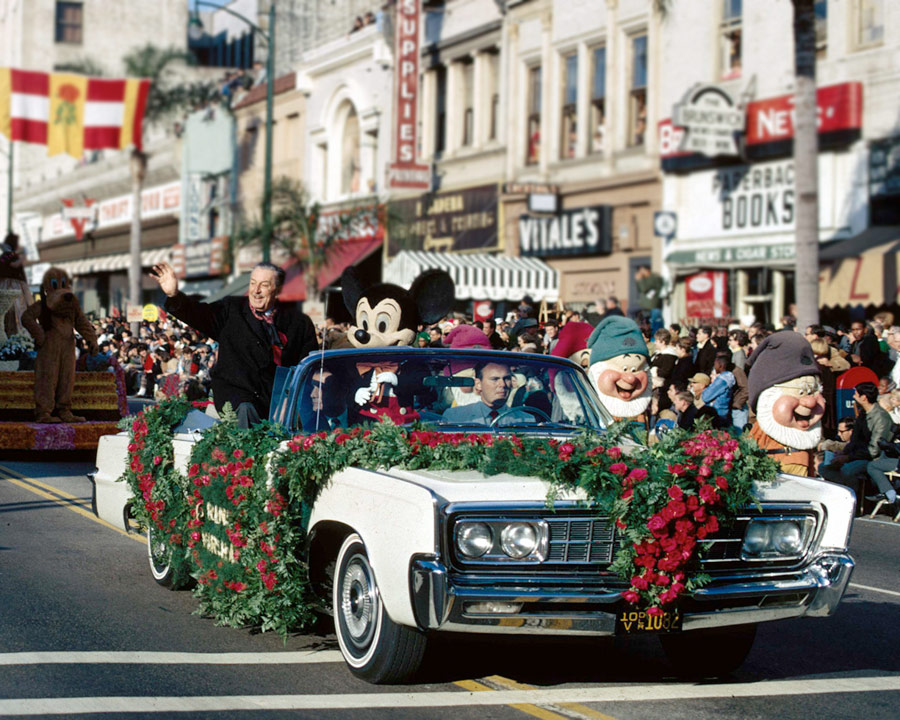
Image courtesy of the official Disney Parks blog
Eleven years later, the 77th Grand Marshal of the Rose Parade would be none other than Walt Disney himself. He proudly rode at the front of the parade with Mickey Mouse by his side. Interestingly, one of the spectators that year would be a young John Lasseter, future co-founder of Pixar, and another would be Pat Burke, one of the top future Imagineers.

In 1980, Disneyland was once again part of the parade when they presented a special pre-parade show celebrating the park’s 25th Anniversary. As part of the festivities, the Firehouse Five Plus Two was enticed out of retirement to make an encore Rose Parade appearance.

In 2000, another Disney became Grand Marshal of the Rose Parade. This time it was Walt’s nephew, and longtime Disney Board member, Roy E. Disney.

Image courtesy of caltech.edu
For the 115th Rose Parade in 2004, Disneyland Resort once again sponsored a float. This one was based on its newest attraction, the Twilight Zone Tower of Terror. Rising 100 feet above the street, this float would be the tallest in parade history.

Mickey Mouse would serve as the 116th Grand Marshal just a year later. Disneyland Resort’s 50th anniversary advertising campaign would also kick off during the commercial breaks of the parade’s television coverage. The following year a float with recreations of the castles from each of Disney’s five magical theme parks from around the world was featured.

Disney would have a small presence in the 2007 parade. A representation of Disneyland’s monorail would be part of the City of Anaheim’s sesquicentennial float. Six years later, a float based on Disneyland Resort’s newest area, Cars Land, would ride down Colorado Boulevard.

Image courtesy of KPCC
And, finally, in 2016, the longest, most massive float of the parade that year consisted of three distinct parts: a Frozen castle followed by Sleeping Beauty’s Castle (decorated for Disneyland’s 60th anniversary) with the Millennium Falcon bringing up the rear.

Year after year, the Tournament of Roses Parade (as it’s officially known) never fails to please, even in those years when it pours. And whenever Disney enters a float, it’s sure to be something spectacular. I, for one, look forward to all the collaborations between the two in the years to come.

Thursday, January 3, 2019

December 31 - Virginia Davis

Image courtesy of d23.com
On this day, in 1918, Virginia Davis was born in Kansas City, Missouri. Just five years later, Virginia would be hired by a young upstart named Walt Disney to star in a film he was producing at the Laugh-O-Gram studio, Alice's Wonderland. The picture was a combination of live action footage of Virginia in an animated universe. Unfortunately, it was also more expensive to produce than the little studio could handle. Laugh-O-Gram went belly up and, if the story involved anyone other than Walt, Virginia's career would have over as soon as it began.

Image copyright Warner Brothers
Walt traveled west, however, carrying few things with him other than the print of Alice's Wonderland. He managed to restart his studio based on that print but was convinced that he wouldn't make it without his star. It apparently didn't take much to convince Virginia's parents that a move to Hollywood was in everyone's interest. Over the next two years, she would star in 15 Alice Comedies, as the series became known. Margie Gay, the next actress to portray Alice, would star in more than twice as many but it's Virginia who has become synonymous with the role. A tomboy at heart, she often said her favorite short was Alice's Wild West Show, because she got to act tough in that one.

Image courtesy findagrave.com
Following her final Alice short in 1925, Virginia was cast in the First National Pictures production The Greater Glory. This lead to a contract with famed actor of the era Harry Carey (not to be confused with the Cubs announcer). Over the next eighteen years, Virginia sang, danced and acted her way through dozens of films including Three On a Match, Flying Down to Rio and Westerns like Hands Across the Rockies. She even did some voice tests for Snow White and the Seven Dwarfs, but wasn't ultimately hired for it.

Like many women of the time, Virginia's career came to an end when she married a Navy aviator in 1943. Over the next several decades, she spent her time raising two daughters and occasionally working as a real estate agent. She became an official Disney Legend in 1988 for being the girl who launched the company. Virginia passed away in her sleep at her home in Corona, California on August 15, 2009. She was 90 years old.

December 30 - Bill Tytla

Image courtesy of d23.com
On this day, in 1968, Vladimir Peter Tytla passed away at home on his farm in Flanders, Connecticut. Bill, as he was known, came into this world on October 25, 1904 in Yonkers, New York as the son of Ukrainian immigrants. Supposedly at the age of nine, he saw Winsor McCay's Gertie the Dinosaur and instantly fell in love with the medium of animation. While in high school, Bill started taking night classes at the New York Evening School of Industrial Design. It wasn't long before his love of art began to win out over his love of pretty much every other subject and he didn't bother going to high school anymore. By the time he was 16, Bill worked at the New York branch of Paramount Studios doing the lettering for their title cards.

Image courtesy of Wikipedia.com
Bill soon moved over to the Raoul Barre Studio and began working on the Mutt and Jeff shorts. He then sign on with John Terry and eventually ended up at John's brother Paul's studio, Terrytoons. By this time, Bill was making a good living as an animator but the medium was a little simplistic and crass for his taste. He still dreamed of becoming a master artist. He enrolled in classes again, this time at the Art Students League of New York. Then, in 1929, he relocated to Paris, France and studied painting and sculpture. Unfortunately, being surrounded by the works of the old masters didn't help his confidence any. He ended up destroying most of his work from this period because of its inferiority and hightailed it back to America.

Determined that his studies would make him a master animator if not painter or sculptor, Bill resumed working for Terrytoons. He became good friends with a fellow artist there, Art Babbitt. When Art left New York for Hollywood and the Walt Disney Studio, he would spend the next two years trying to entice Bill to follow him. Bill resisted. He was making great money during the Great Depression after all. But finally, he decided to make a visit to his old friend Art. He was so impressed by the city and the studio, he took a pay cut to move there.

Image copyright Disney
Starting in 1935, Bill worked on Silly Symphonies like The Cookie Carnival and Mickey shorts like Mickey's Fire Brigade. His work was so filled with passion that he reportedly tore holes in his paper with his pencil. His work was also so incredibly good that Walt was quickly throwing money at him to get him to stay. Bill and Art became the studio's top money makers and even became roommates again, like they'd been while working at Terrytoons. That arrangement would stand until Bill's 30 year marriage began in 1938.

Image copyright Disney
When work began on Disney's first feature, Snow White and the Seven Dwarfs, Bill was one of the first animators assigned to the project. Working closely with Fred Moore, he designed the look of the whole film and helped define each of the dwarfs personalities. One of the best scenes in the film where you can experience Bill's talent is watching Grumpy's transformation after Snow White kisses him. Following the success of Snow White, Bill's next assignment was the villain of Pinocchio. His ability to express the strong inner feelings of the somewhat crazy kidnapper makes Stromboli marvelous to watch.

Image copyright Disney
Bill's followup to Stromboli would be the Giant in Brave Little Tailor. Ollie Johnston, one of Walt's Nine Old Men, rightly argues that the look, feel and personality of giants in cartoons was set once Bill had done it. The short was nominated for an Oscar but lost to another Disney short, Ferdinand the Bull. Bill then moved on to animating the sorcerer, Yen Sid, in The Sorcerer's Apprentice. Once that became part of the larger project of Fantasia, though, Bill would get assigned perhaps the most iconic character of his career, Chernabog. The fierce, domineering and downright scary demon is clearly only that way because Bill Tytla was his animator. Growing tired of drawing "heavies," as he put it, his next assignment was decidedly more light hearted. He got to become the title character of 1941's Dumbo, which he modeled partly on his baby son.

Image copyright Disney
Then came the infamous Disney Studio Strike of 1942. Even though he was one of the best paid animators, Bill sympathized with his friends and, to the consternation of Walt, joined them on the picket line. Even though he returned to work once the strike was over, it was never the same. The war economy meant much less stimulating assignments. For Saludos Amigos, Bill animated Pedro the airplane and Jose Carioca, neither much of a challenge for him. He lent his talent to a couple of wartime shorts, but his growing dread of a Japanese attack on California led him to make a decision he would regret for the rest of life. On February 24, 1943, Bill resigned from the Disney Studio and went to live on a farm he owned in Connecticut.

Image copyright Warner Brothers
For a while, Bill went back to work for Terrytoons as an animator but soon left to become a director at a Paramount owned studio, Famous Studios. Over the next decade he directed shorts featuring Popeye, Little Lulu, Casper the Friendly Ghost and Little Audrey. In the early Fifties, he joined Tempo Productions, a studio formed by former Disney compatriots David Hilberman and Zack Schwartz, and began producing animated television commercials for the likes of Camel cigarettes, Plymouth cars and Tide. His last project was on the 1964 Warner Brothers film The Incredible Mr. Limpet, which starred future Disney Legend Don Knotts.

During production on Limpet, Bill's health began to decline and, shortly after it wrapped, he suffered a series of small strokes that left him blind in one eye. Near the end of his life, he tried several times to return to Disney, but, since Walt had passed a couple of years before, he was told there wasn't a place for him anymore. The excuse was given that there wasn't enough work for the animators the company already had, but Bill's heart just became even heavier with regret. He would pass away in 1968, mere weeks after his final rejection. Thirty years later, in recognition of his animation genius he was made an official Disney Legend.

Wednesday, January 2, 2019

December 29 - Duncan Marjoribanks

Image courtesy animationguild.org
On this day, in 1953, Duncan Marjoribanks was born in Toronto, Ontario, Canada. Duncan grew up in a liberal family and was considered a far-out hippy type in high school. Painfully introverted, he was also incredibly smart and extremely talented at drawing. His talents would take him to the Sheridan Institute of Technology and Advanced Learning, Canada’s premiere school for animation located in Oakville, Ontario. Following his graduation from Sheridan in 1978, Duncan became part of a group that was hired by Hanna-Barbera prompting a move to Los Angeles, California. Duncan quickly became one of the studio’s top animators, working on shows like Scooby and Scrappy Doo and Godzilla. Then the great Animator’s Strike of 1982 happened. 

Image copyright CBS
The strike began as the union protested how much work was being sent overseas (where it was much cheaper to produce) and lasted for several months. The end result, ironically predictable, was that most US animation production disappeared. Duncan changed his career focus to designing characters and began freelancing for several studios. One of the projects he would work on, and his first as animator in a decade, was a short lived television series called Family Dog. It was created and directed by a guy named Brad Bird who was thoroughly taken with Duncan’s style and talent. Brad recommended Duncan to a friend of his, John Musker. John was starting a little project over at Disney about a mermaid and hired Duncan as the first animator on the team.
Image copyright Disney
Duncan became supervising animator for Sebastian the Crab on Disney’s 28th animated feature, The Little Mermaid. He took Samuel E. Wright’s marvelous vocal performance and the basic character designs that had already been done and created one of the most endearing and enduring characters that had been seen in decades. Don’t believe me? Just watch the scene when Sebastian finally decides to help rather than hinder Ariel and get back to me.
The success of The Little Mermaid led to Duncan staying on with Disney and supervising again for the next feature film, The Rescuers Down Under, this time for the villain, McLeach. While this film did end up being less successful, it was the grueling schedule that really took its toll on Duncan. By the time the last frame had been drawn, he needed more than a vacation and actually took a year off to live in England. Which doesn’t mean he didn’t work. He provided some character design for a short-lived Hanna-Barbera show called The Pirates of Dark Water.
Image copyright Disney
In 1991, Duncan returned to the states, and Disney, to begin supervising work on another great sidekick, Abu in Aladdin. As if his previous work wasn’t impressive enough, now he would create a memorable character without using words at all. His work in the film can also be seen in the opening sequence with the shady salesman. Duncan went right from Aladdin onto the team for Pocahontas and once again supervised a villain, Governor Ratcliffe. His portrayal of Ratcliffe was more cartoonish than the other characters, which give him more of a presence, but still this side of overly flamboyant, so he remains believable. Duncan was then slated to supervise Megera for Hercules but that never happened.

Image copyright Dreamworks SKG
Around this time, Jeffrey Katzenberg was making his spectacularly messy exit from Disney and starting his own studio, Dreamworks SKG, with Steven Spielberg and David Geffen. With big plans to stick it to his former employer, especially in the animation department, one of the first big talents Katzenberg poached was Duncan. The relationship didn't blossom the way anyone hoped. Duncan started out as supervising animator on Moses for Prince of Egypt but struggled with the job so much his only credit on the picture is plain old animator. He did some work on The Road to El Dorado, animating a few scenes with Tzekel-Kan and contributed some story ideas to Spirit: Stallion of the Cimarron before leaving Dreamworks for good. He spent a year over at Warner Brothers, working on the animated parts of the box office bomb Osmosis Jones (he did pretty good work on the movie but left before it was finished, unhappy with the direction it was taking), before returning to the fold at Disney in 2000.

Image copyright Disney
Unfortunately, Duncan's return to Burbank came at a time when the studio was producing its worst picture since The Black Cauldron. As supervising animator for Mrs. Calloway on Home on the Range, Duncan managed some moments of greatness but the movie was a critical and financial failure. Following that disaster, he was trained in computer animation and contributed to the Bowler Hat Guy for Meet the Robinsons. Duncan then got the privilege of working on Disney's last hand drawn feature, The Princess and the Frog, as head animator for Big Daddy La Buff. 

In 2009, Duncan and Disney parted ways once again. The company had decided to stop using traditional animation techniques and Duncan didn't feel comfortable working with CGI. The only thing he's really done since then was a hand drawn short utilizing the characters from Kung Fu Panda. Which is really a shame. Hopefully some day the talent behind Sebastian and Abu, who has inspired so many animators still working today, will himself find inspiration in some new project and give us all a reason to smile again.

Tuesday, January 1, 2019

December 28 - Walt Disney World Airport


Image courtesy of themouselets.com
On this day, in 1972, the last scheduled flights landed on the runway of Walt Disney World’s airport. That’s right, there was (and technically still might be) an airport on the property of the Florida Project located right next to the Magic Kingdom parking lot. The single airstrip is what is known as a STOLport. Those capital letters are an acronym for Short Take-Offs and Landings. In the early Seventies, the FAA was looking at the feasibility of creating hundreds of tiny airports around the country where small planes (we’re talking almost exclusively prop planes here)could make short trips, thus freeing up some of the congestion at large airports and on the nation’s highways. One STOLport was even considered for the top of a building in New York City. Disney naturally wanted in on the action.
Image courtesy of markey.bangordailynews.com
A single 2,000 foot long airstrip was built with enough space to park four planes. No actual hangar space was ever constructed and no cushy terminal ever existed. In spite of the Spartan accommodations, the airport actually saw quite a bit of action, albeit for a short period of time. Opening in October of 1971, the STOLport welcomed regularly scheduled guests from both the Tampa Airport and the Orlando Jetport at McCoy Air Force Base (now known as Orlando International). An outfit called Shawnee Airlines would land with a DHC-6 Twin Otter puddle jumper full of guests, drop them off and take off again to get more. The flight from McCoy was about 15 minutes (which, depending on how bad traffic is today, sounds fantastic). Eastern Airlines listed it as an extension option for fliers coming into Tampa and Orlando. Commercial planes weren’t the only ones to use the airport. VIP guests and celebrities would also frequently start their Disney World visits by stepping out of their private Cessnas onto the tarmac at the STOLport.

Image courtesy of micechat.com
The tiny airport, however became the victim of a perfect storm of problems. First, the company hoped to build an actual airport within a few years down around where the Animal Kingdom is now. That’s part of the reason no real facilities were ever built at the STOLport. They’d just need to be torn down when the real project took shape. However, the oil crisis heated up and company officials quickly realized that an operation that required a steady stream of fuel might not be a great idea. The FAA also deemed STOLports to be unfeasible (which means that roof top one never got past the planning stages unfortunately). Then Disney executives famously lost their nerve all together over most things, began to worry about the liability of plane crashes, couldn’t get any airlines to agree to help pay for it and pulled the plug. A little over a year after flights began, they ended.
Image copyright Disney
Over the remainder of the Seventies, there would occasionally be a plane that landed on the WDW airstrip but they became fewer and farther between. When construction began on EPCOT Center and the new monorail line was put in, coming really close to one end of the tarmac, they stopped altogether. When Walt’s personal plane, Mickey Mouse One, was flown in to be displayed at the Disney-MGM Studios in the late Eighties, it had to land on World Drive. Even though the FAA listed the airstrip as active well into the nineties, it hasn’t been anything more than a holding area for buses for over three decades now. And with all the new construction that’s been going on lately in that area of the World, I’m not even sure it still exists. But if it does, and you find yourself riding the monorail between Epcot and the Transportation and Ticket Center, you can now turn to your fellow passengers and say “Did I ever tell you the one about the Disney airport?”

December 27 - Jack Bradbury


Image courtesy of comicvine.gamespot.com
On this day, in 1914, John Morin Bradbury was born in Seattle, Washington. Jack was always interested in the comic strips he saw in the newspapers growing up and felt that drawing them must be a pretty great way to spend one’s time. So he practiced his skills as often as he could, waiting for an opportunity to break into the business. In 1933, he saw the Disney produced Silly Symphony The Three Little Pigs and not only was enamored of it himself, but noticed how everyone in town seemed to be talking about it. He heard rumors that the Disney Studio was hiring and sent a portfolio down to Hollywood. He was invited to come down for a two week trial run, mostly at his own expense. Jack put $50 in his pocket and took the offer. He passed the test and, at just 20 years of age, started his life in cartoons for the princely sum of $15 per week.
Image copyright Disney
For the next four years, Jack worked as an inbetweener on such classic Mickey Mouse shorts as The Band Concert and Through the Mirror. As work ramped up on Snow White and the Seven Dwarfs, he began working under Eric Larson and Milt Kahl. The employees of the studio were encouraged to work up their own little pieces of animation and actually have them filmed so they could be critiqued and given pointers on how to improve. As the big drive to finish Snow White wound down, Jack made a couple of those pieces and asked Ham Luske, who’d been supervising animator for Snow White’s title character, to look at them. Ham approved of them and showed them to Walt, who also approved.
Image copyright Disney
In 1938, Jack became a full animator. He worked on shorts like Ferdinand the Bull (one of his sequences is when Ferdinand sits on the bee) and Barnyard Symphony. He also lent a hand to the next several features the studio produced. Jack’s work can be seen in some of Figaro’s scenes in Pinocchio, the Pegasus family in Fantasia and the stage fight in Bambi. Then, in 1941, Jack got caught up in the big animator’s strike at the studio. After being out for several weeks, he was invited back to work when the strike ended but his return didn’t last long. By the end of the year, Jack was one of a number of animators who would be permanently laid off.
Image copyright Disney/Western Publishing
From 1942-44, Jack went across town to work for Friz Freleng at Warner Brothers, mostly working on Bugs Bunny shorts. Following his stint there, he went to work for American Comics Group working on comic book stories for characters like Fremont Frog and Spencer Spook. In 1947, Jack began working for Western Publishing, the company that produced comic books based on works by Disney, Walter Lantz and Warner Brothers. For the next 31 years, he drew practically every Disney character that existed for comic books and the Little Golden Books. He was so adept at it that Walt reportedly told Western that if Jack drew it, it didn’t need to be submitted for approval.

Starting in late 1969, Jack would begin to suffer from macular degeneration. As his eyesight worsened, he gradually moved from drawing comics to writing them instead. He finally had to call it quits for good in 1978. Towards the end of his life, Jack enjoyed a resurgence of interest in his work and would occasionally make appearances at various comic cons. He would pass away from kidney failure on May 15, 2004 in Sylmar, California. He was 89.

December 26 - Byron Howard

Image copyright Disney
On this day, in 1968, Byron P. Howard was born in Misawa, Japan. Byron grew up in Issaquah, Washington, a small city about 15 miles east of Seattle. He graduated from Issaquah High School in 1986 and moved on to Evergreen College in Olympia. His dream had always been to be an animator for Disney and to help achieve that dream he wrote Frank Thomas, one of Disney’s Nine Old Men, for advice. The letter he got back was treated like a roadmap to success and it clearly worked (or I wouldn’t be talking about him today).
To help speed up his goals, Byron moved to Orlando, Florida after his college graduation and began submitting his portfolio in an effort to get hired. While he was waiting to check that box, he figured why not and took a job at the Disney-MGM Studios as a guide on the animation tour. In 1994, after four submissions, Byron was selected to be a part of the internship program. He began as an inbetweener on Pocahontas. He then became a full-fledged animator for Mulan and by Lilo and Stitch, a mere five years after being hired, he was the supervising animator for the character of Cobra Bubbles. He continued that role with Brother Bear as supervisor for Kenai. After the release of Brother Bear (and the collapse of the Florida animation department), Byron relocated to Southern California and enjoyed another promotion.


Image copyright Disney
In 2008, Byron co-directed Disney’s 48th animated feature, Bolt, with Chris Williams. Bolt was only moderately successful at the box office but signaled a turnaround in Disney’s commitment to story and quality in its animated offerings. Byron and Chris’ efforts earned them an Oscar nomination for Best Animated Feature (they would lose to Disney’s other feature that year, WALL*E). Byron followed his freshman picture with the even more successful Tangled. He co-directed the Rapunzel tale with Nathan Greno (and it strangely did not get nominated for the Oscar).
 

As they sometimes say, the third time’s the charm. In 2016, Byron teamed up with Rich Moore to direct the mega-hit Zootopia. This time out, Byron’s work became the fourth animated film to rack up over $1 Billion in worldwide box office receipts (which still only made it the fourth highest grossing film of the year) and put several little golden statues on his mantle including an Oscar, a Golden Globe, a Critic’s Choice Award and an Annie. As a follow up to Zootopia, Byron is reportedly working on a new story with Lin-Manuel Miranda, who we all now know as Jack from Mary Poppins Returns (I think he also did some sort of historical piece on Broadway).