Sunday, July 7, 2019

June 27 - Kathryn Beaumont

Image courtesy famousbirthdays.com
On this day, in 1938, Kathryn Beaumont was born in London, England. The daughter of a singer and a dancer, Kathryn was exposed to show business from the moment she was born. When the Germans began bombing London during World War II, she relocated to Northern Wales with her mother in 1941. Through her parents' contacts she made an uncredited appearance in a British romantic comedy, It Happened One Sunday, in 1944. When she returned to London at the war's end, Kathryn was offered a contract with MGM, who was looking to capitalize on American's war time fascination with all things British. The Beaumonts relocated to Los Angeles, California in order to fulfill that contract, but it never really panned out. She had small parts in On an Island With You, which starred Jimmy Durante, Challange to Lassie, and the 1949 production of The Secret Garden, which turned out to be child star Margaret O'Brien's last film and led to Kathryn's Disney debut, albeit in a roundabout way.

Image courtesy kathrynbeaumont.com
Margaret O'Brien was quickly outgrowing her career, which apparently everyone but her mother could see. As her contract with MGM was nearing it's end, Margaret's mom tried to toughly renegotiate it by saying the studio should resign her for more money or let her go so she could make more money somewhere else. MGM immediately agreed to let her go, which should have been a red flag to Mrs. O'Brien. Being released from her contract meant that Margaret was available to play Alice in the Walt Disney Studio's Alice in Wonderland. Walt announced the casting and Mrs. O'Brien saw that announcement as a chance to ask for more money. A heated discussion ensued (some would call it a shouting match). At the end of it, Margaret was unemployed, Kathryn, who had also just been let out of her MGM contract, was auditioned and, four hours later, offered the role. In later years, Disney tried to say that Kathryn was the choice all along because she was British enough to stay true to the British story but not too British that American audiences would be put off. I say bullox. Margaret wasn't British at all and that's just a story to cover up a bad casting choice. At any rate, the problem was fixed and fixed well.

Image courtesy youtube.com
Not only did Kathryn provide the voice for Alice but she filmed all the live action reference for the animators as well, which ended up being a little more than she bargained for. With all the crazy twisting and turning Alice had to do because of falling down rabbit holes (and various other hallucinatory moves), the live action shots actually made Kathryn quite nauseous. She was literally spun and twirled and dropped using all sorts of contraptions in order for the animators to get perspectives (and I'm sure facial expressions) just right. It wasn't enough to put her off performing as Alice however. She continued to be part of the movie's press events and was even there for the studio's first television production, One Hour in Wonderland.

Image copyright Disney
Following an extended press tour, Kathryn returned home to be offered a role in Disney's next animated feature, Peter Pan. She accepted the role of Wendy Darling and once again agreed to do the live action reference filming, once again ending up out of her comfort zone. This time around, the animators wanted shots of people flying through the air, so they rigged their three kids up on wires and suspended them high enough to film them from below. Kathryn has a fair to middling fear of heights and recalls feeling safe in the harness but that the stage looked really far away. Once again, she survived the ordeal and was more than happy to assist the studio with press events.

Following Peter Pan, Kathryn went off to high school where she joined the student government but shied away from the Drama Club. She was then accepted into the University of Southern California as an education major. During the summers throughout college, she continued her relationship with Disney, making appearances and recording voice overs for theme park attractions. When she graduated from USC, she became a teacher at a local elementary school and almost never looked back. I say almost because there was a handful of times when a student wondered why they recognized their teacher's voice and actually figured out why. It was a era before home video so Kathryn was safe most of the time, it was only during a periodic rerelease of one of her movies (or a showing on television) that anyone would make the connection. She lost touch with the Disney stuio and happily taught in relative anonymity for nearly thirty years.

Image copyright Disney
In 1983, in preparation for the 30th anniversary of Peter Pan, Disney tracked Kathryn down and was surprised to find her practically in their backyard. She reacquainted herself with the company and began making appearances again, as well as making new recordings of Alice and Wendy. When the Alice in Wonderland ride at Disneyland was refurbished and given a new soundtrack, Disney was able to get the original voice to do it. She also recorded all sorts of bits for various parades and video games. In 2005, she officially retired from acting a second time, turning all future recording duties over to Hynden Walch. In 1998, for embodying the quintessential classic Disney heroine, Kathryn was declared an official Disney Legend. She currently resides in Southern California with her husband of 34 years, Allen.

Saturday, July 6, 2019

June 26 - Woolie Reitherman

Image courtesy alchetron.com
On this day, in 1909, Wolfgang Reitherman was born in Munich, Bavaria, Germany. Woolie, as he was generally known, and his family moved to Southern California when he was but a babe. He graduated from Pasadena Junior College and became a draftsman for the Douglas Aircraft Company. His interest in the more artistic side of drawing felt stifled at Douglas, however, and he began taking classes at the Chouinard Art Institute. Woolie graduated from Chouinard in 1933 and was immediately hired on at the Walt Disney Studio as an animator.

Woolie began in the Shorts Department (of course, it was the only department for a few more years) with his first project, the Silly Symphony Funny Little Bunnies. He then lent his talents to classics like The Band Concert, Elmer Elephant and Goofy and Wilbur. As most of the crew was being pulled into the new Features Department in the mid Thirties, Woolie was tasked with doing all the Magic Mirror sequences for Snow White and the Seven Dwarfs. He continued to mostly work on features from that point on. For Pinocchio, he was in charge of the dramatic parts with Monstro the Whale and he specialized in action sequences after that.

Image courtesy d23.com
Woolie's talent, combined with his seemingly endless amount of energy, helped him rise to the top of studio's animation pool and he became part of the elite group Walt affectionately called his Nine Old Men. He managed to tackle the dinosaur fight in the Rite of Spring part of Fantasia and produce several scenes with Timothy Q. Mouse in Dumbo before World War II interrupted his career. In 1942, Woolie left the studio to join the United States Air Force. He served as a pilot in Africa, India, China and the South Pacific,  becoming an ace and earning both the rank of Major and the Distinguished Flying Cross. He received an honorable discharge in 1946 and returned to work at the Walt Disney Studio.

Image copyright Disney
Following the war, Woolie slipped back into his old role of head animator directing parts of Fun and Fancy Free as well as the Headless Horseman for The Adventures of Ichabod and Mr Toad. Over the next dozen years he directed sequences in Cinderella (Gus Gus and Jacques), Alice in Wonderland (the White Rabbit), Peter Pan (Captain Hook and Tick-Tock Croc), Lady and the Tramp (Tramp and the rat) , Sleeping Beauty (Prince Phillip's fight with Maleficent) and One Hundred and One Dalmatians (the Twilight Bark). Then, in 1963, Walt did something he'd never done before and made Woolie the sole director of The Sword in the Stone (up to that point multiple directors were in charge of various scenes in a film).

Image copyright Disney
Following Stone, Woolie would continue to be sole director of whatever he did. His next project was Winnie the Pooh and the Honey Tree, the studio's first Pooh short. He then helmed The Jungle Book, followed by Winnie the Pooh and the Blustery Day, which won the Academy Award for Best Animated Short. When Walt passed away during the production of those last two films, Woolie was credited as the one that managed to corral everyone's egos and keep them focused on getting the job done without their guiding light of the last thirty years. For the remainder of his career, he also added the role of producer to his resume, the position formerly held by Walt.

Image copyright Disney
Woolie charged on successfully throughout the Seventies, adding his name to the list of the highest grossing directors in the process. He produced and directed Robin Hood, The Many Adventures of Winnie the Pooh and The Rescuers. His career ended on a slightly sour note. His last film for the studio was The Fox and the Hound, for which he was initially slated to co-direct. He had some pretty epic conflicts with Art Stevens, his co-director, however and was taken off the project, being left with a co-producing credit instead. Following that, he tried to get a couple of ideas off the ground only to be vetoed in favor of The Black Cauldron. Seeing the writing on the wall, Woolie chose to retire in 1981 after 47 years making animation magic.

Woolie's life ended tragically just a few years later. On May 22, 1985, the car he was driving veered into a tree blocks away from his Burbank, California home, killing him in the process. He was 75 and the third of the Nine Old Men to pass away. Four years later, Woolie would be officially named a Disney Legend along with the rest of the Men in just the second class of Legend inductees.


Friday, July 5, 2019

June 25 - Milt Kahl

Image courtesy d23.com
On this day, in 1934, Milton Erwin Kahl began working at the Walt Disney Studio. Born on March 22, 1909 in San Francisco, California, Milt loved drawing so much he dropped out of high school to follow his dreams of becoming a cartoonist. He started by working in newspapers layout artist for first the Oakland Post-Enquirer and then the San Francisco Bulletin. After getting his feet wet, he went out on his own, starting a commercial art business, just in time for the Great Depression to begin its strangle hold on the nation's economy. Milt struggled to keep his shop open until one day, in 1933, when he went to the movies for a mental health break and saw a Silly Symphony, The Three Little Pigs. He thought it was the most fantastic thing he'd ever seen and was immediately hooked on animation. By June 1934, his own enterprise was at an end and he applied at the Walt Disney Studio for a job. His talents were so impressive, he skipped the inbetweener position and began as an assistant animator.

Image copyright Disney
Milt began his Disney career in the Shorts Department, making contributions to classics like The Lonesome Ghosts, Mickey's Circus and the Academy Award winning Silly Symphony The Ugly Duckling. It didn't take long for him to move up to animator. I mean pretty much everyone got promotions once production started on Snow White and the Seven Dwarfs, but Milt really deserved his. For the studio's first feature, he was in charge of animating the Woodland Animals and the Prince. By the second feature, Pinocchio, all of Milt's peers were awe of his talents. Ollie Johnston remembers Fred Moore coming into his office one day just raving about Milt's drawings. Ollie went to look for himself and was blown away. Walt was so impressed he made Milt Pinocchio's supervising animator.

Not only did Milt become one of Walt's Nine Old Men (as did Ollie), he's generally considered the leader of the group. He was comfortable and talented enough to do technically hard things like realistic looking fawns or stag antlers, he could also do artistically hard things like humans. Throughout the decades, Milt was responsible for finalizing the look of hundreds of characters in dozens of films. The list of characters he personally animated is almost mind blowing:

Image copyright Disney
Snow White and the Seven Dwarfs - Forest Animals and Prince

Pinocchio - Pinocchio and some of Jiminy Cricket

Bambi - Bambi, Thumper, several deer

Saludos Amigos - riding a llama sequence

Make Mine Music - The Martins and the Coys

Song of the South - Br'er Rabbit, Br'er Fox, Br'er Bear (especially the Tar Baby sequence)

Fun and Fancy Free - Lulubelle, Lumpjaw and various bears

Image copyright Disney
Melody Time - Johnny Appleseed, Guardian Angel, Slue Foot Sue, Pecos Bill

The Adventures of Ichabod and Mr. Toad - Angus MacBadger, Rat, Mole, an angry mob, Brom Bones

Cinderella - Fairy Godmother, Prince Charming, The King, The Grand Duke

Alice in Wonderland - Alice, the White Rabbit, the Dodo, flamingos and hedgehogs

Peter Pan - Peter Pan, Wendy Darling, John Darling, Michael Darling, Mr and Mrs. Darling, Nana

Image copyright Disney
Lady and the Tramp - Lady, Tramp, Beaver, Trusty

Sleeping Beauty - Prince Phillip, King Hubert, King Stefan, animals, Samson

One Hundred and One Dalmatians - Roger, Anita, Pongo, Perdita

The Sword in the Stone - Wart, Merlin, Sir Ector, Kay, Archemedes, Madame Mim, dogs

Mary Poppins - Master of Hounds, hounds, fox

Image copyright Disney
The Jungle Book - Mowgli, Baloo, Bagheera, Shere Khan, King Louie, Kaa, the Vultures

The Aristocats - Thomas O'Malley, Duchess, Madame Bonfamille, Edgar, George

Bedknobs and Broomsticks - King Leonidas, Secretary Bird

Robin Hood - Robin Hood, the Sheriff of Nottingham, Little John, Allan-a-Dale, Maid Marian, Friar
 Tuck, King Richard

The Many Adventures of Winnie the Pooh - Tigger, some Winnie the Pooh, a little Piglet

The Rescuers - Madame Medusa, Mr. Snoops, Penny, Brutus and Nero

Image courtesy waltdisney.org
Once you've wrapped your mind around that list, realize this: not only did he animate all those characters, but for the titles in bold, he was also that film's directing animator. Meaning he animated his characters and made sure that all the other characters were being handle correctly as well. I don't think it's an understatement to say that if Milt's commercial art business hadn't failed, the Walt Disney Studio wouldn't have been as successful as it was.

Milt retired in 1976, as production was wrapping up on The Rescuers and after 42 years creating magic for millions of moviegoers. He moved back to the Bay Area and spent the remainder of his days making wire sculptures of ballerinas and other human forms. On April 19, 1987, Milt succumbed to pneumonia at his home in Mill Valley, California. Just two years later, in the second class of inductees, Milt and his fellow Old Men would be declared official Disney Legends. If he'd been there to accept the award, he would probably have declared, with his usual humility, "Aww... You're full of it!" And indeed, every time we watch a Disney classic, because of Milt, we are full of It.

Wednesday, July 3, 2019

June 24 - Roy Oliver Disney

Image courtesy allears.net
On this day, in 1893, Roy Oliver Disney was born in Chicago, Illinois. The third son (behind Herb and Ray) of Elias and Flora Disney, Roy experienced much of the same childhood his younger brother Walt did, just as someone eight years older. After Walt was also born in Chicago, the family moved to a farm in Marceline, Missouri, where they welcomed the only sister in the bunch, Ruth. After struggling with farm life for a while (though the impact those years would have on Walt were incalculable), Elias moved the family again, this time to Kansas City, and started his two younger sons on the journey of a lifetime.

image courtesy thisdayindisneyhistory.com
One of the shared experiences Roy and Walt got to have together was providing the labor on a paper route their father managed to buy for the Kansas City Star in 1911. Roy was eighteen at the time and, twice a day, he and his ten year old brother delivered papers to nearly 2000 customers. Two hours in the morning, two more in the evening, no matter the season, no matter the weather. The work was miserably tiresome for the brothers, although it did seem to create a work ethic within them and a bond between them that lasted for the rest of their lives. Needless to say, once Roy graduated from Manual Training High School in 1912, he stopped slinging papers for a living and joined his older brother Ray at the First National Bank of Kansas City as a clerk.

 In 1917, when the United States was finally pulled into World War I, Roy signed up for the Navy and shipped out to win one for democracy. Unfortunately, he caught tuberculosis along the way and was discharged in 1919 to come home and recuperate. For health reasons, Roy relocated to a hospital in Los Angeles, California. He was now in the perfect place to help his little brother pick up the pieces when his bottom fell out just a few years later.

Image copyright Disney
When Laugh-O-Gram Studios, Walt's first business in Kansas City, went bankrupt in 1923, he took all his worldly possessions with him to live with an uncle in Southern California to regroup. After making a few brash claims, he was able to sell his idea for a series mixing animation and live action to an actual distributor, but he had a problem. Walt knew that he didn't have much of a head (or interest) in the day to day running of a business, hence having to declare bankruptcy. He also knew someone who did. With his new contract in hand, Walt visited Roy in the hospital and convinced him to become the money man in a new joint venture between the brothers. Still fairly weak, Roy checked himself out of the hospital the very next day and the Walt Disney Studio was born.

Image courtesy pinterest.com
It truly was the partnership of Roy and Walt that turned the studio from a dream into a multi-million dollar company. The two brothers were each other's opposite and compliment at the same time. Over the decades, a pattern formed. Walt would get some crazy idea in his head, like a feature length animated movie or a theme park, and dive headlong into it. Roy would try to reign Walt in, actually discourage him from following some scheme, do a lot of yelling and ultimately find a way to pay for everything. The arguments between them sometimes reached legendary proportions. But, in the end, they wholly trusted each other.

Not that there weren't a lot of really great times. In 1928, they bought adjacent lots and built houses together. They witnessed each other's weddings, went on vacation together, celebrated the birth of children (Roy E. Disney came along in 1930) and grieved together (like when their mother, Flora, passed away in 1938). By 1929, Walt had bought out Roy's share in the studio, so while they weren't technically partners anymore, they were lifelong equals. Roy was the company's first CEO, long before he was officially given that title in 1968. And when Walt passed away in December 1966, Roy was left to grieve alone for the first time in six and a half decades.

The irony of the last several years of Roy's life, is that he meant to spend them enjoying retirement. After all the hard work he'd put in keeping the Walt Disney Company financially solvent, he certainly deserved it. But after Walt's death, Roy felt an obligation to finish what the brothers had started in Florida. Roy had been there for the big press conference announcing Disney World just a few months earlier after all.  So he delayed his retirement and oversaw the biggest building project the company had ever undertaken. He insisted on one seemingly small change however. The Florida Project would officially be called Walt Disney World, a final tribute to his younger sibling. 

Image courtesy jaysenheadleywrites.com
When the dust had finally settled and the Magic Kingdom, complete with a handful of hotels, opened on October 1, 1971, Roy was on hand to officially dedicate everything, just as Walt had done at Disneyland sixteen years before. When all the pomp and ceremony was over, he quietly retired, handing the reigns of the company he'd help found over to the next generation of leadership. Unfortunately, he didn't get to enjoy his twilight years for very long. Whether the stress of building another theme park used up the last bit of life in him, or just the fact that he was eight years older than his little brother and had outlived him by several years, Roy passed away from an intracranial  hemorrhage on December 20, 1971. He was 78.

Roy is enshrined on windows on Main Street USA in both Disneyland and Walt Disney World for obvious reasons. A less well known tribute to him comes in the form of a stone lantern, currently part of the Japan pavilion at Epcot. When Walt Disney World opened, the company was starting negotiations to build a park in Japan. Emperor Hirohito personally presented Roy with the lantern as a symbol of future prosperity. It was on display at the Polynesian Resort for a decade before being relocated when Epcot opened. There isn't a plaque commemorating it that I know of, you just have to know what it is (and now you do). You can also find a life size statue of him, sitting on a bench with Minnie Mouse, in the Magic Kingdom's Town Square, at the opposite end of Main Street from the statue of Walt. Both men were responsible for making the magic happen. Without either one, the studio would have failed. Thankfully, they had each other and it didn't have to.

June 23 - The Enchanted Tiki Room

On this day, in 1963, the Enchanted Tiki Room began serenading guests in Disneyland's Adventureland. As WED Enterprises (today's Imagineering Department) was working on attractions for the 1964 World's Fair, they were also looking for ways to improve Disneyland. One of the technologies they were developing was a kind of robotics eventually trademarked as Audio-Animatronics (we'll see why they got that name in a bit). The first dive into that pool came when Walt brought a mechanical bird back from a trip to New Orleans and set his Imagineers to trying to upgrade its movements. The team then moved on to a figurine that tap danced like Buddy Epsen. They continued to expand their knowledge, making more and more complex figures and systems. Eventually they would wow audiences with a likeness of Abraham Lincoln at the Fair, but first Walt had his whiz kids work up a little something for Disneyland.


Originally, the Enchanted Tiki Room was going to be a Polynesian themed restaurant, filled with birds and flowers that would sing to guests as they ate. The large fountain in the middle of the theater was supposedly going to be a coffee service station. That plan was quickly abandoned in favor of more Audio-Animatronic figures appearing in a full blown show. Underneath the theater, was an enormous room filled floor to ceiling with all the computers necessary to run all the figures. Because of the enormous amount of heat generated by those computers, the Tiki Room became the first building in Disneyland to include air conditioning. While that might entice guests into the show today, it actually wasn't as much of a selling point in 1963; the technology itself was impressive enough to fill the seats.


Image courtesy electro-tech-online.com
By today's standards, the birds, flowers and totems of the Tiki Room are so basic they aren't even sophisticated enough to be considered quaint. But for guests of the time, watching an entire room seemingly come alive by itself was amazing. How did they do that? was a question pretty much on everyone's lips. A lot of folks today probably think they know how they did that, but most of them would only be partially right at best. The clue comes from how the technology was named, Audio-Animatronics. Yes there an electrical impulse that moved something mechanical, but that impulse was actually initiated by sound.


Image courtesy pinterest.com
Each individual movement requires its own channel and each channel requires its own reel of magnetic tape, that's why figures in the Tiki Room are so simple. Less movements means less reels which means less computers that need to stay synched up. Every movement has two positions, a resting place and a moved place. In other words the movement is either on (moved) or it is off (resting). Each reel of magnetic tape has a certain tone recorded on it that, when played, vibrates a metal reed, closing a circuit, sending a pulse of electricity to a pneumatic (or air driven) valve that causes whatever movement it’s connected to (eye blink, wing flap, mouth opening, etc). When the electrical pulse is spent, the movement returns to its resting position and waits for the next one. The tones are laid out on the tape at precise intervals to make, in the Tiki Room’s case, it appear that all the figures are dancing and singing in time with a recorded soundtrack. That’s why it took an entire room of computers, running hundreds of reels of tape to make the whole thing work. Nowadays, of course, we have fancy computing systems with enough power that you could probably run a set up like the Tiki Room from a couple of laptops (and hardly anyone even knows what magnetic tape is), but in 1963 this was top of the line stuff.


Image courtesy undercovertourist.com
As mind boggling as the technology was, Walt didn’t rely solely on gizmo’s to make the show work. He got the Sherman Brothers to write another earworm, The Tiki Tiki Tiki Room (they were writing their slightly more famous earworm, It’s a Small World, around the same time). He got the best voices he could find for his four macaw stars, half of which actually came from in-house. Wally Boag and Fulton Burley, who played the Mexican bird, Jose, and the Irish bird, Michael, respectively, were regular cast members across the park at the Golden Horseshoe Revue in Frontierland for decades. The quartet is rounded out by Thurl Ravenscroft (who also appears in The Haunted Mansion) as Fritz, the German parrot, and Ernie Newton (who was also the singing voice of Boo-Boo Bear) as Pierre, the French parrot. Walt also had some of his best Imagineers working on how the figures looked, Legends like Harriet Burns and Joyce Carlson. The attention to detail paid off.

Image copyright Disney
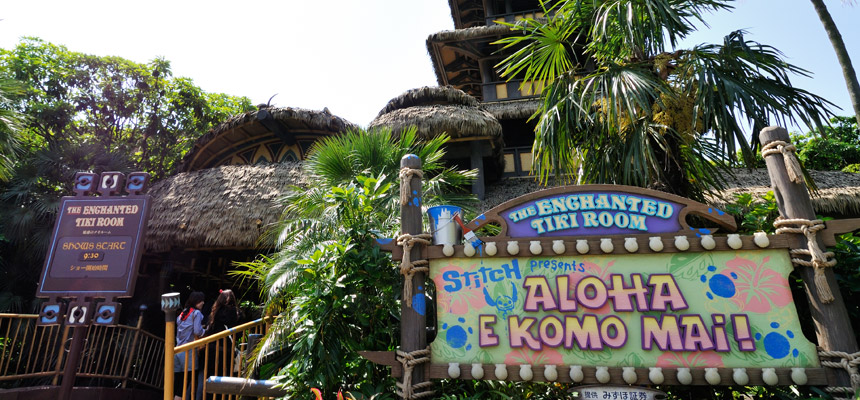
The Enchanted Tiki Room was a hit from the beginning. An extra Audio-Animatronic bird, placed near the entrance in an effort to get people to come see the show, caused traffic jams of guests trying to see just what this new thing was. Interestingly, entrance to the Tiki Room cost an extra 75 cents, supposedly because technically WED Enterprises owned it, not Disneyland, and it was therefore a separate attraction from the rest of the park. The popularity of the show saw an identical version installed in the Magic Kingdom in Walt Disney World right on time for opening day and Tokyo Disneyland was also Enchanted at its opening. The first two Tiki Rooms are still running just as they did back in the day (we won’t talk about the couple of years that Florida’s version was “Under New Management”), albeit with upgrades in the technology that run them, but Tokyo’s has undergone a complete revision. It’s now a Stitch themed Hawaiian show and no longer uses the original theme song. Speaking of which, you know you’re dying to sing a few verses of it, so All together now, in the tiki, tiki, tiki, tiki, tiki room, in the tiki, tiki, tiki…

Tuesday, July 2, 2019

June 22 - Floyd Norman

Image courtesy d23.com
On this day, in 1935, Floyd Norman was born in Santa Barbara, California. While still in high school, Floyd began dabbling in the art of animation, creating short films on his own. One of his first jobs out of school was as an assistant to comic book artist Bill Woggon, the creator of the Katy Keene character featured in Archie Comics. During this same time he took classes at the Art Center School in Pasadena, focusing on illustration. After two years of instruction, Floyd was hired at the Walt Disney Studio as an inbetweener in 1956, the first black man to ever do so with Disney.

Image courtesy laughingplace.com
And now we have to take a small detour from our regularly scheduled post into the Land of Finer Points. When asked the question “Who was Disney’s first black animator?” a large number of people will give Floyd’s name as their answer. And yes, Floyd was the first black man to work in the animation department at the Walt Disney Studio. However, as another section of the populace will be quick to point out, while he did many marvelous things in other departments at the studio for years, he never actually ascended to the position of Animator. For decades at Disney, an artist had to produce over 100 feet of film in order to get screen credit as an Animator. As petty as it might sound to people outside the industry, only a select few ever earned the title of Animator. By those standards, Ron Husband, who joined the studio in the Seventies, is Disney’s first black Animator, having risen to the position for Cody in The Rescuers Down Under. Ron worked on most of the movies that came out during the Disney Renaissance only to find himself out of a job in 2004, when the company mostly stopped doing hand drawn animation. So there you have it: first black man doing animation at Disney, Floyd Norman, first black Disney Animator, Ron Husband. Now back to our post.

Image courtesy themeparkpress.com
Floyd’s first project with Disney was doing inbetween work on Sleeping Beauty. Shortly before that film’s production wrapped up, however, his career was interrupted with a draft summons from the United States Army. He fulfilled his patriotic duty, returning to the studio when his tour was over in 1960. He continued as an inbetweener on One Hundred and One Dalmatians and The Sword in the Stone. At this point, Walt saw some of the sketches Floyd periodically made to entertain his co-workers, saw some potential in him and moved him into the Story Department. He spent the next couple of years with Walt and Larry Clemons, trying to turn the darkness of The Jungle Book into a light, breezy animated movie. When Walt died in December 1966, Floyd decided to strike out on his own and created Vignette Films, Inc. with Leo Sullivan, another black man working at the studio (I hesitate to say the other black man, but let’s just say the studio got a lot less colorful when these two talented guys left; it was not good for the studio’s diversity).

Image courtesy atlantablackstar.com
It didn’t take long for Floyd and Leo to become involved in several high profile projects. They began writing and animating segments for Sesame Street, which debuted in 1969. They were instrumental in developing the original Hey Hey Hey It’s Fat Albert television special that came out the same year. They also produced training films for the United States Navy and made some of the first movies to document black history. Floyd also began his long association with Hanna-Barbera during this period as a layout artist on the Josie and the Pussycats and Sealab 2020 television series.

Image copyright Hanna-Barbera
In the early Seventies, Floyd returned to Disney briefly as an uncredited assistant animator (the level just under the coveted Animator) on Robin Hood. He spent the rest of the decade at Hanna-Barbera, working mostly as a layout artist on series ranging from Goober and the Ghost Chasers to Scooby’s Laff-A-Lympics to Godzilla. As the calendar rolled on into the Eighties, Floyd was promoted to the position of Story Director and contributed to The Smurfs, Pac-Man, Snorks, and Super Friends.

In the mid-Eighties, Floyd returned to Disney again, this time in the Comic Strip Department. He has the distinction of being the last writer and layout artist of the syndicated Mickey Mouse comic strip before the company discontinued it in 1995. At that point, Floyd was sucked back into the House of Mouse as a regular player, folding right back into the story department of the animation studios. The sad part of that statement is that he turned down the opportunity to help a little studio called Pixar develop a little movie called Toy Story in favor of (what he saw as) steadier work at Disney (they were two separate companies at that point). He contributed story to The Hunchback of Notre Dame, Mulan, The Tigger Movie and Dinosaur. When Pixar asked for his help again (who says opportunity never strikes twice), Floyd made sure he said yes and earned additional story credits for Toy Story 2 and Monsters, Inc.

Image courtesy imdb.com
When Floyd turned 65, he was given retirement from Disney, whether he wanted it or not. Turns out he didn’t. He combated his ousting by just constantly showing up at the studio, mostly driving his longtime companion, Adrienne, to her job every day. They’d met at the company and she still worked in the Publishing Department. Simply by his presence, Floyd would continue to contribute to all sorts of projects including story elements to Cinderella II and Kronk’s New Groove. His latest productions have been non-Disney related things like the movie Free Birds and Cartoon Network’s Robot Chicken.

Image courtesy netflix.com
It should come as no surprise that Floyd has racked up a number of awards and honors over the course of his career. In 1979, he was inducted into the Black Filmmakers Hall of Fame. In 2002, he was the recipient of the prestigious Winsor McCay Award at the Annies. In 2007, he was declared an official Disney Legend. In 2008, he was awarded the Inkpot Award for his dozen years on the Mickey comic strip. He won a Sergio Award in 2013, a DFC Disney Legend Award from the Disneyana Fan Club in 2014, The Friz Freleng Award in 2015, a Special Achievement Award from the African-American Film Critics in 2016 and the Milton Caniff Lifetime Achievement Award from the National Cartoonists Society earlier this year. Whew.

Even at 84, Floyd still occasionally makes appearances at Comic Cons around the country but if you’d like to learn more about his life and career, check out the documentary that came out a few years ago, Floyd Norman: An Animated Life, currently available on Netflix and, for a fee, Amazon Prime Video.

Monday, July 1, 2019

June 21 - The Hunchback of Notre Dame

Image copyright Disney
On this day, in 1996, Walt Disney Pictures widely released its 34th animated feature The Hunchback of Notre Dame, two days after its world premiere at the New Orleans Superdome. The idea for adapting Victor Hugo’s epic novel came in 1993 to David Stainton, one of Disney’s development executives, after reading one of those Illustrated Classic comic book versions (feel free to insert your own jokes here about the reading levels of corporate clowns, but it was actually David’s job to read that kind of stuff looking for new material to mine). Gary Trousdale and Kirk Wise, who had co-directed Beauty and the Beast a couple years prior, were struggling to put together an adaptation of the Greek myth Orpheus when Jeffrey Katzenberg assigned them to helm Hunchback. It didn’t take Gary and Kirk long to get excited about the project while at the same time they quickly realized that many of the books dark themes were going to have to be toned way, way down in order to get a G rating.

So Gary and Kirk went to work. Alan Menken and Stephen Schwartz came on board to do the music and also to help shape the story. A whole bunch of characters were shown the door. A few new ones were introduced, specifically Quasimodo’s gargoyle friends. The ending was made a lot (and I mean a lot) happier. In the book, literally everyone but Phoebus dies, although Hugo does quip that the soldier doesn’t get off scot free because he ends up getting married (you can see why Hugo is known for drama and not comedy). And in the end, Hunchback did get its G rating but it is still one of the, if not the, darkest Disney animated films ever made (Frollo sniffing Esmerelda’s hair, anyone?).


Image copyright Disney
At its release, Hunchback received mostly positive reviews and its fair share of controversy. To date, it is the only Disney animated film to overtly take on the issue of religion, which it did with mixed signals. On the one hand, the only actual religious figure in the film, the Archdeacon played by David Ogden Stiers, is weak, doesn’t offer much spiritual guidance other than to vaguely hint at God and presents the official church as mostly ineffective at actually helping people (although he does keep Frollo from committing infanticide at the beginning, day to day nurturing seems to overwhelm him). On the other hand, God Help the Outcasts clearly denounces religious hypocrites and, in the end, it’s strongly suggested that God himself kills Frollo when the cathedral itself causes him to fall to his death. Needless to say, there are obvious reasons Disney hasn’t touched religious material since then.

Image courtesy disney.fandom.com
The Hunchback of Notre Dame earned an Oscar nomination for its score, ten Annie Award nominations and numerous other award nominations. It won a Satellite Award for best Animated Film, two Golden Reel Awards for editing and a BMI Film Music Award for Alan Menken. The movie would later be adapted into a stage musical that only played in Berlin, Germany. But that wasn’t the only stage version that came out of the deal, which leads us to the second part of today’s post.

Also on this day, also in 1996, The Hunchback of Notre Dame – A Musical Adventure debuted at the Disney-MGM Studios in Lake Buena Vista, Florida. Considered by many guests (and cast members) to be one of the best productions to ever grace a Disney theme park stage, the Hunchback show opened to coincide with the release of the film. Closely following and condensing the plot of the movie (the only songs not included were Hellfire and The Court of Miracles, for obvious and logistic reasons respectively),  it ran for six incredible years on the Backlot Stage, then abruptly ended. The show is now infamous in the annals of Disney entertainment history as a cautionary tale for anyone who thinks being cast in a successful show equates to job security.

Image courtesy laughingplace.com
The story goes that Hunchback went down for one of its periodic refurbishments, as all shows and attractions that run 365 days a year have to do. However, not only wasn’t any refurbishing work done but part way through the refurbishment period, it was announced that the show wasn’t coming back. No explanations, just it’s done. It would be pure speculation how much management knew in advance of the decision to close (somebody somewhere was very aware). It also isn’t clear as to why the decision was made, although the best guess is that the company was no longer willing to shell out for the size of the cast required with the amount of costly expertise needed to pull the production off. What is clear is that there wasn’t a burning desire to put something else in Hunchback’s place. The Backlot Stage stood empty for years after the show’s closing.

Not to be left out of the Hunchback celebration on this day, in 1996, Disneyland also debuted their own show, The Hunchback of Notre Dame – Festival of Fools. Festival of Fools was similar to A Musical Adventure in that it was a retelling of the film but it was a very different staging of the story. The Disneyland version had more of a carnival atmosphere than a stage show. Festival wasn’t nearly as successful and only ran for two years.